

Where AI creates measurable value across the medicines lifecycle, and what data, evidence, and governance a pharmaceutical organization needs before it scales a single use case.
TL;DR:
- AI spans the full medicines lifecycle – discovery, clinical development, regulatory and safety operations, manufacturing and supply, and patient engagement – but conventional ML, generative AI, and agentic AI carry different evidence and risk requirements.
- Value depends on foundations, not algorithms alone. Data quality, interoperability, and domain expertise determine whether a use case delivers, per EMA’s 2024 reflection paper on AI in the medicinal product lifecycle.
- Start with a bounded, measurable pilot rather than enterprise-wide adoption. The best first use case has an accountable business owner, usable data, and proportionate risk.
- Regulators now expect documented credibility evidence. The FDA’s January 2025 draft guidance sets out a seven-step, risk-based credibility framework for AI used in regulatory submissions.
- Case-study results are context-specific. A published outcome from one organization’s dataset and workflow does not automatically transfer to another company’s operations.
- ROI measurement must combine operational, financial, model-performance, and risk-control metrics against a pre-defined baseline, not a single headline percentage.
- Generative and agentic AI expand what is possible but require proportionally more validation, monitoring, and human accountability as autonomy increases.
Introduction
Pharmaceutical leaders face a familiar squeeze: research and development costs keep climbing, clinical timelines stay long, regulators scrutinize every submission, and patients expect faster access to effective treatment. Artificial intelligence will not remove any of these pressures on its own. What it can do is help a well-run organization make faster, better-supported decisions at specific points in the medicines lifecycle, from target identification through post-market safety monitoring.
This guide treats AI as a regulated decision-support capability, not a generic technology trend. FDA and EMA’s joint 2026 guiding principles frame AI’s role in drug development the same way: AI can support pharmaceutical work from discovery to post-market safety, but its value depends on context of use, data quality, validation, and human oversight. That framing sets the tone for everything below.
Three questions guide the rest of this article. Where in the pharmaceutical value chain does AI create real value? What separates a use case worth piloting from one worth shelving? And what governance does a regulated organization need before it scales an AI system beyond a single team? SmartDev’s broader AI use-cases library covers how other regulated and unregulated industries answer the same questions.
1. AI in Pharma at a Glance
“AI” is an umbrella term. In a pharmaceutical context, it covers three distinct capability classes, and each carries a different evidence and risk profile once it touches drug development or patient safety.
What AI means in a pharmaceutical context
Conventional machine learning (ML) finds patterns in structured or semi-structured data and produces predictions such as toxicity scores or demand forecasts. Generative AI creates new content, from candidate molecules to draft regulatory text, based on patterns learned from training data. Agentic AI goes a step further: it plans and executes multi-step tasks with limited human intervention between steps. SmartDev’s guide to AI models versus AI agents covers this distinction in more technical depth for teams scoping a build.
AI, machine learning, generative AI, and agentic AI: where each fits
| Category | What it does | Typical pharma role | Evidence burden |
|---|---|---|---|
| Conventional ML | Learns patterns from labeled or structured data to classify, predict, or score | Toxicity prediction, demand forecasting, patient stratification | Established validation practice; still context-dependent |
| Generative AI | Produces new molecules, text, or images from learned patterns | Molecule design, document drafting, literature synthesis | Higher; outputs need independent verification before use |
| Agentic AI | Plans and executes multi-step tasks with reduced human intervention | Workflow orchestration, multi-source research assistance | Highest; requires defined guardrails and checkpoints |
Where AI creates value across the pharmaceutical lifecycle
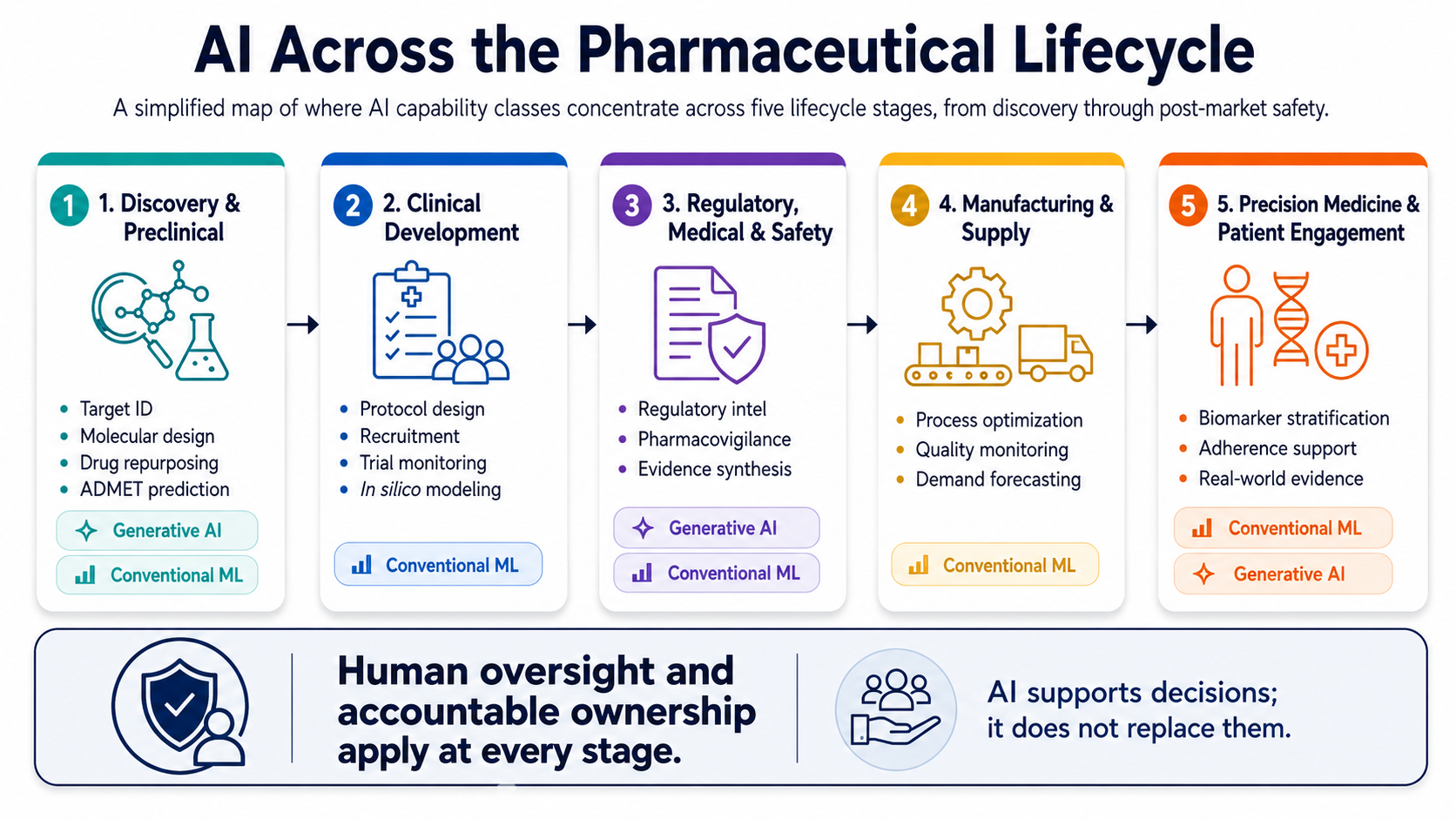
AI’s footprint now spans nonclinical research, clinical development, manufacturing, and post-marketing safety monitoring. The FDA’s January 2025 draft guidance on AI in regulatory decision-making explicitly covers nonclinical, clinical, post-marketing, and manufacturing phases where an AI model’s output feeds a regulatory decision on safety, efficacy, or quality. Drug discovery itself sits partly outside that guidance’s scope, though EMA’s reflection paper does extend attention to discovery-stage AI when its outputs later support a regulatory submission.
| Claimed benefit | Operating dependency | What breaks it |
|---|---|---|
| Faster candidate screening | Curated, labeled chemical and biological datasets | Fragmented lab data; no reproducibility checks |
| Reduced trial dropout | Clean EHR and trial-database integration under GCP | Inconsistent data capture across sites |
| Earlier safety-signal detection | Standardized adverse-event coding and human review | High false-positive rates overwhelming reviewers |
| Lower manufacturing downtime | Sensor data pipelines and validated predictive models | Model drift across plants with different equipment |
| Better patient stratification | Diverse, representative biomarker and outcomes data | Underrepresented populations skew predictions |
A pharmaceutical AI use case should be assessed based on its intended use, evidence quality, risk level, data readiness, and accountable ownership, rather than projected efficiency alone.
Takeaway: Separate what AI could theoretically deliver from what a specific organization’s data, governance, and expertise currently support. Every benefit in the table has a corresponding dependency that determines whether it actually appears.
3. AI Use Cases Across the Pharmaceutical Value Chain
This section covers five lifecycle clusters. Each use case below follows the same structure: the business problem, AI’s role, data dependencies, human oversight, and risk considerations. Detailed evidence for named organizations appears later in Section 5, so the descriptions here stay concise.
Discovery and preclinical research
Discovery is where AI’s data appetite and generative capability show up most visibly, and where the distance between a promising computational result and a validated drug candidate remains largest.
Target identification and validation
Machine learning models mine genomic, proteomic, and literature data to prioritize disease targets worth pursuing. Bioinformatics platforms rank candidate targets by predicted druggability and disease relevance, narrowing thousands of possibilities to a shortlist for experimental follow-up. The output remains a hypothesis; wet-lab validation still confirms whether a target actually drives disease biology.
Molecular design, virtual screening, and lead optimization
Generative chemistry models propose novel molecular structures, and virtual screening tools estimate binding affinity and drug-likeness before any physical synthesis. Insilico Medicine’s Pharma.AI platform, discussed in Section 5, combined a generative-chemistry engine with target-prioritization software to move a novel TNIK inhibitor from target identification to a nominated preclinical candidate.
Drug repurposing and indication discovery
Repurposing models search existing, already-approved compounds for new therapeutic indications, using molecular similarity, real-world data, and literature mining. Because the drug’s safety profile is already established, repurposing can shorten the path to a new indication substantially compared with developing a molecule from scratch, though clinical validation for the new indication is still required.
ADMET, toxicity, and developability prediction
Absorption, distribution, metabolism, excretion, and toxicity (ADMET) models predict how a candidate molecule is likely to behave in the body before animal or human testing. The FDA’s April 2025 roadmap for reducing reliance on animal testing explicitly supports combining laboratory methods, computer simulation, and AI to focus limited animal studies on the most critical open questions.
Clinical development
Clinical trials generate some of pharma’s richest and most tightly regulated data. AI’s role here sits directly inside Good Clinical Practice (GCP) obligations.
Protocol design and feasibility
Predictive models estimate enrollment feasibility, likely site performance, and protocol complexity before a trial launches. This use case directly supports the ICH E6(R3) Good Clinical Practice guideline, finalized in January 2025, which explicitly encourages proportionate, risk-based, technology-enabled trial design.
Patient identification, recruitment, and retention
Natural language processing tools scan electronic health records against protocol inclusion and exclusion criteria to identify eligible candidates faster than manual chart review. Predictive models flag participants at elevated risk of dropping out, so trial teams can intervene earlier with additional support or scheduling flexibility.
Trial monitoring, data review, and safety-signal detection
Risk-based quality management, a core principle of ICH E6(R3), increasingly relies on AI-assisted, centralized statistical monitoring rather than 100 percent source-data verification. Algorithms flag anomalous data patterns across sites for human statisticians to investigate, concentrating scarce monitoring resources where risk is highest.
In silico trial modeling and simulation
Simulation tools model virtual patient populations to test protocol design choices, such as dosing schedules or endpoint selection, before committing to a live trial. This remains a planning aid; regulators still require the live trial data itself as evidence for approval decisions.
Regulatory, medical, and safety operations
This cluster carries the clearest distinction between AI as an assistant and AI as a decision-maker; final regulatory and safety accountability stays with qualified people.
Regulatory intelligence and document-assistance use cases
Generative AI tools help draft, summarize, and format regulatory submissions, briefing documents, and internal reports, pulling from prior filings and current guidance. Human regulatory affairs specialists still review and approve every submission before it reaches an agency; the tool accelerates drafting, not decision-making.
Pharmacovigilance and adverse-event signal detection
Machine learning systems process individual case safety reports (ICSRs) at a scale manual review cannot match. The Uppsala Monitoring Centre, which maintains the World Health Organization’s global VigiBase safety database, uses a machine learning model called vigiMatch to predict duplicate case reports by comparing patient age, sex, onset date, and reported adverse events across report pairs. Because VigiBase received tens of millions of reports as of recent counts, automated duplicate detection is a documented, operationally necessary application of AI in pharmacovigilance, not a speculative one. The tool flags suspected duplicates for review; it does not make final determinations.
Medical information and evidence synthesis
Natural language processing tools summarize published literature and internal safety data to support medical information queries and evidence packages. As with document assistance, output requires review by a qualified medical or scientific professional before it informs external communication.
Manufacturing, quality, and supply operations
Manufacturing AI use cases tend to have clearer, more contained data environments than discovery or clinical work, which makes validation more tractable but does not remove it.
Process optimization and predictive maintenance
Sensor data from production equipment feeds predictive maintenance models that flag likely equipment failures before they cause downtime. This use case depends on consistent, well-instrumented equipment and a model retrained as conditions change; a model transferred from one plant to another without recalibration can underperform.
Computer vision, anomaly detection, and quality monitoring
Machine vision systems inspect tablets, vials, and packaging at line speed, catching defects that manual visual inspection would miss at high volume. These systems also support serialization requirements under frameworks like the U.S. Drug Supply Chain Security Act, which set phased compliance deadlines for manufacturers, distributors, and dispensers through 2025 and 2026.
Demand forecasting, inventory, cold-chain, and logistics resilience
Forecasting models combine historical demand, market signals, and external data to plan inventory levels and reduce the risk of stockouts or overstock, particularly for temperature-sensitive biologics. Real-time tracking flags cold-chain deviations in transit so a batch’s viability can be assessed before it reaches a patient.
Sustainability and resource-efficiency applications
The same predictive and monitoring models that reduce downtime and waste also support energy-use optimization and material-efficiency goals in manufacturing, aligning operational and sustainability objectives without requiring a separate AI initiative.
Precision medicine and patient engagement
This cluster sits closest to the individual patient, which raises the stakes around bias, privacy, and clinical validation.
Biomarker-led patient stratification and treatment matching
Machine learning models analyze genomic, proteomic, and clinical data to match patients with therapies most likely to work for their specific disease profile. Section 5 covers a peer-reviewed, published trial of this approach in aggressive blood cancers.
Patient support, adherence, and real-world evidence
AI-supported patient engagement tools provide medication reminders and answer routine questions, while structured data from these interactions can feed back into real-world evidence programs. Any tool operating in this space needs clear boundaries: it should support, not replace, a patient’s relationship with their clinical care team, and must handle patient data under applicable privacy law.
Takeaway: AI can create significant value across the pharmaceutical lifecycle, but the closer it gets to patients or regulated decisions, the more critical clinical validation, bias testing, data integrity, privacy, cybersecurity, and human oversight become, with AI supporting decisions rather than replacing accountable human judgment.
4. How to Prioritize an AI Use Case
Interest in AI is rarely the constraint; deciding where to start is. This section converts the lifecycle map above into a repeatable, executive-level decision process.
Define the business problem and accountable owner
Every use case needs a named business function that owns the outcome, not just the IT or data science team that builds the model. Without an accountable owner, a technically successful pilot often stalls before it reaches production, because no one has the authority or incentive to drive adoption.
Assess data availability, quality, access, and interoperability
Before committing resources, confirm the required data actually exists, is accessible under current governance policies, and is of sufficient quality. A use case with an excellent business case but poor data readiness should wait, or start with a data-foundation project first.
Evaluate patient, scientific, quality, regulatory, and operational risk
Risk assessment should be proportionate to context of use, echoing the FDA’s risk-based credibility framework described in Section 6. A pharmacovigilance signal-detection tool and an internal document-summarization tool carry very different risk profiles, even if both use similar underlying technology.
Select a measurable pilot and define a baseline
A pilot needs a pre-defined success metric and a documented baseline for comparison. Without a baseline, it becomes difficult to distinguish a genuine improvement from normal operational variation.
Decide whether to build, buy, or partner
Organizations can build proprietary models, license established platforms, or partner with vendors and technology firms. The right choice depends on how differentiated the use case is to the organization’s competitive position, in-house AI capability, and the vendor’s domain-specific evidence and regulatory track record. SmartDev’s AI proof-of-concept guide walks through this decision in more detail, including how to structure a go/no-go evaluation.
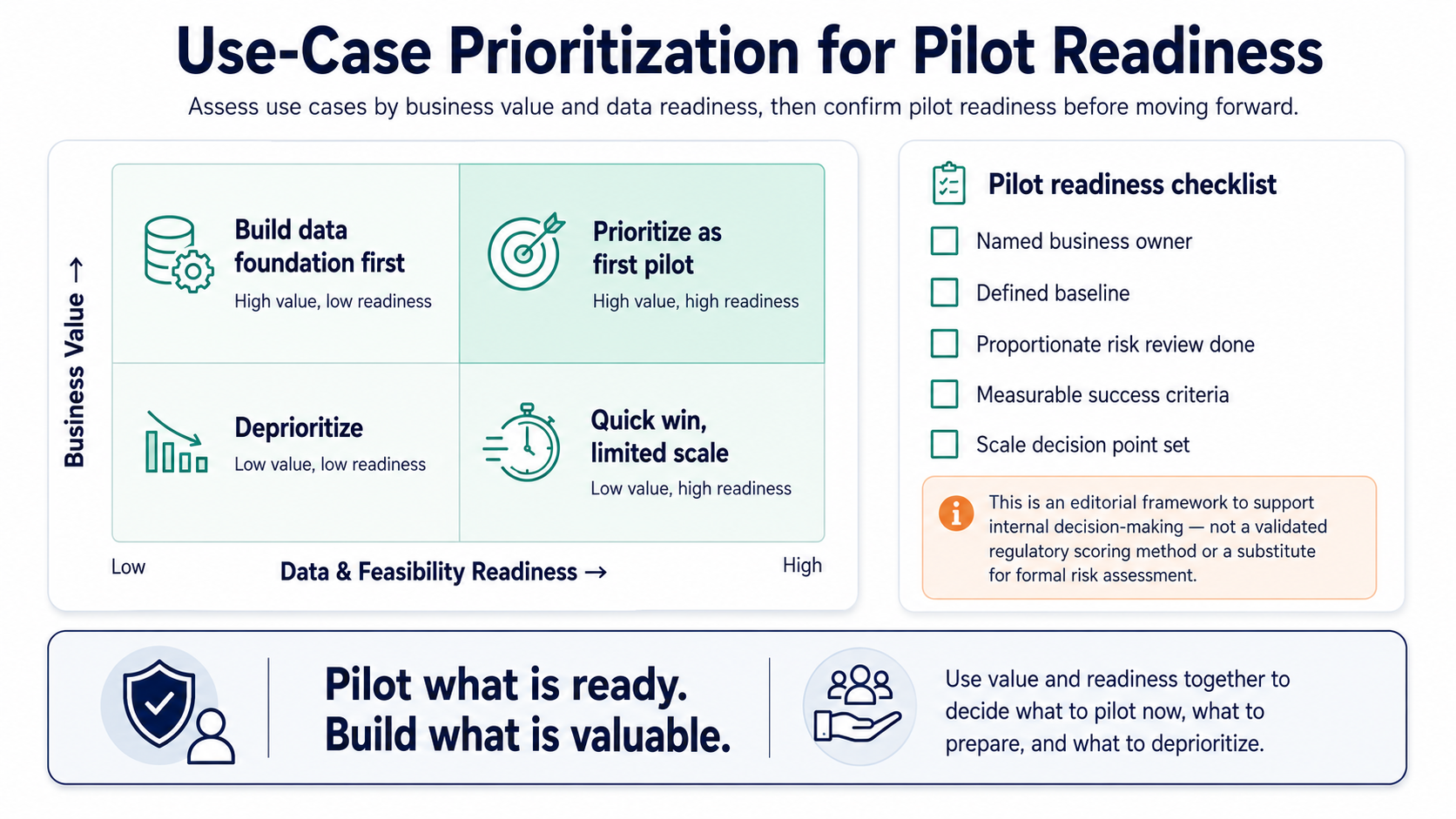
The framework helps teams prioritize AI pilot use cases by balancing business value with data and feasibility readiness, rather than selecting projects based on potential efficiency alone.
- High value + High readiness → Prioritize as first pilot: These use cases offer strong business impact with the data and infrastructure already available.
- High value + Low readiness → Build data foundation first: The opportunity is valuable, but foundational data or technical gaps need to be addressed before piloting.
- Low value + High readiness → Quick win, limited scale: These are easy to implement but offer limited strategic impact, making them suitable for small-scale experimentation.
- Low value + Low readiness → Deprioritize: Neither the expected value nor the current readiness justifies significant investment.
Before starting a pilot, teams should also confirm a named business owner, a baseline, a proportionate risk review, measurable success criteria, and a predefined decision point for scaling.
The key principle is to pilot where value and readiness intersect, while using data and governance gaps to determine what needs to happen before deployment.
Takeaway: The best first pharma AI use case is bounded, measurable, owned by a business function, supported by usable data, and proportionate to its risk, not necessarily the use case with the biggest headline potential.
5. Evidence-Led Pharma AI Case Studies
Case studies illustrate what has actually happened, not what is guaranteed to happen elsewhere. Each example below traces to a primary source: a peer-reviewed publication, a regulator-adjacent database operator, or a company’s own clinical trial disclosure.
| Use case | Organization | Lifecycle stage | Documented outcome | Source |
|---|---|---|---|---|
| Generative AI-designed small molecule | Insilico Medicine (Rentosertib / INS018-055) | Discovery through clinical development | First published randomized Phase IIa trial of an AI-discovered, AI-designed drug; 71 idiopathic pulmonary fibrosis patients; the 60 mg once-daily dose group showed a mean +98.4 mL change in forced vital capacity versus a mean –20.3 mL decline on placebo over 12 weeks. The program has since advanced to Phase III. | Nature Medicine, peer-reviewed (2025) |
| AI-supported functional precision medicine | Exscientia / Medical University of Vienna (EXALT-1) | Precision medicine, hematologic cancers | Of 56 patients treated per the AI-guided approach, 30 (54%, 95% CI 40–67%) reached a progression-free survival ratio of at least 1.3 versus their own prior therapy; median PFS ratio 3.4. | Cancer Discovery, peer-reviewed (2021) |
| Machine learning duplicate-report detection | Uppsala Monitoring Centre (vigiMatch, WHO VigiBase) | Pharmacovigilance / post-market safety | An operational, deployed ML model that scores report pairs for duplicate likelihood, used routinely to clean data before pharmacovigilance signal analysis across a global safety database with tens of millions of reports. | Uppsala Monitoring Centre product documentation |
Drug discovery and molecular-design examples
Insilico Medicine’s Pharma.AI platform combined a target-prioritization engine (PandaOmics) with a generative chemistry engine (Chemistry42) to discover and design a TNIK inhibitor for idiopathic pulmonary fibrosis. The resulting molecule, now called rentosertib, became the industry’s first AI-discovered, AI-designed drug candidate to publish a randomized, placebo-controlled Phase IIa result in a major peer-reviewed journal, and the program has since moved into a Phase III trial expected to enroll 320 patients.
Clinical-development and pharmacovigilance examples
Exscientia’s EXALT-1 trial applied a single-cell functional precision-medicine platform to match aggressive hematologic-cancer patients with therapies predicted to work for their individual tumor biology, publishing results in the peer-reviewed journal Cancer Discovery. On the safety-monitoring side, the Uppsala Monitoring Centre’s vigiMatch model demonstrates a mature, operational use of machine learning in pharmacovigilance: identifying likely duplicate adverse-event reports so human reviewers can focus on genuinely new safety information.
Manufacturing and supply-operation examples
Machine vision and predictive-maintenance tools have become standard components of modern pharmaceutical manufacturing lines, particularly as serialization requirements under the U.S. Drug Supply Chain Security Act phased in compliance deadlines for manufacturers, distributors, and dispensers through November 2025 and 2026. These deployments tend to be less publicly documented with named quantitative outcomes than clinical or safety examples, largely because manufacturing performance data is commercially sensitive.
Limits of case-study transferability across organizations
Every case study above reflects a specific dataset, patient population, workflow, and regulatory context. Rentosertib’s Phase IIa result reflects a 71-patient trial in a specific disease; EXALT-1’s result reflects a 56-patient cohort with aggressive hematologic cancers. Neither result predicts performance in a different indication, population, or organization. Reading a case study for the underlying method and evidence quality, rather than as a promise of similar returns, is the safer interpretation.
Takeaway: Case-study outcomes should be interpreted in the context of the dataset, workflow, comparator, implementation setting, and source quality. All three examples above trace to a verifiable primary source, which is the standard worth applying to any case study before citing it internally.
6. Implementing AI Responsibly in a Regulated Environment
Responsible implementation in pharma means defined context of use, proportionate risk controls, documentation, monitoring, and clear human accountability. Regulators on both sides of the Atlantic converged on this framing in 2026.
Establish data governance and a fit-for-purpose data foundation
EMA’s reflection paper and the joint FDA/EMA principles both list data governance as a foundational requirement, covering data quality, provenance, representativeness, and access control. Without this foundation, later validation and monitoring steps rest on unreliable ground.
Design validation, documentation, traceability, and human-oversight controls
The FDA’s January 2025 draft guidance proposes a seven-step, risk-based credibility assessment framework for AI models used to support regulatory decisions: define the question of interest, define the context of use, assess model risk, plan a credibility-establishment approach, execute the plan, document results and any deviations, and determine adequacy for the intended context of use. This structure gives sponsors a consistent way to document why a given model deserves trust for a specific decision.
Build a cross-functional operating model
Responsible AI implementation in a regulated environment cannot sit inside a single department. Scientific, clinical, quality, regulatory, IT, and data teams each hold a piece of the accountability, and the joint FDA/EMA principles explicitly call for multidisciplinary expertise across the model lifecycle.
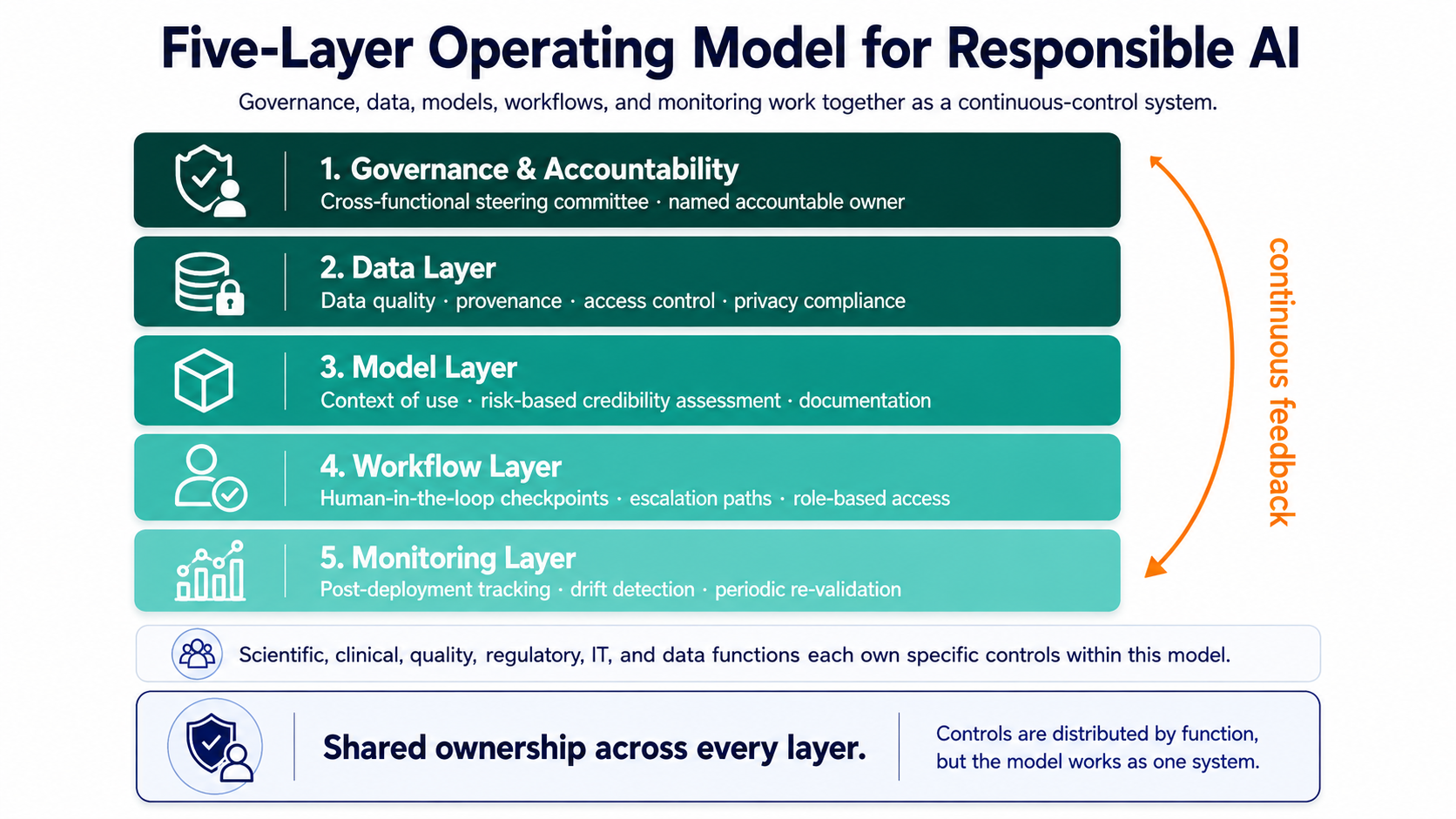
The operating model divides regulated AI governance into five interconnected layers, with different functions responsible for specific controls.
- Governance & Accountability – Establishes cross-functional oversight and a clearly named owner accountable for the AI system.
- Data Layer – Ensures data quality, provenance, access control, and privacy compliance.
- Model Layer – Defines the context of use, assesses model credibility based on risk, and maintains appropriate documentation.
- Workflow Layer – Builds human review checkpoints, escalation paths, and role-based access into the operational process.
- Monitoring Layer – Tracks post-deployment performance, detects model drift, and triggers periodic re-validation.
The key principle is that these layers work together continuously, with scientific, clinical, quality, regulatory, IT, and data teams owning specific controls rather than treating AI governance as the responsibility of one function alone.
Select technology partners and evaluate vendor evidence
When buying or partnering rather than building in-house, ask a vendor for the same category of evidence a regulator would expect internally: documented context of use, validation data, and a clear description of training-data provenance. A vendor unwilling or unable to provide this evidence is a risk signal, regardless of how polished its product demonstration looks.
Pilot, monitor, learn, and scale
A pilot’s job is to generate evidence for a scale decision, not to prove the concept works in the abstract. Monitoring should continue after deployment, since a model’s performance can shift (“data drift”) as the underlying data environment changes.
Build workforce capability and adoption readiness
A validated model still fails in practice if the people expected to use its output do not trust it or do not understand its limitations. Training programs that explain what a model does, and just as importantly what it does not do, support sustainable adoption more than a one-time rollout announcement.
Jurisdictional note: FDA guidance and the EMA reflection paper are not identical, and neither applies as a universal legal requirement across every jurisdiction. Organizations operating across regions should confirm which specific requirements apply to their submission or activity in each market.
7. Measuring AI ROI in Pharma
A credible AI ROI case combines several measurement categories rather than a single headline percentage, and it starts with a defined baseline before deployment.
Link KPIs to the selected use case and lifecycle stage
A discovery-stage use case and a manufacturing-stage use case need different KPIs. Tying metrics to the specific lifecycle stage and business problem, rather than applying a generic AI scorecard, keeps measurement meaningful.
Metrics for discovery, clinical development, safety, quality, manufacturing, and supply operations
| Lifecycle stage | Operational metric | Model-performance metric | Risk-control metric |
|---|---|---|---|
| Discovery | Time to candidate shortlist | Hit-rate versus experimental validation | Reproducibility across independent runs |
| Clinical development | Time to full enrollment | Recruitment-model precision/recall | Data-integrity deviation rate |
| Safety / pharmacovigilance | Case-processing cycle time | Signal-detection sensitivity and false-positive rate | Reviewer override rate |
| Manufacturing / quality | Unplanned downtime hours | Predictive-maintenance lead time accuracy | Model drift across sites |
| Supply operations | Stockout / overstock incidents | Forecast error (MAPE) | Cold-chain deviation detection rate |
Measure value realization, model performance, and risk-control effectiveness together
Financial value should always be read alongside model performance and risk-control data. A cost-saving result paired with a rising override rate, for instance, suggests reviewers are rejecting the model’s output more often, a signal worth investigating before scaling further.
Common measurement mistakes and how to avoid them
Three mistakes recur across pharma AI programs: skipping a pre-deployment baseline, measuring only cost savings while ignoring model-performance drift, and presenting one organization’s or one pilot’s result as a benchmark applicable to the whole company. Building a finance-approved measurement methodology before the pilot starts avoids all three. SmartDev’s guide to AI return on investment covers measurement methodology in more depth for teams building a business case.
Takeaway: AI ROI should combine operational, financial, model-performance, adoption, and risk-control measures against a pre-defined baseline, never a single, isolated percentage borrowed from someone else’s deployment.
8. What Is Next for AI in Pharma?
Emerging capabilities may expand what pharma AI can do, but maturity, evidence, governance, and accountability remain the deciding factors, not novelty.
Generative AI, multimodal models, and scientific workflows
Generative chemistry and multimodal models that combine text, image, and structured data continue to extend discovery and regulatory-document workflows. The FDA and EMA’s January 2026 joint principles explicitly name foundation models and large language models as an area requiring stronger data-quality and bias-assessment expectations going forward.
Digital twins, automation, and connected operations
Digital twins, virtual replicas of a manufacturing line or biological process, are moving from pilot projects toward more established use in process optimization, though full autonomous operation across a manufacturing site remains an incremental, multi-year path rather than a near-term default.
Agentic AI: potential applications, required controls, and limitations
Agentic systems that plan and execute multi-step tasks with limited human intervention could eventually coordinate cross-functional workflows, from literature triage to trial-monitoring escalation. Because agentic systems act with less step-by-step human review than conventional tools, they need correspondingly stronger guardrails, defined checkpoints, and clear limits on what decisions they may execute without sign-off. SmartDev’s guide to building AI agents covers the technical controls this requires.
Signals leaders should monitor
- Finalization of FDA’s draft AI credibility guidance and any resulting binding requirements
- EMA’s rollout of practical governance expectations building on its reflection paper, including its 2026–2028 data and AI workplan
- Publication of additional peer-reviewed, prospective trial results for AI-discovered or AI-designed drug candidates beyond rentosertib
- Evolving international harmonization efforts, including ICH’s work on digital technologies
Takeaway: Novel AI capabilities should be evaluated by intended use and evidence maturity rather than novelty alone. Treat emerging tools as “monitor,” “experiment,” or “scale cautiously,” not as a uniform category ready for enterprise-wide deployment.
FAQ: AI in the Pharmaceutical Industry
What are the highest-value AI use cases in pharma?
Value depends on the specific business problem, data readiness, risk level, and implementation context, not the use case category alone. Discovery-stage molecular design, clinical trial recruitment support, and pharmacovigilance signal detection all have documented applications, but the “highest-value” use case for a given organization is the one matched to its own data foundation and accountable ownership, as covered in Section 4.
How is AI used in drug discovery and development?
AI supports target identification, molecular design and virtual screening, drug repurposing, and toxicity prediction in discovery, then extends into protocol design, patient recruitment, and trial monitoring during clinical development. Insilico Medicine’s rentosertib program, covered in Section 5, illustrates this path from AI-assisted target discovery through a published Phase IIa clinical result.
Can AI be used in regulated pharmaceutical processes?
Yes, but accountable human oversight and proportionate controls remain essential. The FDA’s 2025 draft guidance and the FDA/EMA joint 2026 principles both frame AI as a tool that produces information supporting regulatory decisions, not as an autonomous decision-maker in clinical, safety, regulatory, or quality contexts.
What data and governance foundations are required?
Organizations need data-quality standards, clear access and provenance documentation, validation evidence tied to a defined context of use, and clear ownership for each AI system. EMA’s reflection paper and the FDA’s risk-based credibility framework both treat these foundations as prerequisites, not optional extras.
How should a pharmaceutical company measure AI ROI?
Combine a pre-defined baseline with operational, financial, model-performance, adoption, and risk-control metrics specific to the use case’s lifecycle stage, as outlined in Section 7. Avoid presenting one pilot’s or one organization’s result as a benchmark for the whole company.
What is the difference between generative AI and traditional AI in pharma?
Conventional AI and machine learning classify or predict from existing data, such as flagging a likely trial dropout. Generative AI creates new content, such as a candidate molecule or a draft regulatory document, which raises a higher evidence burden because every generated output needs independent verification before use.
Conclusion
Sustainable value from AI in pharma comes from matching a clearly defined problem to a suitable AI approach, trustworthy evidence, strong governance, and accountable implementation. None of these elements works in isolation: a well-chosen use case with poor data foundations underperforms, and a well-governed program applied to the wrong problem wastes effort regardless of how carefully it is monitored.
The lifecycle map in Section 1, the prioritization framework in Section 4, and the responsible-implementation model in Section 6 connect into a single operating logic. Identify where AI can genuinely help, confirm the organization has the data and oversight structures to support it, and measure results against a real baseline rather than an industry average.
AI maturity in pharma should be assessed by dependable outcomes and controls, not by how new or ambitious a given tool sounds.