

TL;DR
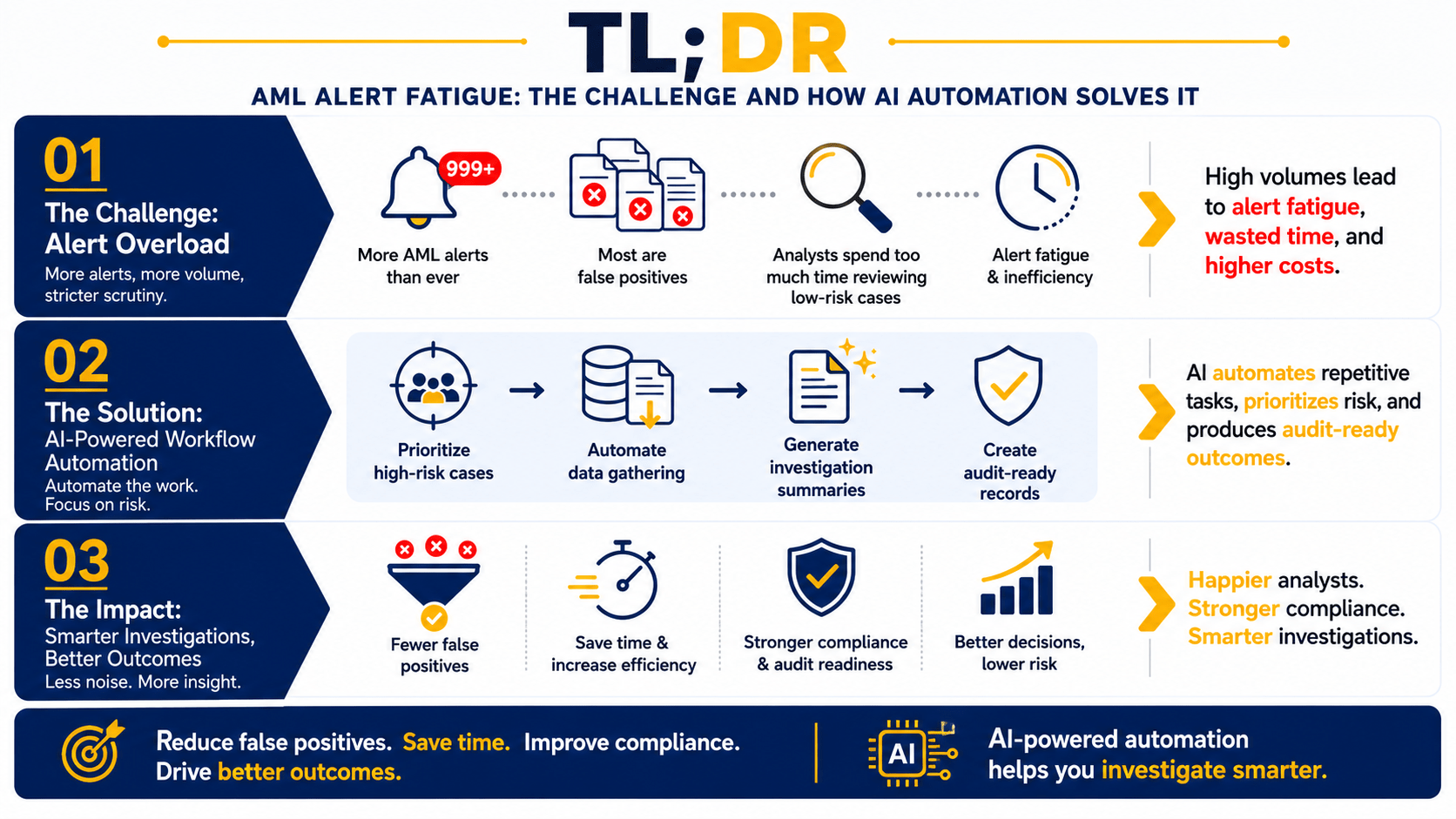
- Financial institutions are generating more AML alerts than ever as transaction volumes, digital banking adoption, and regulatory scrutiny continue to increase.
- Most alerts turn out to be false positives, forcing compliance analysts to spend large portions of their day reviewing cases that pose little actual risk.
- AI-powered workflow automation helps reduce alert fatigue by prioritizing high-risk cases, automating data gathering, generating investigation summaries, and creating audit-ready records.
Introduction
For many financial institutions, the biggest challenge in Anti-Money Laundering (AML) compliance is that it often fails to detect suspicious activity. It is keeping up with the overwhelming number of alerts generated every day.
Transaction monitoring systems have become increasingly sophisticated over the past decade. Banks, fintechs, payment providers, and financial services firms now monitor millions of transactions across multiple channels in real time. While this improves visibility into potential risks, it also creates a new operational problem: Compliance teams are drowning in alerts.

Analysts often spend hours reviewing alerts that ultimately prove harmless. Investigation queues grow longer, operational costs increase, and genuinely suspicious cases risk being buried beneath thousands of low-risk notifications. This phenomenon is commonly known as AML alert fatigue.
As financial crime risks continue to evolve, organizations need a more scalable approach to compliance operations. Increasingly, that means combining AI-powered compliance screening with workflow automation to help investigators focus on the cases that matter most.
The Growing AML Alert Fatigue Problem
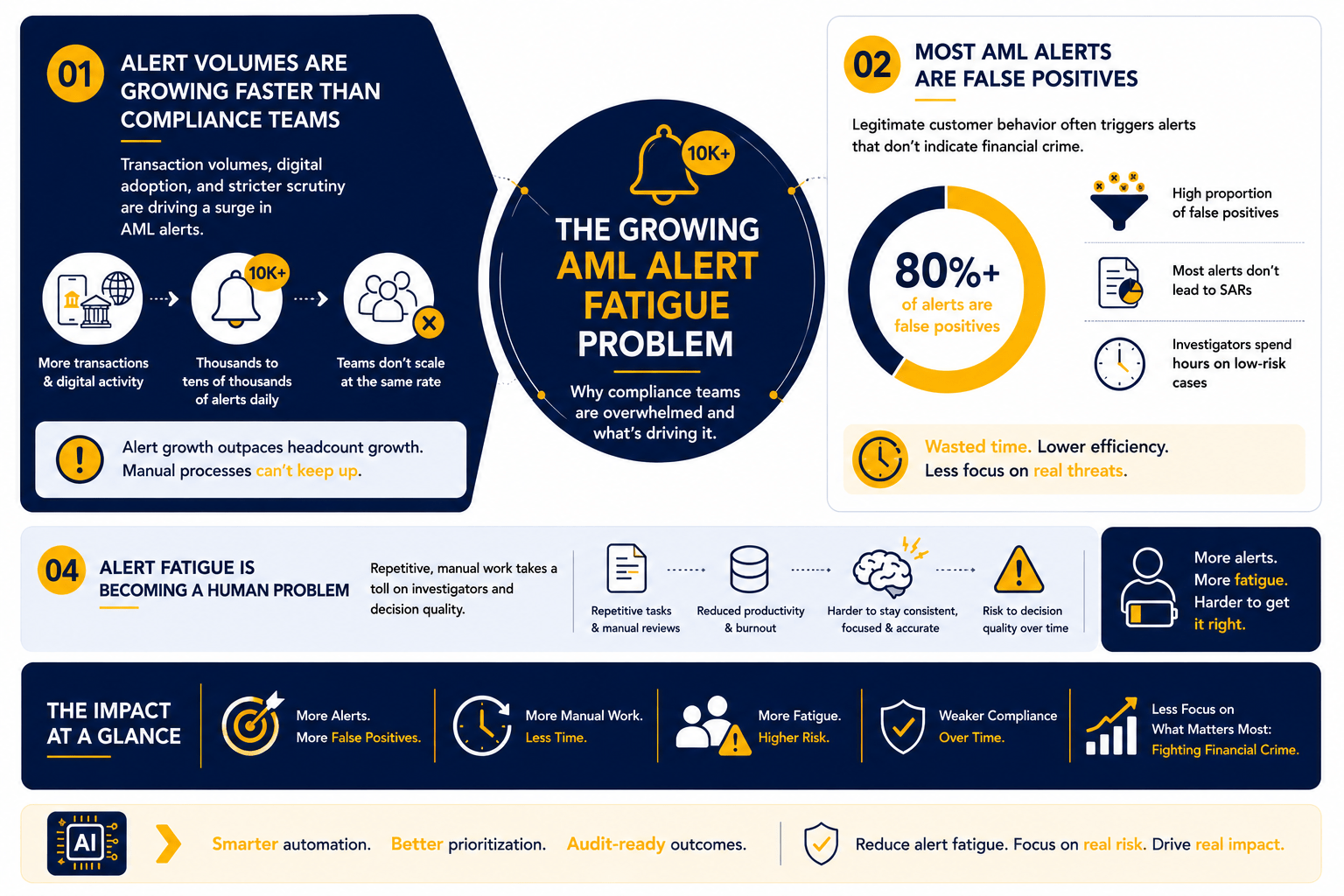
1. Alert Volumes Are Growing Faster Than Compliance Teams
Modern financial institutions process significantly more transactions than they did even five years ago. Digital banking, instant payments, embedded finance, cross-border transfers, and growing customer bases all contribute to a dramatic increase in monitoring activity.
To reduce regulatory risk, transaction monitoring systems are often configured conservatively. Rules are designed to catch potentially suspicious activity, even when uncertainty exists. As a result, institutions generate thousands – or sometimes tens of thousands -of alerts every day.
The challenge is that compliance teams do not scale at the same rate. Adding investigators may temporarily reduce backlog pressure, but alert growth often outpaces headcount growth. Eventually, teams reach a point where manual investigation processes can no longer keep up.
2. Most AML Alerts Are False Positives
One of the biggest contributors to alert fatigue is the high proportion of false positives. Many alerts are triggered by legitimate customer behavior that happens to match predefined monitoring rules. A transaction may exceed a threshold, resemble a historical pattern, or involve a geography that requires additional scrutiny without actually representing financial crime.
The result is a paradox. Compliance teams spend most of their time investigating alerts that do not lead to suspicious activity reports. This creates significant inefficiency. Skilled investigators devote valuable hours to repetitive reviews, documentation, and evidence collection instead of focusing on genuinely high-risk cases.
4. Alert Fatigue Is Becoming a Human Problem
AML alert fatigue is not simply an operational issue. It is increasingly a workforce challenge. Investigators are often required to perform repetitive tasks such as gathering customer records, reviewing transaction histories, checking sanctions databases, documenting findings, and preparing case summaries.
Over time, this repetitive workload can contribute to reduced productivity, lower job satisfaction, and investigator burnout. The more alerts analysts review, the harder it becomes to maintain consistency, concentration, and decision quality throughout the day.
Why Traditional AML Investigation Models Struggle to Scale
1. Manual Investigation Workflows Create Bottlenecks
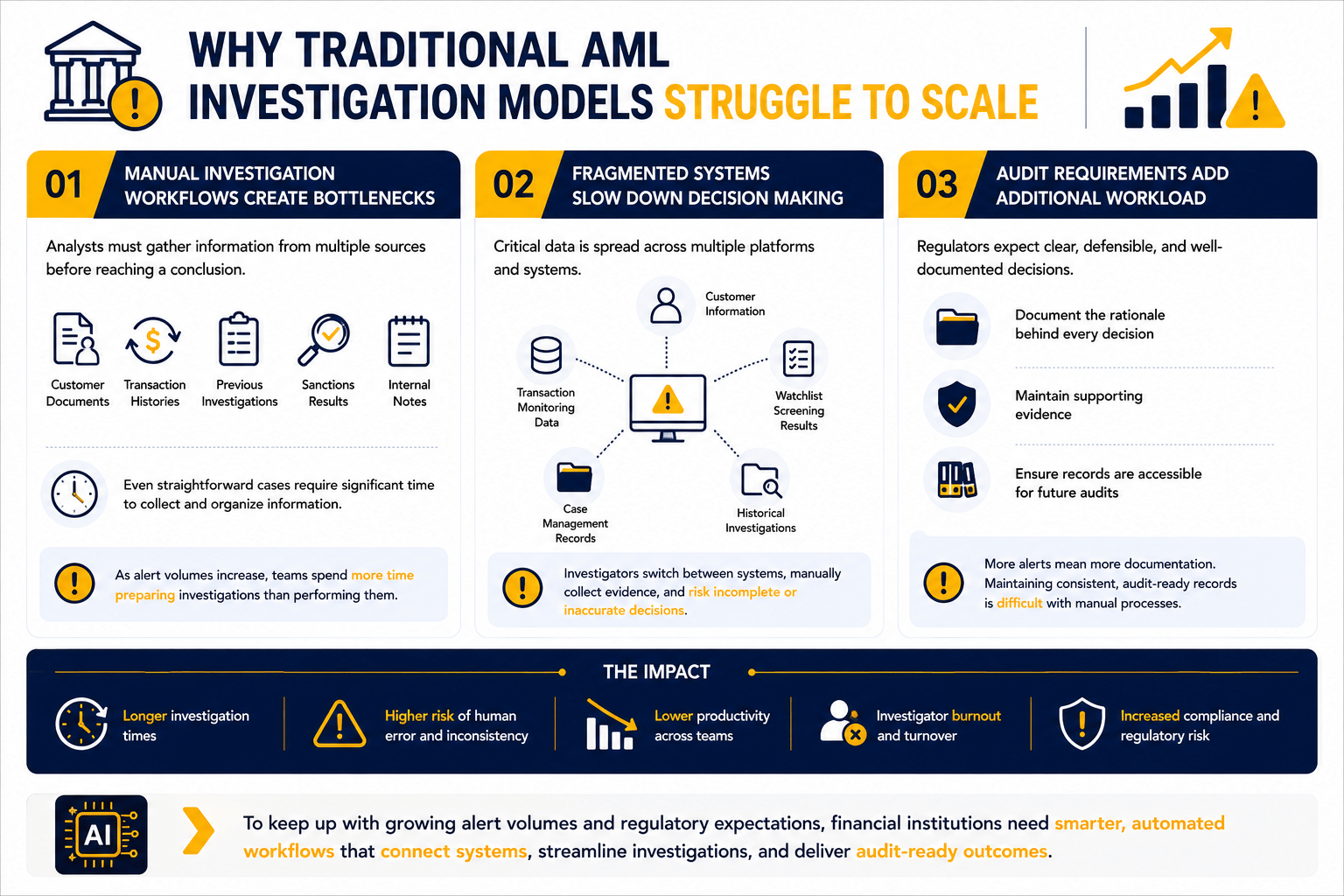
A typical AML investigation requires analysts to gather information from multiple sources before reaching a conclusion. They may need to review customer onboarding documents, transaction histories, previous investigations, sanctions screening results, and internal notes. Even for relatively straightforward cases, collecting and organizing this information can take considerably longer than the actual risk assessment itself.
As alert volumes increase, these manual processes become a significant bottleneck. Compliance teams often find themselves spending more time preparing investigations than conducting them.
2. Fragmented Systems Slow Down Decision Making
Many organizations operate across multiple compliance platforms, databases, and business systems. Customer information may reside in one application. Transaction monitoring data may sit in another. Watchlist screening results, case management records, and historical investigations may exist elsewhere.
Investigators are forced to move between systems, manually gather evidence, and piece together a complete picture before making a decision. This fragmented workflow increases investigation time and introduces opportunities for human error.
3. Audit Requirements Add Additional Workload
Regulators increasingly expect institutions to demonstrate how compliance decisions were made. Investigators must not only review alerts but also document the rationale behind every decision, maintain supporting evidence, and ensure records remain accessible for future audits.
While essential for governance, this documentation process adds another layer of work to already overloaded compliance teams. As alert volumes grow, maintaining consistent and defensible audit trails becomes increasingly difficult through manual processes alone.
Why AI Workflow Automation Is Emerging as the Solution?
The goal of AI in AML compliance is not to replace investigators. Instead, the objective is to eliminate repetitive work so compliance professionals can focus their expertise where it creates the greatest value. This is where AI workflow automation becomes practical: not as a generic chatbot, but as an operational layer that connects data, screening, reasoning, case routing, and audit documentation into one managed workflow.
NORA is SmartDev’s AI adoption accelerator, designed to help organizations implement AI-powered workflow automation faster and more cost-effectively. Rather than functioning as a standalone AML solution, NORA provides a collection of reusable AI capabilities that can be orchestrated into specific business processes, including compliance screening, investigation support, document processing, and risk management.
At its core, NORA combines information extraction, data screening, risk assessment, recommendation engines, workflow automation, and auto-monitoring into a unified operational framework. Instead of requiring organizations to build and integrate multiple AI components from scratch, NORA helps accelerate deployment by providing a structured foundation that can be adapted to existing workflows.
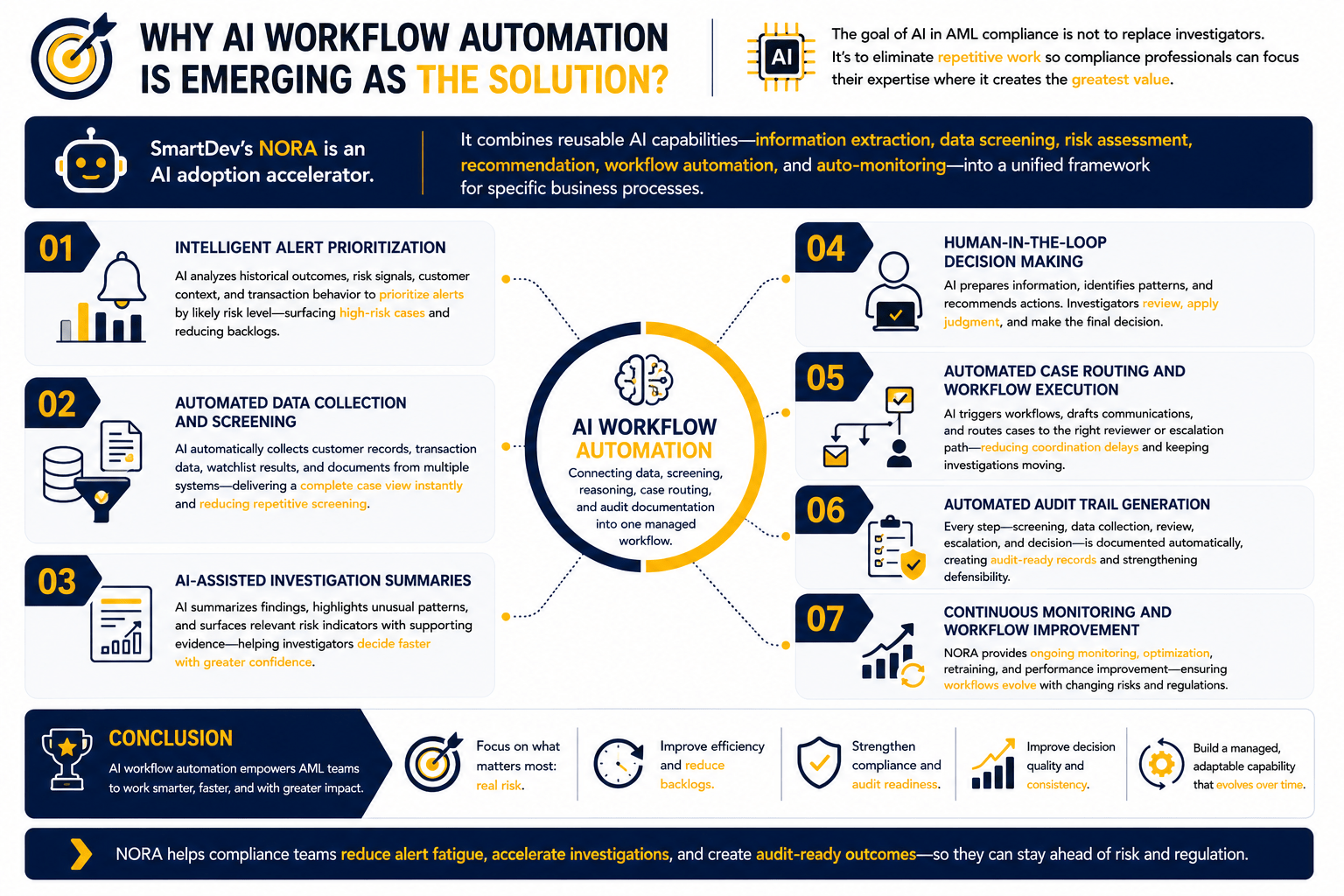
1. Intelligent Alert Prioritization
AI can analyze historical investigation outcomes, risk indicators, customer context, and transaction behavior to help prioritize alerts according to likely risk levels. Rather than presenting investigators with thousands of alerts in chronological order, AI-assisted workflows can surface the cases most likely to require immediate attention. This allows teams to allocate resources more effectively and reduce review backlogs.
In an AML workflow, NORA can support this process by applying its data screening and risk assessment capabilities to classify alerts, identify contextual risk signals, and recommend which cases should be escalated for human review. The point is not to let AI make final compliance decisions, but to stop high-risk cases from being buried under low-value noise.
2. Automated Data Collection and Screening
One of the most time-consuming parts of AML investigations is gathering information. AI-powered workflows can automatically collect customer records, transaction histories, sanctions screening results, previous case notes, and supporting documents from multiple systems. Instead of spending valuable time searching for information, investigators receive the relevant context immediately.
This is where NORA’s foundation data skills become especially useful. Its information extraction capability can pull key data from documents, emails, and enterprise records, while unified data indexing helps organize fragmented information into a more accessible structure. For AML teams, this means investigators can start from a prepared case view rather than manually assembling evidence from disconnected systems.
NORA’s compliance screening capability can also support customer and transaction checks against defined compliance rules and watchlists. In practice, this helps reduce repetitive screening work and allows compliance teams to focus on cases that require judgment.
3. AI-Assisted Investigation Summaries
Large investigations often require analysts to review extensive datasets before making a decision. AI can summarize key findings, highlight unusual patterns, identify relevant risk indicators, and present supporting evidence in a structured format. This reduces administrative effort while helping investigators reach decisions faster.
NORA’s reasoning layer supports this by turning raw data into investigation-ready insight. Through enterprise search and answer, recommendation, and risk assessment capabilities, NORA can help analysts understand why an alert matters, what evidence supports the case, and what action may be appropriate next.
For AML investigators, this can turn a fragmented pile of data into a clearer case narrative. Instead of reading through every document and system record from scratch, analysts receive a concise summary that supports faster and more consistent decision-making.
4. Human-in-the-Loop Decision Making
Despite advances in AI, compliance decisions remain a human responsibility. The most effective compliance programs use AI to support investigators rather than replace them. AI prepares information, identifies patterns, and recommends actions. Compliance professionals review the evidence, apply judgment, and make final decisions.
NORA is designed around this human-in-the-loop principle. Its autonomous layer can operate proactively and trigger workflows, but human reviewers remain involved where judgment, escalation, or regulatory accountability is required.
This matters in AML because full automation without oversight is risky. Compliance teams need speed, but they also need defensibility. NORA helps create a workflow where AI handles repetitive preparation while investigators retain control over the final decision.
5. Automated Case Routing and Workflow Execution
Reducing AML alert fatigue is not only about analyzing alerts faster. It is also about moving cases through the right process without unnecessary manual coordination. In many compliance teams, analysts still spend time assigning cases, drafting internal messages, requesting additional information, or updating case management tools. These small administrative tasks accumulate quickly when alert volumes are high.
NORA’s execution skills can support this operational layer by triggering workflows, drafting documents, automating emails, and helping route cases to the right reviewer or escalation path. For example, when an alert reaches a certain risk threshold, NORA can help prepare the case package, notify the appropriate reviewer, and support the next step in the investigation process. This allows compliance teams to reduce coordination delays and keep investigations moving without depending entirely on manual follow-up.
6. Automated Audit Trail Generation
Modern workflow automation platforms can automatically document investigation activities, screening outcomes, supporting evidence, and decision histories. Instead of reconstructing audit records after the fact, organizations create audit-ready compliance documentation as a natural byproduct of the investigation process.
NORA supports this by helping compliance teams capture each step of the workflow, from screening and data collection to recommendation, review, escalation, and final decision. This creates a more consistent record of what happened, what evidence was used, and why a decision was made.
For AML teams, this is not a nice-to-have. It is essential. When regulators ask for evidence, compliance teams should not have to rebuild the story manually. The workflow should already contain the record.
7. Continuous Monitoring and Workflow Improvement
AML risks evolve constantly. Customer behavior changes, criminal typologies shift, transaction patterns move across channels, and regulatory expectations continue to rise. This means AML automation cannot be treated as a one-off implementation. A workflow that works today may become less effective if it is not monitored, refined, and updated over time.
NORA’s managed service model is designed to address this issue. Beyond initial implementation, it supports ongoing monitoring, optimization, retraining, and performance improvement. For compliance teams, this means the system does not simply go live and then slowly become outdated. It continues to evolve with the business environment.
That is the real shift: AML automation should not be a static tool. It should be a managed operating capability that improves how compliance teams detect, investigate, document, and escalate risk over time.
Conclusion
AML alert fatigue is no longer simply a staffing challenge. It is a structural problem created by growing transaction volumes, increasing regulatory expectations, and investigation workflows that remain heavily dependent on manual effort.

As alert volumes continue to rise, adding more analysts alone is unlikely to provide a sustainable solution.
AI-powered workflow automation offers a more scalable path forward by helping organizations prioritize risk, automate repetitive investigation tasks, improve audit readiness, and increase overall compliance efficiency.
With solutions like NORA, financial institutions can move beyond reactive alert management and build intelligent compliance workflows that allow investigators to focus on what matters most: identifying and managing real financial crime risk.