
TL;DR
- Many STP failures in document-intensive financial workflows begin before the workflow engine runs — at the point where documents are captured, classified, and validated. Workflow logic, system integration, compliance checks, and exception escalation design all contribute to failure rates, but document quality is consistently the least-addressed layer.
- The five root causes — poor scan quality, naming inconsistencies, missing fields, misclassification, and multi-language content — all occur at document intake, where traditional OCR and rule-based systems fall short.
- AI document review fixes this upstream: it extracts, validates, and standardizes unstructured data before it enters the processing pipeline, turning would-be exceptions into clean, routable records.
- Organizations that fix document quality at intake see compounding benefits: lower cost per transaction, faster cycle times, stronger audit trails, and better customer experience — without expanding headcount.
Introduction
For every trade, payment, or onboarding application that passes through a financial system without human touch, there are several others that don’t. They fall out of the automated pipeline the moment something doesn’t match — a name formatted differently across two documents, a date field that a legacy scanner couldn’t read cleanly, a beneficial ownership certificate that arrived as a handwritten PDF.
SWIFT research has long documented that manual exception handling is one of the largest hidden cost centers in financial operations. According to McKinsey, financial institutions spend a significant share of their operational budget on manual exception resolution — work that is repetitive, error-prone, and difficult to scale. And the volume isn’t shrinking. As digital transaction volumes grow and regulatory document requirements expand, the number of documents entering operations teams is increasing faster than headcount can keep up.

The conventional response has been to improve the workflow engine itself — adding routing rules, refining exception handling logic, investing in better RPA. These are necessary steps, but they don’t address what’s happening upstream. The majority of document-related STP failures originate before the workflow engine sees the data at all, at the point where unstructured documents are captured and their data is extracted for the first time. This is what AI document review is designed to do.
What is Straight-Through Processing – And Why It Matters
Straight-Through Processing (STP) refers to the automated execution of a financial transaction or business process from end to end, without any manual intervention at any stage. The term originated in capital markets — specifically in trade settlement, where the goal was to move a confirmed trade through clearing, custody, and settlement systems automatically.
Today, STP is used more broadly across financial services to describe any processing pipeline where data flows from intake to outcome without a human touching it. An STP rate of 80% means 80 out of every 100 transactions complete automatically; the remaining 20 fall out and require manual handling.
When that data originates from documents — which in financial services it almost always does — the quality of document processing determines how many transactions make it through without intervention. A pipeline with sophisticated workflow logic but weak document intake will still produce high exception volumes, because the failures are happening before the workflow even starts.
How Documents Move Through a Financial Processing Pipeline
Straight-Through Processing works by automating the movement of a transaction or application through every required processing stage without human intervention. For STP to succeed, each stage of the workflow needs to receive clean, complete, correctly formatted data that matches what it expects.
In practice, that data almost always originates from documents — customer onboarding packs, trade confirmations, invoices, payment instructions, contracts, and regulatory filings. These documents are inherently unstructured. They arrive in different formats, with different layouts, from different sources, and with varying levels of completeness. The moment a required field is missing, illegible, or formatted in a way the downstream system doesn’t recognize, the transaction exits the automated pipeline and enters a manual review queue.
According to Gartner, organizations that rely on manual document handling in their intake processes see significantly higher exception rates and slower cycle times compared to those using intelligent document automation. Deloitte similarly notes that document quality and data extraction accuracy are among the leading operational risk factors in financial services processing environments.
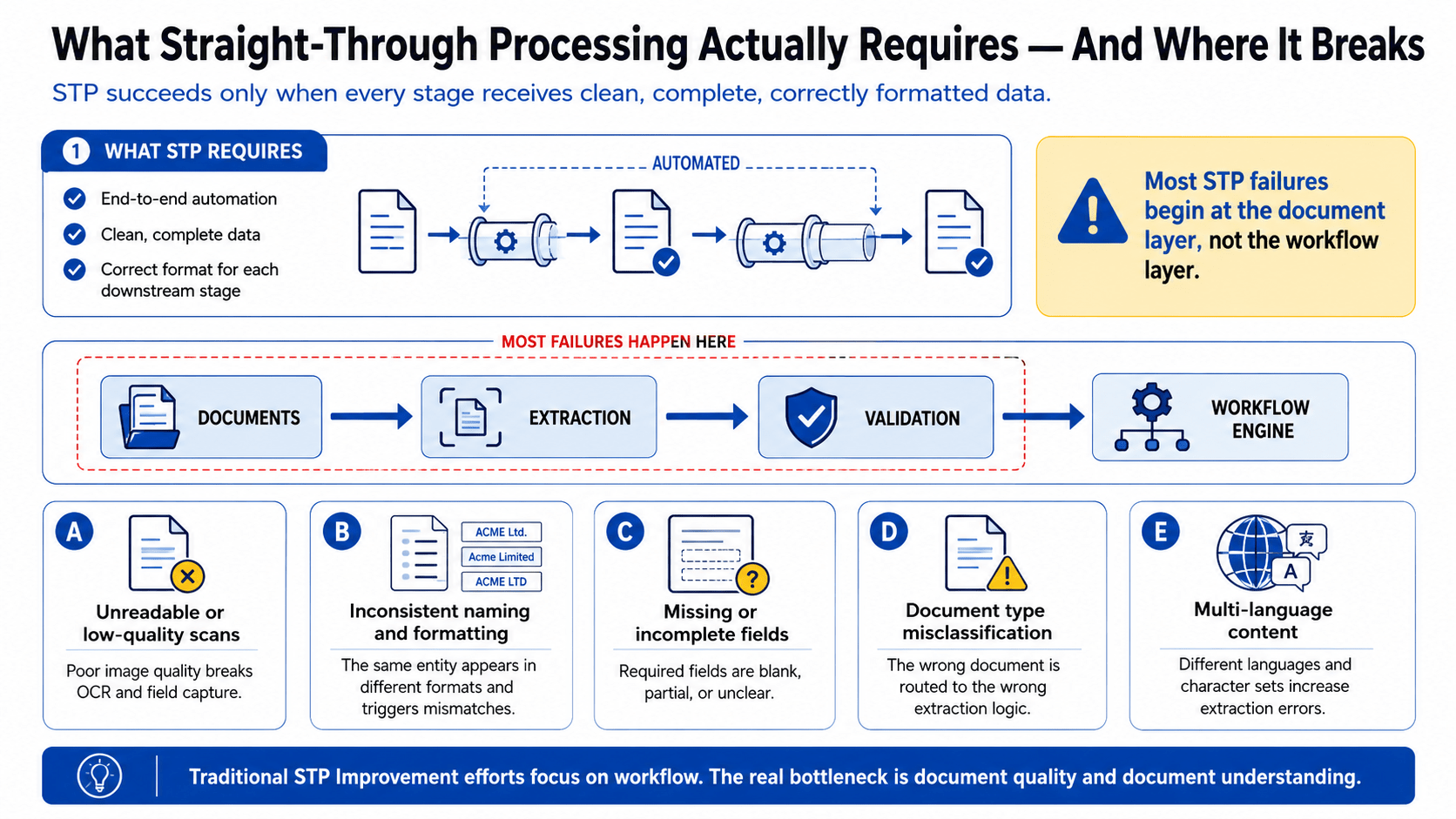
In document-intensive financial workflows, the processing journey begins the moment a document enters the organization — through a customer portal, email, API feed, or physical scan. Before any business logic runs, that document must pass through several stages: ingestion and format normalization, document type classification, field extraction, data validation against internal records or external databases, and handoff to the downstream processing system.
Each of these stages is a potential failure point. A document that arrives as a low-resolution scan may produce unreliable extraction output. A file classified as the wrong document type will have the wrong fields extracted. Extracted data that doesn’t match what the downstream system expects will trigger a validation error and exit the pipeline. None of these failures involve the workflow engine — they occur in the layer that feeds it.
This is why organizations investing heavily in workflow automation still see high exception rates: they are optimizing steps three through ten of a twelve-step process while leaving steps one and two largely unaddressed. AI document review targets precisely that upstream layer — the ingestion, classification, extraction, and validation stages that determine whether clean data ever reaches the workflow in the first place.
How AI Document Review Addresses Each Failure Point
AI document review refers to the application of machine learning, optical character recognition, and natural language processing to extract, classify, validate, and standardize information from unstructured documents before it enters downstream systems. Unlike rule-based OCR systems that apply fixed templates, AI document review models learn from variation. They can handle poor scan quality, inconsistent layouts, multi-language content, and non-standard formatting in ways that brittle template-based systems cannot.
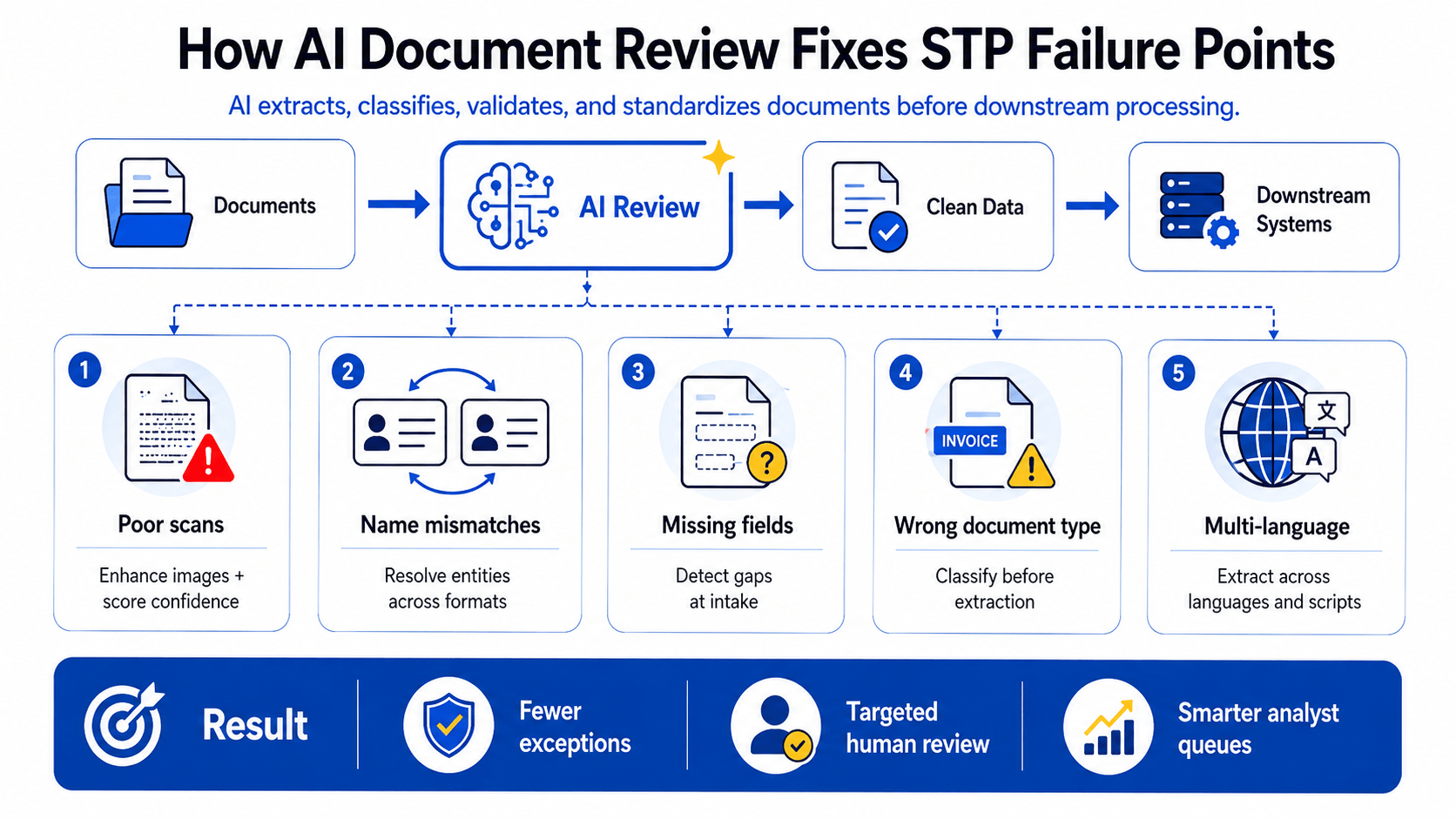
On unreadable or low-quality inputs, modern AI document models apply image enhancement and confidence scoring. Fields that fall below a confidence threshold are flagged for targeted human review rather than causing the entire document to fail. This is a significant operational improvement: instead of an analyst reviewing a complete document because one field was unclear, AI isolates the specific field in question and surfaces only that element for review.
On naming inconsistencies and cross-document mismatches, AI applies entity resolution logic that can recognize probable matches across formatting variations, transliterations, and abbreviations. A beneficial owner appearing in three different formats across three documents can be recognized as the same individual, allowing the system to resolve what would previously have been a manual exception automatically.
On missing fields, AI can be configured to detect absence proactively at the point of document submission rather than at the point of processing failure. Instead of allowing an incomplete document to enter the pipeline and fail mid-flow, the system identifies missing information at intake and returns an automated request for the specific fields required — often before any human has looked at the file.
On document type classification, AI models trained across diverse document libraries can classify incoming files accurately even when layout, issuer, or jurisdiction varies significantly. This ensures that the correct extraction logic is applied from the start, reducing misclassification-driven errors.
On multi-language content, AI extraction models can be fine-tuned for specific languages and scripts, extracting structured data from Vietnamese, Arabic, Chinese, or other non-Latin documents with the same reliability as English-language files.
The net result is that far fewer exceptions reach the manual review queue — and those that do are better prepared, with AI-generated summaries and flagged discrepancies already highlighted for the analyst.
How NORA Approaches AI Document Review
NORA, SmartDev’s AI workflow automation accelerator, takes a layered approach to AI document review that mirrors the architecture of the problem itself. Rather than positioning AI document review as a single isolated function, NORA treats it as a capability built from interconnected skill layers — each one addressing a different level of the document processing challenge.
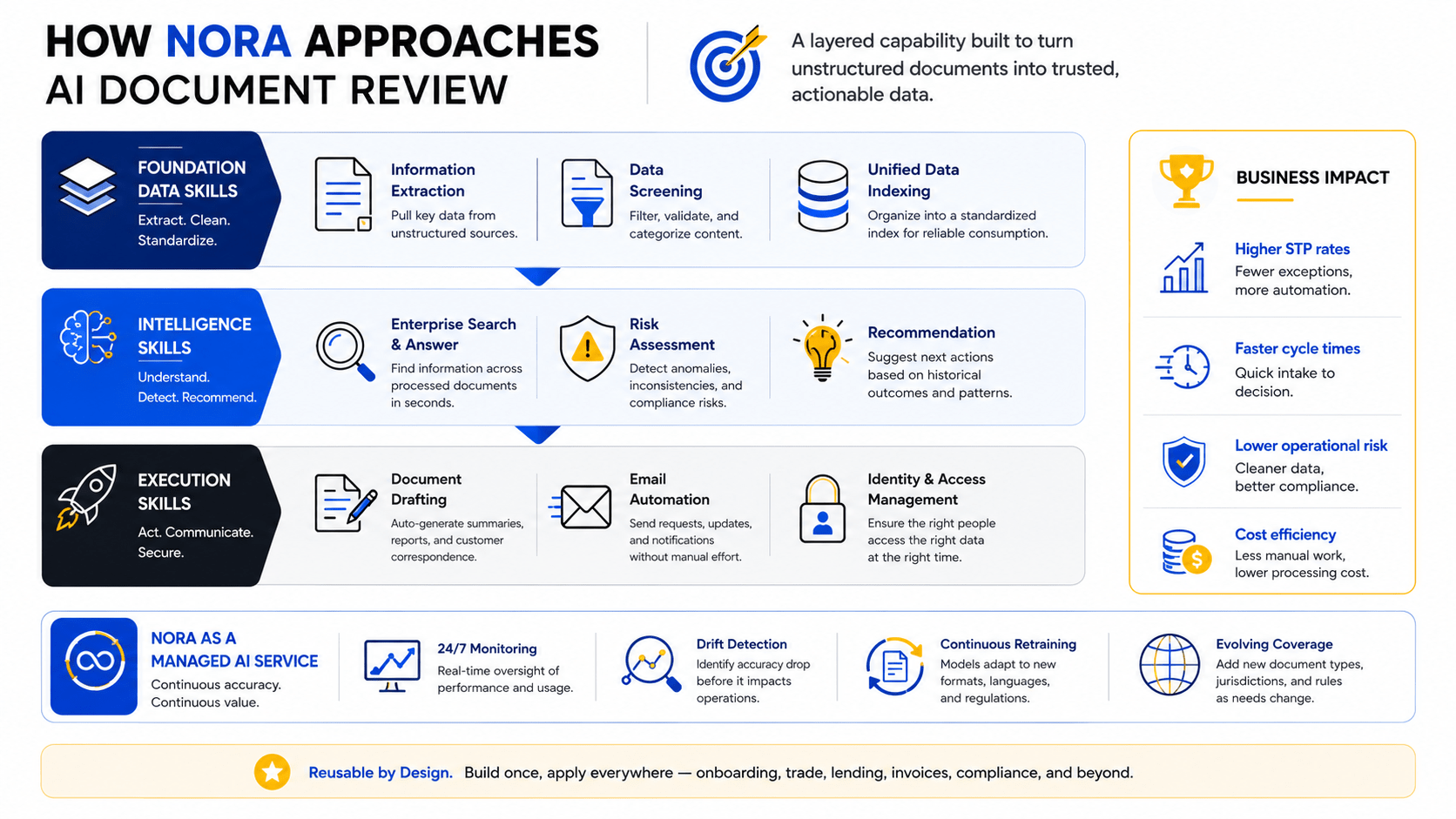
At the foundation, NORA’s Foundation Data Skills handle the raw intelligence work: extracting key data from documents and emails, screening and categorizing incoming content, and organizing it into a unified, standardized index that downstream systems can reliably consume. This is where the problems of poor scan quality, missing fields, and layout variation are addressed. Information Extraction pulls structured data from unstructured sources; Data Screening filters and categorizes it; Unified Data Indexing ensures everything is stored in a format that processing workflows can act on without further transformation.
Above that layer, NORA’s Intelligence Skills apply reasoning to the extracted data. Enterprise Search and Answer allows operations teams to query across processed documents instantly rather than searching manually through file systems. Risk Assessment analyzes extracted data to identify potential anomalies — a mismatch between declared ownership and extracted certificate content, for instance, or a document date that falls outside an acceptable range. Recommendation surfaces suggested next actions based on patterns in previous processing outcomes, helping teams resolve ambiguous cases faster.
At the action layer, NORA’s Execution Skills close the loop between document review and processing outcomes. Document Drafting generates standardized outputs — review summaries, exception reports, correspondence to customers requesting missing fields — automatically from extracted content. Email Automation handles outbound communication without manual composition. Identity and Access Management ensures that sensitive document data is only accessible to the right people at each stage of the workflow.
What distinguishes NORA from a point solution is that these skill layers are reusable. Once a document extraction capability is built for an onboarding workflow, the same Foundation Data Skills can be applied to trade documentation, invoice processing, or regulatory filing review. This reflects NORA’s core philosophy: rather than building bespoke AI systems for every use case, SmartDev builds reusable AI components that accelerate deployment across multiple business problems.
For organizations managing STP pipelines, this matters because document review requirements are rarely confined to a single workflow. The same document quality problems that affect customer onboarding affect trade settlement, loan origination, and compliance reporting. NORA’s layered architecture means that investing in AI document review for one process creates a foundation that extends to others.
NORA also operates as a managed AI service rather than a software license. This distinction matters for STP improvement specifically because document AI requires ongoing maintenance — models need to adapt as document formats evolve, new jurisdictions are added, and regulatory requirements change. NORA’s continuous management model includes 24/7 monitoring, drift detection, and retraining, which means the accuracy of document extraction doesn’t degrade over time as conditions change.
In practice, NORA’s contribution to STP improvement can be summarized across five operational functions: capturing and normalizing incoming documents regardless of format or quality; validating extracted fields and cross-document consistency before data enters the pipeline; routing only low-confidence or anomalous cases to human reviewers rather than entire documents; logging every extraction, validation step, and intervention decision for audit purposes; and delivering clean, structured data to downstream systems via standard API integration. Each function addresses a distinct category of document-related STP failure, which is why NORA’s impact on STP rates is measurable across multiple failure modes simultaneously — not just in one.
The Operational Impact: What Improves When Document Review Improves
Reducing STP failures through better document review has downstream effects that extend well beyond the obvious time savings in the exception queue.
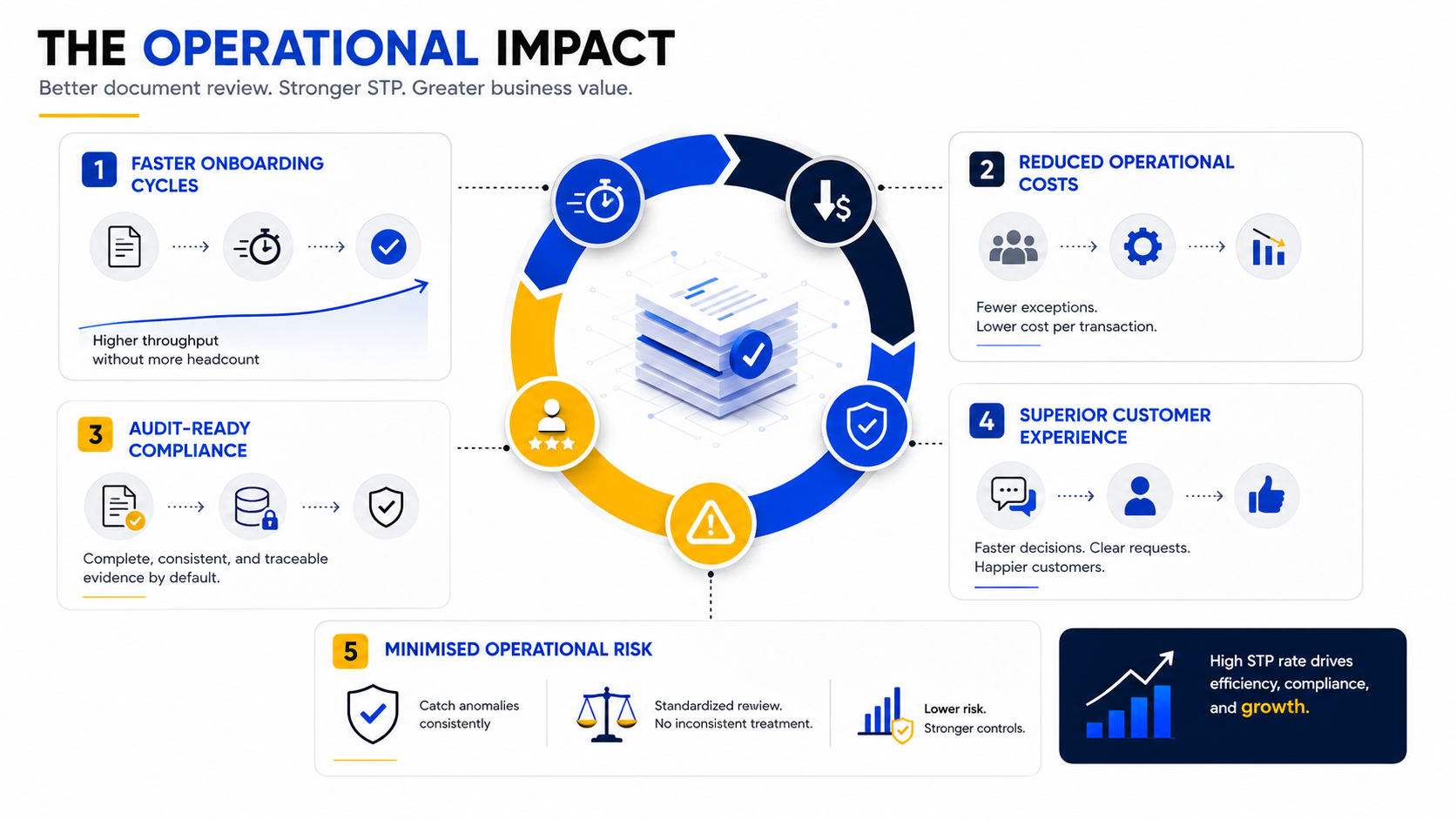
1. Faster Onboarding Cycles
Processing cycle time compresses significantly when documents don’t fail mid-pipeline. In financial services, the difference between STP and manual handling is often measured in hours or days rather than minutes. Fenergo reports that banks handling manual KYC reviews spend between $1,500 and $3,000 per client and can take 31 to 60 days for corporate onboarding. AI-assisted document review collapses a significant portion of that timeline by eliminating the extraction errors and missing fields that cause cases to stall.
Faster onboarding cycles also have a compounding effect on throughput. When fewer transactions fall into manual queues, operations teams can process higher volumes without adding headcount — meaning the same team handles more cases in less time. For financial institutions competing on speed-to-activation, reducing document-related delays through AI workflow automation is one of the most direct levers available, and one of the fastest to produce measurable results after deployment.
2. Reduced Operational Costs
Operational cost per transaction falls as the proportion of STP-completed transactions rises. Manual exception handling carries fully loaded costs that include analyst time, system switching, rework after errors, and management oversight — costs that multiply quickly when exception volumes are high. Each percentage point improvement in STP rate translates directly into cost reduction at scale, making document quality improvement one of the highest-ROI investments an operations team can make.
The cost reduction compounds further when AI document review eliminates rework loops — situations where a transaction fails, gets manually corrected, re-enters the pipeline, and fails again because the underlying data issue wasn’t fully resolved the first time. According to McKinsey, financial institutions that automate document-intensive processes report significant reductions in per-transaction operating costs, with the largest gains coming from eliminating repetitive manual tasks rather than from headcount reduction alone.
3. Audit-Ready Compliance
Regulatory auditability improves because AI document review creates a structured record of what was extracted, how it was validated, and what the confidence levels were at every step. This is increasingly important as regulators in Singapore, the EU, and the UK require financial institutions to demonstrate not just that a compliance check was performed, but how it was performed and on what basis. SmartDev’s AI compliance audit trail capabilities integrate directly with NORA’s document review workflows, ensuring every extraction and validation decision is logged and traceable by default.
Unlike manual processes — where audit evidence depends on what an analyst happened to document at the time — AI-generated audit trails are comprehensive, consistent, and produced automatically as a byproduct of normal processing. This reduces the cost and effort of responding to regulatory inquiries, simplifies internal audit cycles, and gives compliance officers a reliable evidence base for demonstrating procedural consistency. For institutions operating across multiple jurisdictions, this level of auditability is no longer a competitive advantage; it is a baseline expectation.
4. Superior Customer Experience
Customer experience improves when STP rates rise because customers receive decisions faster and are contacted for missing information proactively rather than after a processing failure has already occurred. For institutions where onboarding speed is a competitive differentiator, this has direct commercial value. Fenergo reports that 70% of financial firms lost clients due to slow onboarding in recent years — a figure that reflects not just operational inefficiency but direct revenue loss attributable to document processing delays.
AI document review also improves the quality of customer-facing communication during onboarding. Instead of a generic rejection or a long wait followed by a phone call from an analyst, customers receive precise, automated notifications identifying exactly which document or field is missing and what format is required. This kind of targeted communication reduces back-and-forth cycles, shortens time-to-resolution, and signals to the customer that the institution’s processes are professional and well-organized.
5. Minimised Operational Risk
Risk exposure is reduced because AI document review catches discrepancies and anomalies that manual review, under volume pressure, can miss. An analyst reviewing 50 onboarding packs in a day is statistically more likely to overlook a subtle inconsistency than an AI model applying consistent validation logic to every document in the same way. AI doesn’t experience fatigue, distraction, or the cognitive shortcuts that humans naturally develop when handling repetitive, high-volume tasks.
Beyond individual errors, AI document review also reduces systemic operational risk by standardizing how documents are assessed across the entire organization. When extraction and validation logic is codified in an AI model rather than distributed across individual analysts, the risk of inconsistent treatment — where two reviewers apply different standards to similar documents — is eliminated. This consistency matters not just for compliance, but also for risk management.
Where AI Document Review Fits in the Broader STP Improvement Journey
AI document review is not a standalone STP solution. It addresses the document quality problem at the intake stage, but sustained improvement in STP rates also requires clean workflow logic, reliable system integration, and appropriate exception escalation design. Organizations that achieve high STP rates typically combine AI document review with AI workflow automation that orchestrates the downstream processing pipeline, and compliance automation that handles regulatory checks without manual intervention.
This is the context in which NORA is designed to operate. Rather than selling a document extraction point product, SmartDev frames NORA as an AI adoption accelerator — a system that combines the component capabilities needed to move from manual processing to high-STP automation across multiple workflows simultaneously. The first deployment often focuses on a specific bottleneck, such as document intake for a particular product line. But because NORA’s skill layers are reusable, subsequent deployments extend the same foundation to adjacent workflows faster and at lower cost.
For organizations early in their AI journey, the 3 Weeks AI Discovery Program offers a structured entry point: a rapid assessment that identifies where document quality problems are most affecting STP rates and which AI capabilities would have the greatest impact. For those ready to move directly into implementation, the 10 Weeks AI Product Factory delivers a production-ready workflow within a defined timeframe and at a fixed cost.
FAQ
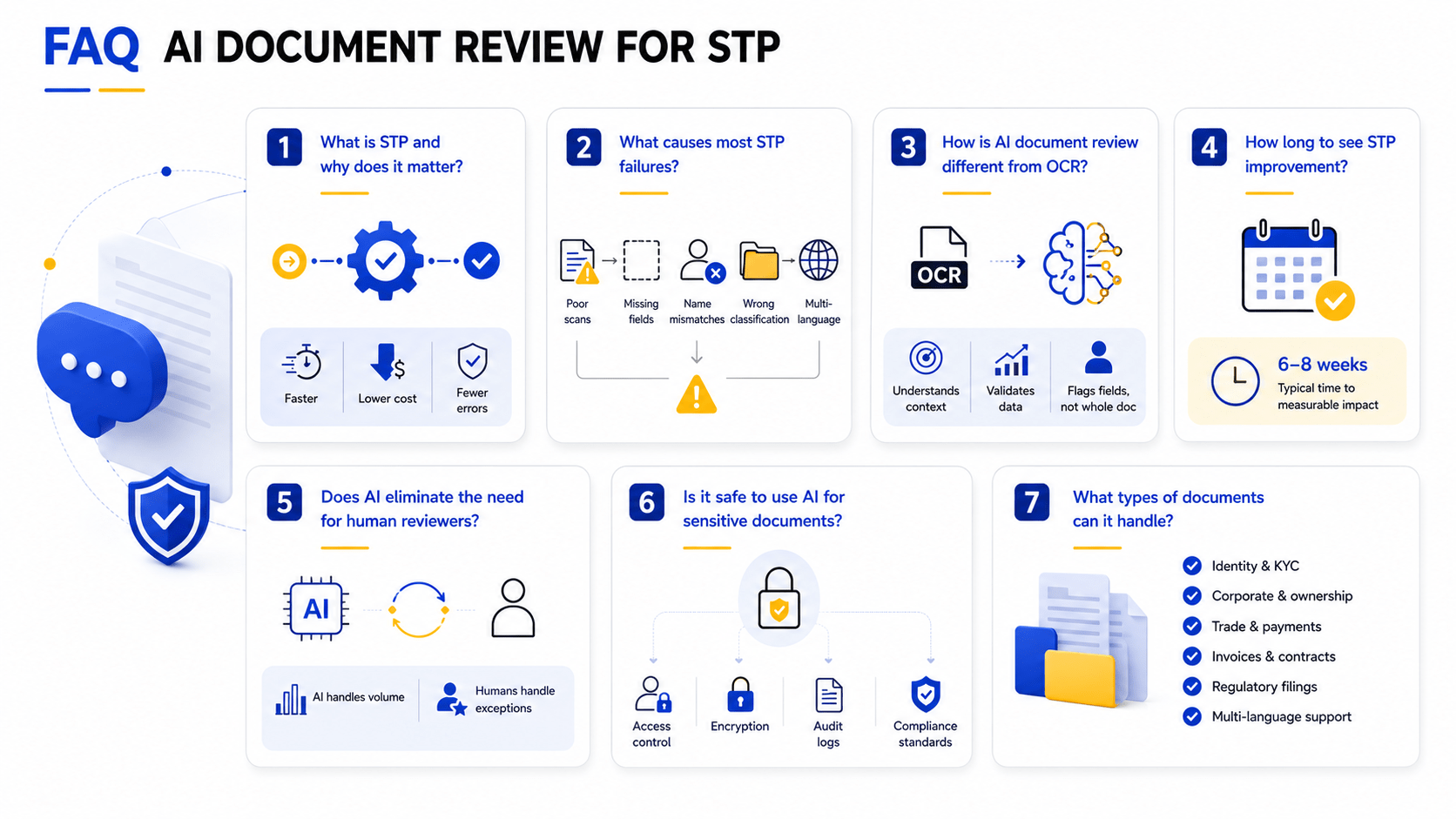
What is Straight-Through Processing (STP) and why does it matter?
Straight-Through Processing refers to the automated handling of a financial transaction or business process from initiation to completion without any manual intervention. High STP rates mean faster cycle times, lower operational costs, and fewer error-prone handoffs. In financial services, STP performance is a key operational metric because even small improvements in STP rate translate to significant cost savings and speed advantages at scale.
What causes most STP failures in document-intensive workflows?
Most STP failures originate at the document intake stage, not within the workflow engine itself. The leading causes include poor scan quality that produces unreliable OCR output, missing or incomplete fields in submitted documents, naming inconsistencies across documents that trigger mismatch exceptions, incorrect document classification, and multi-language content that standard extraction logic can’t handle reliably. Fixing these problems requires addressing document quality before data enters the processing pipeline.
How is AI document review different from traditional OCR?
Traditional OCR applies fixed template logic to extract text from documents. It works well when documents are consistent and high quality, but fails when layout varies, scans are degraded, or fields appear in unexpected positions. AI document review combines OCR with machine learning models and NLP that can adapt to variation, understand context, validate extracted data against other sources, and flag specific fields for human review rather than failing the whole document. The result is significantly higher extraction accuracy across a diverse document population.
How long does it take to see improvement in STP rates after deploying AI document review?
This depends on the complexity of the document types involved and the current state of the processing pipeline. With a structured deployment approach like NORA’s, organizations typically see measurable improvement within 6–8 weeks of go-live — the time needed to deploy the AI extraction layer, validate it against production document samples, and integrate it with existing workflow systems. Initial STP improvement is often visible within the first processing cycle after deployment.
Does AI document review eliminate the need for human reviewers?
No, and it shouldn’t be expected to. The goal of AI document review is not to remove humans from the process but to change where they spend their time. AI handles the high-volume, repetitive extraction and validation work. Human reviewers focus on exceptions, ambiguous cases, and final decisions on high-risk items. This human-in-the-loop model maintains control and accountability while dramatically reducing the volume of work that requires manual attention.
Is it safe to use AI for reviewing sensitive financial documents?
Yes, when deployed with appropriate data governance controls. Reputable AI document review implementations follow strict access management policies, encrypt data at rest and in transit, maintain detailed audit logs of every extraction and decision, and comply with applicable data protection regulations. NORA specifically uses standard APIs rather than proprietary data pipelines, which ensures data ownership remains with the client and avoids vendor lock-in. SmartDev operates under ISO 27001 and GDPR-aligned standards.
What types of financial documents can AI document review handle?
Modern AI document review systems can handle a wide range of financial document types, including customer identity documents (passports, national IDs, driver’s licenses), proof of address, bank statements, corporate registration certificates, beneficial ownership declarations, trade confirmations, payment instructions, invoices, contracts, and regulatory filings. Multilingual documents and documents from multiple jurisdictions are also supported when the underlying models are trained for those contexts.
Conclusion
Straight-Through Processing failures are rarely a workflow problem. They are a data quality problem, and data quality problems in document-intensive environments start with the documents themselves. Poor scans, missing fields, naming inconsistencies, and classification errors create exceptions that exit the automated pipeline long before workflow rules ever apply.
AI document review addresses this at the root. By combining intelligent extraction, cross-document validation, anomaly detection, and automated exception flagging, it ensures that the data entering your STP pipeline is clean, complete, and consistently formatted — and that the human effort saved goes toward higher-value decisions rather than routine data entry and exception routing.
NORA brings these capabilities together as a reusable, managed AI skill set that deploys in weeks rather than months and improves over time. For financial institutions serious about raising STP rates, reducing operational costs, and building document workflows that scale, it represents a fundamentally different approach to a problem that manual process optimization has never been able to fully solve.
To learn more about AI workflow automation for financial operations, explore how NORA compares to alternative approaches, or read our white paper on AI automation for document and data processing.