

TL;DR
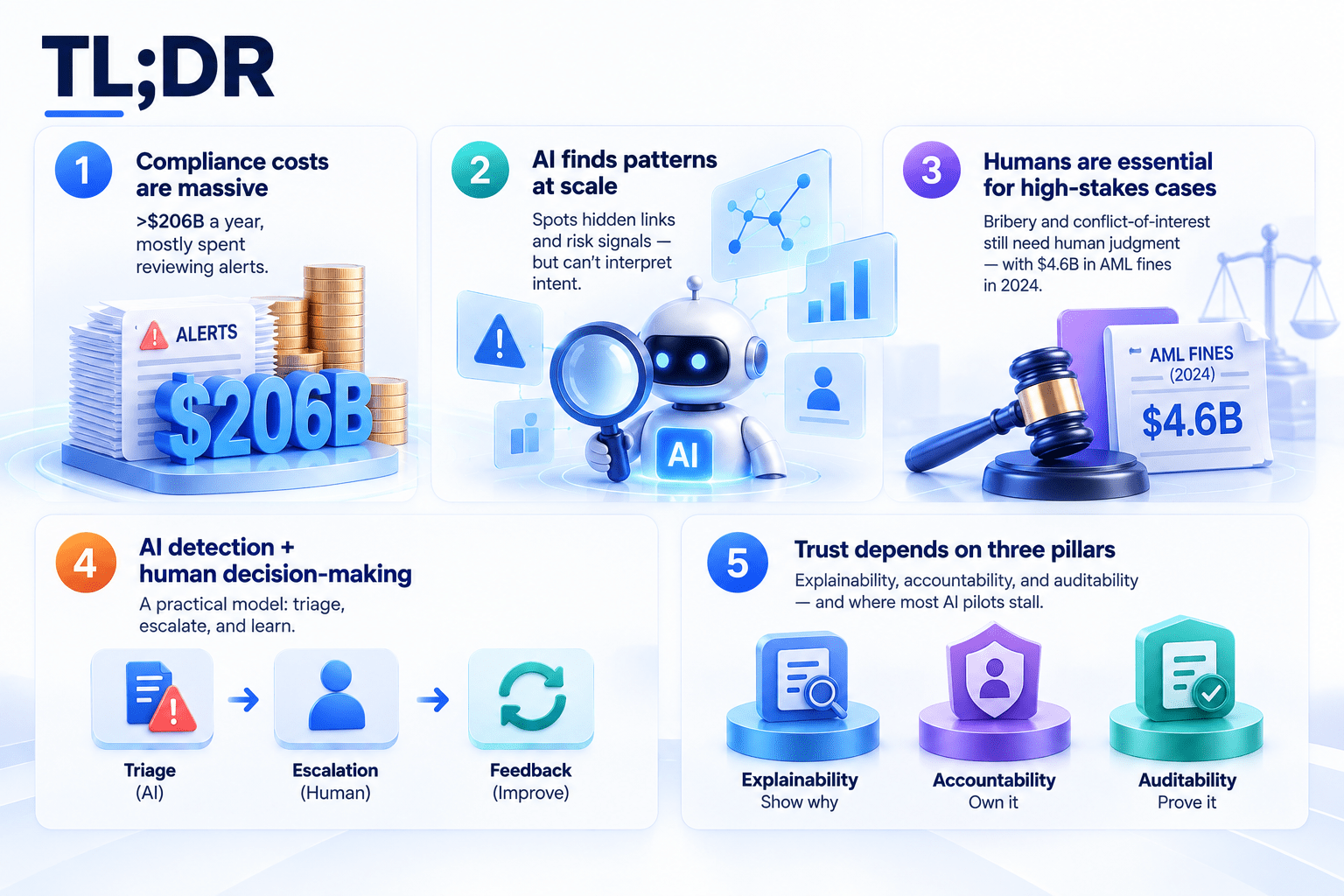
- Financial crime compliance now costs over $206 billion a year, and most of that money goes to reviewing alerts, not catching criminals.
- AI is strong at spotting patterns at scale – behavioral shifts, hidden entity links, and dynamic risk scores – but it can’t interpret intent or context.
- High-stakes decisions like bribery or conflict-of-interest cases still need human judgment, backed by $4.6 billion in 2024 AML fines as a reminder of the stakes.
- The practical model is AI detection paired with human decision-making, running through triage, escalation, and a feedback loop.
- Trust depends on three pillars – explainability, accountability, and auditability – which is also where most AI pilots stall before reaching production.
Introduction: Compliance Is Becoming a Pattern-Recognition Problem
Fraud rarely announces itself. It usually hides inside thousands of small, unremarkable transactions. Each transaction looks fine on its own. But together, they form a suspicious pattern. This is why modern compliance is no longer just a checklist exercise. It has become a pattern-recognition problem at scale.
Compliance teams today face financial crime that is more organized than ever. Criminal networks adapt quickly. They know how to slip past static rules. Humans simply can’t process this volume of data alone. That’s where AI enters the picture.
The stakes are already massive. Financial institutions worldwide now spend more than $206 billion a year on financial crime compliance, according to LexisNexis Risk Solutions. Much of that cost comes from processing alerts, not catching criminals. It’s no surprise that 72% of compliance professionals already use analytics and AI to manage this workload, per the same LexisNexis study. For a broader look at where AI is already reshaping financial services, SmartDev’s overview of AI in finance is a useful starting point.
What AI Does Best: Detecting Patterns at Scale
AI doesn’t just flag “large transactions.” It learns what normal behavior looks like for each customer. Then it detects meaningful deviations from that baseline. For example, a customer who always transacts domestically suddenly starts sending money abroad. Each signal alone might seem minor. But layered together, they form a clear warning.
AI also excels at entity link analysis. Criminals rarely act alone. They often build shell companies, mule accounts, and crypto wallets to move money quietly. Link analysis tools can map these hidden relationships. They surface shared devices, matching IP addresses, or metadata tied to known bad actors.
On top of that, AI enables dynamic risk scoring. Instead of assigning a fixed risk label at onboarding, the system updates scores continuously. It factors in transaction volume, geography, and fresh external intelligence. As a result, teams act on current risk, not outdated profiles. The same logic is already speeding up onboarding itself – SmartDev’s piece on KYC document review automation shows how AI workflows now process onboarding packs in minutes instead of days.
Where AI Falls Short: Context, Intent, and Risk Interpretation
Still, AI has clear limits.
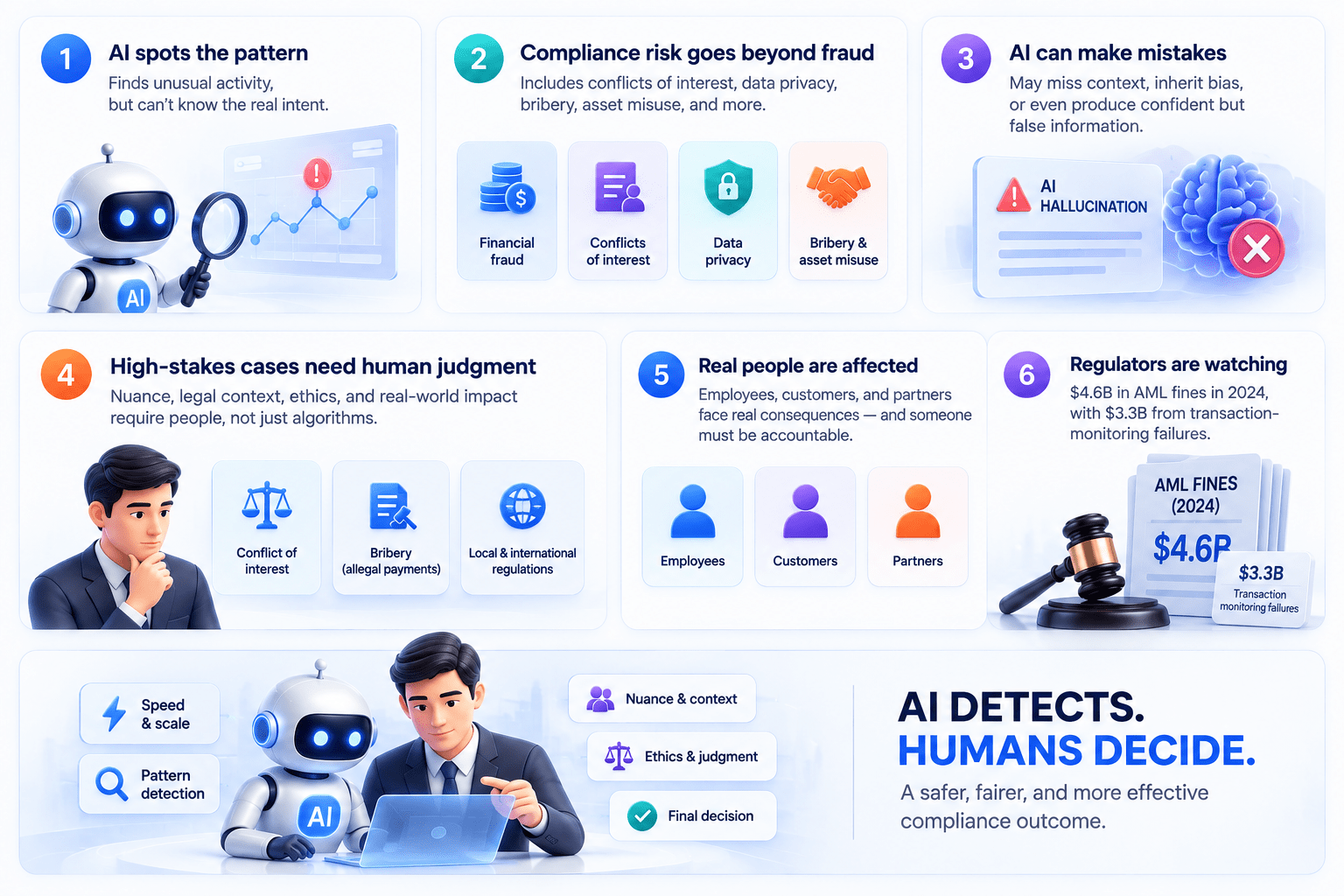
It can spot an unusual pattern. But it can’t truly understand why that pattern exists. An odd transaction might simply reflect a new job, a move, or a legitimate business expansion. AI lacks the ability to interpret real intent behind the numbers.
Compliance risk also extends far beyond financial fraud. It spans conflicts of interest, data privacy violations, bribery, and asset misuse. Each risk type demands a different kind of judgment and context. AI can flag unusual data. But classifying the true severity and legal weight of a case still requires human expertise.
Because of this, a system built purely on algorithms is prone to mistakes. It can miss important contextual factors. Worse, it can produce unfair outcomes if the training data carries hidden bias. SmartDev’s analysis of AI hallucination risk in compliance goes further: a model can state something false with total confidence, and in a compliance setting, that confidence can be more dangerous than an obvious error.
Why Human Judgment Still Matters in High-Stakes Compliance
In high-stakes situations, human judgment remains irreplaceable. Machines handle speed and volume well. But people understand nuance, ethics, and real-world consequences.
Take a conflict-of-interest report as an example. It needs evaluation within the organization’s specific culture. A bribery allegation requires knowledge of local and international law. These are judgment calls algorithms can’t yet make reliably.
Compliance decisions also affect real people directly. An employee might face investigation. A customer might lose access to a service. A partner might lose a contract. These outcomes demand clear accountability. A human has to make the final call.
The regulatory record backs this up. Global regulators issued $4.6 billion in AML-related enforcement actions in 2024 alone, according to Fenergo’s annual fines report. Of that total, $3.3 billion stemmed specifically from transaction-monitoring failures – cases where flagged activity wasn’t reviewed or escalated properly. A model that flags risk correctly still fails if no human closes the loop.
The Future Model: AI Detection + Human Decision-Making
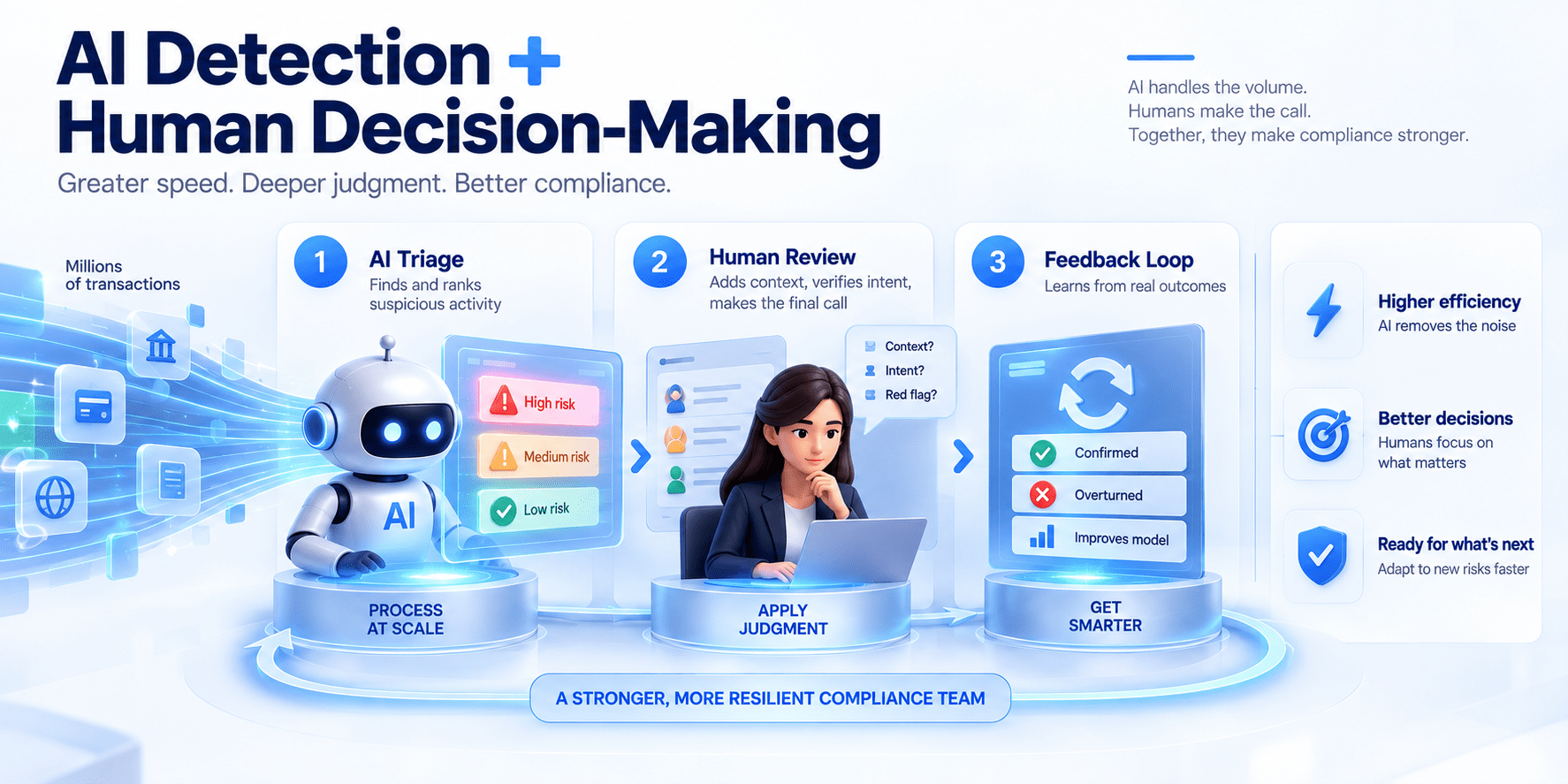
Given all this, a practical model is emerging. It combines AI-driven detection with human decision-making. AI handles the heavy lifting of processing massive datasets. It surfaces the most suspicious signals from millions of transactions. Humans then review these prioritized alerts. They assess context, verify intent, and make the final call.
This model doesn’t treat AI as a replacement for people. It treats AI as an amplifier of human capability. By offloading repetitive, time-consuming work to AI, compliance experts can focus on genuinely complex cases. That balance between speed and accuracy is exactly what modern compliance needs. SmartDev calls this shift from processing alerts to making decisions, and its broader take on AI-native compliance for RegTech firms lays out what that shift looks like at an enterprise level.
In practice, this hybrid model usually runs on three layers. The first layer is automated triage. AI scores every transaction or report and sorts them by risk level, so nothing waits in an undifferentiated queue. The second layer is tiered escalation. Low-risk items get auto-cleared or logged for periodic sampling, medium-risk items go to junior analysts, and high-risk items go straight to senior investigators or legal counsel. The third layer is a feedback loop. Every human decision, whether it confirms or overturns an AI recommendation, feeds back into the model. Over time, the system learns from real outcomes instead of static rules.
This structure changes what a compliance analyst’s day actually looks like. Instead of scrolling through a flat list of thousands of alerts, an analyst opens a dashboard that already ranks cases by urgency and shows the evidence trail behind each score. They spend their time on judgment calls: is this pattern a coincidence, a red flag, or something in between? The model doesn’t remove complexity from compliance work. It removes the noise that used to bury the complexity.
The same structure also makes compliance teams more resilient to change. When a new typology emerges, such as a novel structuring technique or a fresh sanctions evasion route, the AI layer can be retrained relatively quickly on new labeled cases. Human reviewers, meanwhile, keep the institutional judgment needed to sanity-check the model’s new behavior before it goes live. Neither layer works well without the other; that interdependence is the actual point of the model, not a limitation of it.
Building Trust: Explainability, Accountability, and Auditability
For this hybrid model to work, trust is essential.
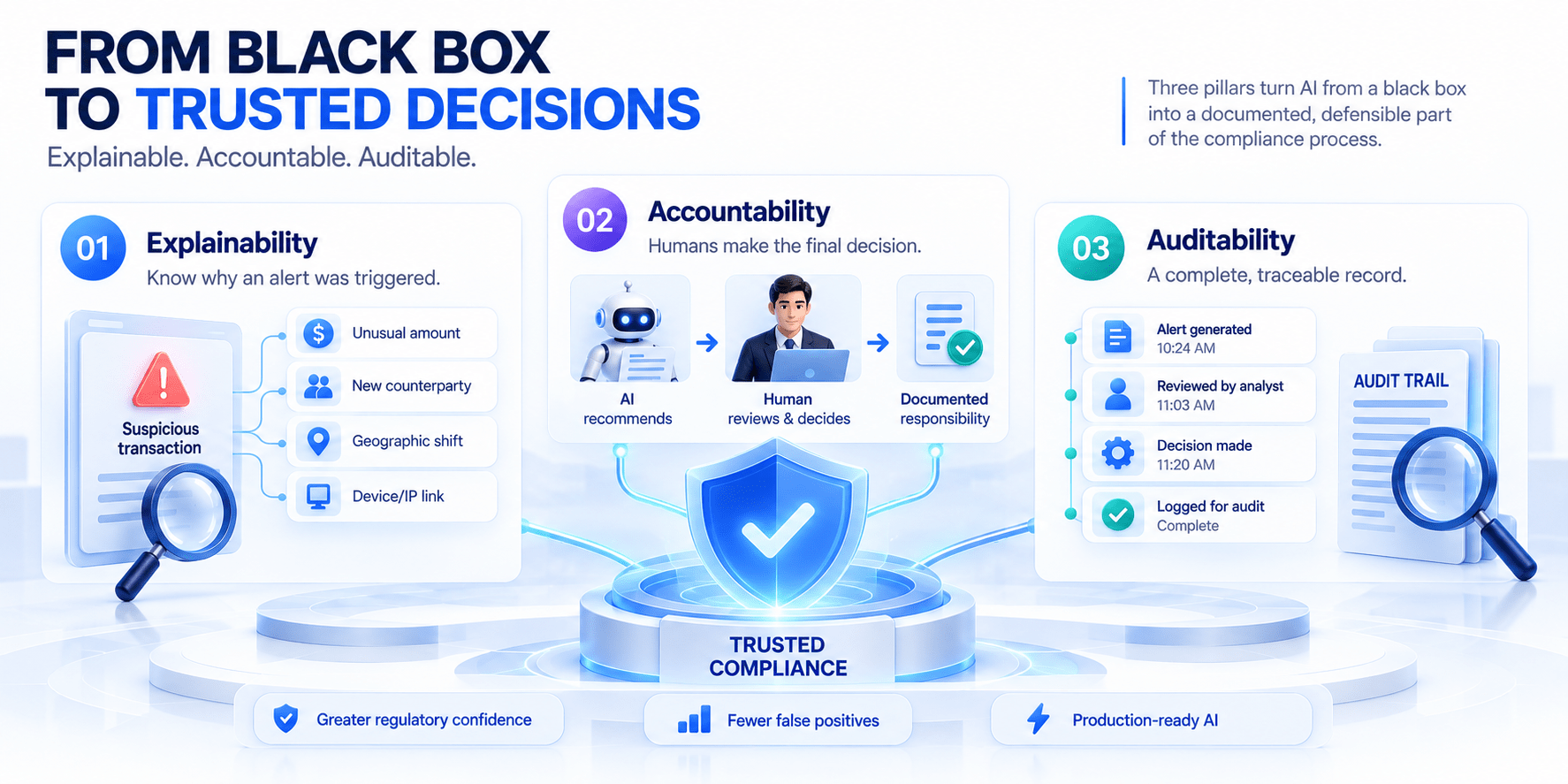
First, AI systems need clear explainability. When a transaction gets flagged, the compliance team needs to know exactly why. “The system triggered an alert” isn’t a good enough answer for a regulator. Explainability means the system can point to the specific factors behind a score: an unusual transfer amount, a new counterparty, a geographic shift, a device or IP link to a flagged account. Analysts can then confirm whether those factors genuinely apply to this case, or whether the model latched onto something coincidental. Without this layer, teams end up trusting a black box, which is a fragile position to defend in front of a regulator or in court.
Second, accountability must be clearly divided between machine and human. AI provides data and recommendations. But humans remain responsible for the final decision. This distinction matters most when regulators demand an explanation for a specific outcome. In practice, this usually means documenting who reviewed an alert, what evidence they considered, what the AI recommended, and why the final decision agreed with or diverged from that recommendation. That record is what turns “the AI decided” into “our compliance officer decided, informed by AI analysis” – a meaningfully different, and far more defensible, statement.
Third, every action in the system needs to be auditable. Each risk-score change and each generated alert should be logged in full. This allows the organization to prove its process is transparent and well-founded. A strong audit trail also does double duty internally: it lets compliance leaders spot patterns in false positives, measure analyst performance fairly, and demonstrate program maturity during internal reviews, not just external ones. SmartDev’s guides on building a compliance audit trail for AI-assisted decisions and how NORA makes every decision regulatorily defensible both dig into what that logging needs to look like in practice.
Together, these three pillars turn AI from a black box into a documented, defensible part of the compliance process. That distinction is often what separates a regulator’s approval from a regulator’s finding.
This is also precisely the gap that stalls most compliance AI initiatives today: a pilot that performs well in a demo but was never engineered for governed, audited production use. It’s a common enough problem that SmartDev is increasingly focused on closing exactly that gap – helping organizations take a working AI pilot and turn it into a safe, governed system that’s actually cleared to run in production. That same discipline runs through NORA’s AI workflow automation for risk and compliance, which by design routes low-confidence or flagged cases to human reviewers rather than letting the model make the final call alone.
From Alert Overload to Smarter Compliance Operations
One of the biggest problems in traditional compliance is alert overload. Tens of thousands of transactions get flagged every day. Only a small fraction actually deserve attention. This exhausts compliance teams and increases the risk of missing real threats.
The scale of this problem is well documented. Traditional AML systems generate a false positive rate as high as 90% to 95%, according to industry analysis from Datos Insights and Retail Banker International. Reviewing all that noise isn’t free -it’s part of why global AML compliance spending now exceeds $274 billion a year, with much of it going toward chasing low-quality alerts instead of real threats.
AI addresses this through contextual filtering. Instead of flagging every international transfer or every large payment, the system focuses on behavior that’s genuinely unusual for that specific customer. According to IDYC360’s analysis of AI-driven fraud detection, this kind of contextual filtering can cut alert volume by 40% to 60%. It frees up teams to focus on cases that truly matter. The gains aren’t just theoretical – SmartDev documented a case where workflow automation cut financial compliance review time by 80%.
Beyond filtering alerts, standardized risk categorization also helps enormously. When risk types like conflicts of interest, data security, and asset misuse are clearly classified, investigation and prioritization become faster and more accurate. NAVEX built its own risk taxonomy on 2.15 million whistleblower and incident reports received in 2024 – a dataset large enough to show that consistent categorization, not just faster detection, is what actually speeds up resolution. This is the foundation for shifting from reactive compliance to proactive risk management.
Conclusion: The Future of Compliance Is Augmented, Not Autonomous
In short, AI is reshaping how organizations approach compliance. It uncovers patterns that humans could never spot on their own. But it cannot fully replace human judgment in high-stakes decisions.
The future of compliance isn’t full automation. It’s mutual augmentation between machines and people. AI delivers scale and speed. Humans bring context, ethics, and accountability. When these two elements work together, organizations get a compliance system that’s both fast and trustworthy.
If your team already has a compliance AI pilot that works in a demo but hasn’t cleared production, that’s exactly the gap SmartDev helps close – turning a working pilot into a governed, audit-ready system. Talk to SmartDev about your next compliance AI pilot