

TL; DR:
- AI ethics concerns are business risks: they affect legal exposure, customer trust, and decision quality, not just reputation.
- Seven risk categories cover most AI use cases: bias, privacy, transparency, human oversight, safety, intellectual property, and environmental impact.
- Not every AI use case needs the same controls. A four-factor risk assessment tells you how much governance a use case actually requires.
- Responsible AI governance is a lifecycle: define, assess, design, test, approve, deploy, monitor, and respond. It does not end at launch.
- Generative AI adds distinct risks around hallucinated output, prompt-based data exposure, and copyright, on top of general AI risk.
- Regulation, government guidance, and voluntary standards are three different layers. A standard such as ISO/IEC 42001 supports governance but does not substitute for legal compliance.
- Start with use-case inventory and risk triage, not a broad ethics statement, when you build a responsible AI program.
Introduction
AI systems now approve loans, screen resumes, and flag patients for care. When these systems run without clear accountability, controls, or escalation paths, the consequences reach customers, employees, and regulators fast. A biased hiring model can trigger a discrimination claim. An opaque credit decision can trigger a regulatory inquiry. A leaked prompt can expose confidential client data.
AI ethics concerns describe the risk that an AI system harms people, produces unfair outcomes, mishandles data, misleads users, or runs without effective accountability. These concerns touch trust, legal exposure, safety, customer outcomes, and operational accountability at once. This guide treats AI ethics as a business-risk and decision-quality issue, not a theoretical debate, and gives you a practical route from spotting the risk to governing it.
1. What Are the Ethical Concerns of AI, and Why Do They Matter to Business?
AI ethics concerns arise whenever an AI system can harm people, produce unfair outcomes, compromise privacy, mislead users, or run without effective accountability. These concerns matter to business leaders because they translate directly into legal, financial, and operational exposure, not just reputational risk.
AI ethics: a practical business definition
According to IMD’s guidance on AI ethics, the field covers the moral principles that guide fair, transparent, and accountable AI development and use. For a business, that definition splits into four related but distinct layers.
| Layer | Question it answers | Who owns it | Example output |
|---|---|---|---|
| Ethics | What should this AI system do? | Product and business leadership | Fairness principle, use-case boundary |
| Governance | Who decides and who is accountable? | Governance board, model owner | Approval workflow, escalation rule |
| Risk management | What could go wrong and how severe is it? | Risk and compliance functions | Risk register, control mapping |
| Compliance | What does the law require? | Legal and compliance | Regulatory filing, audit evidence |
Ethics alone will not satisfy a regulator, and compliance alone will not satisfy a customer who feels an AI decision was unfair. Businesses need all four layers working together, a structure standards such as ISO/IEC 42001 are designed to support.
The business consequences of unethical AI
Unethical AI produces harm across six connected categories: customer harm, employee harm, regulatory exposure, financial loss, security exposure, and trust loss. A single failure often triggers several categories at once. A biased hiring algorithm harms candidates, exposes the company to discrimination claims, and damages recruiting trust simultaneously.
Amazon’s discontinued hiring tool illustrates the pattern. The system, trained mostly on resumes from male candidates, learned to downgrade applications containing the word “women’s,” according to Reuters’ original reporting. Amazon scrapped the tool once engineers could not guarantee the bias was fixed, showing how quickly an unmonitored model can create liability.
When AI ethics becomes a material business risk
Not every AI use case carries the same weight. Four factors push a use case toward material risk: the number of people affected, how much the decision stakes matter to them, whether the system uses sensitive data, and how much autonomy the system holds. A marketing copy generator scores low on all four. A credit-scoring model scores high on most of them and needs proportionally stronger controls, a distinction Section 3 develops into a full assessment method.
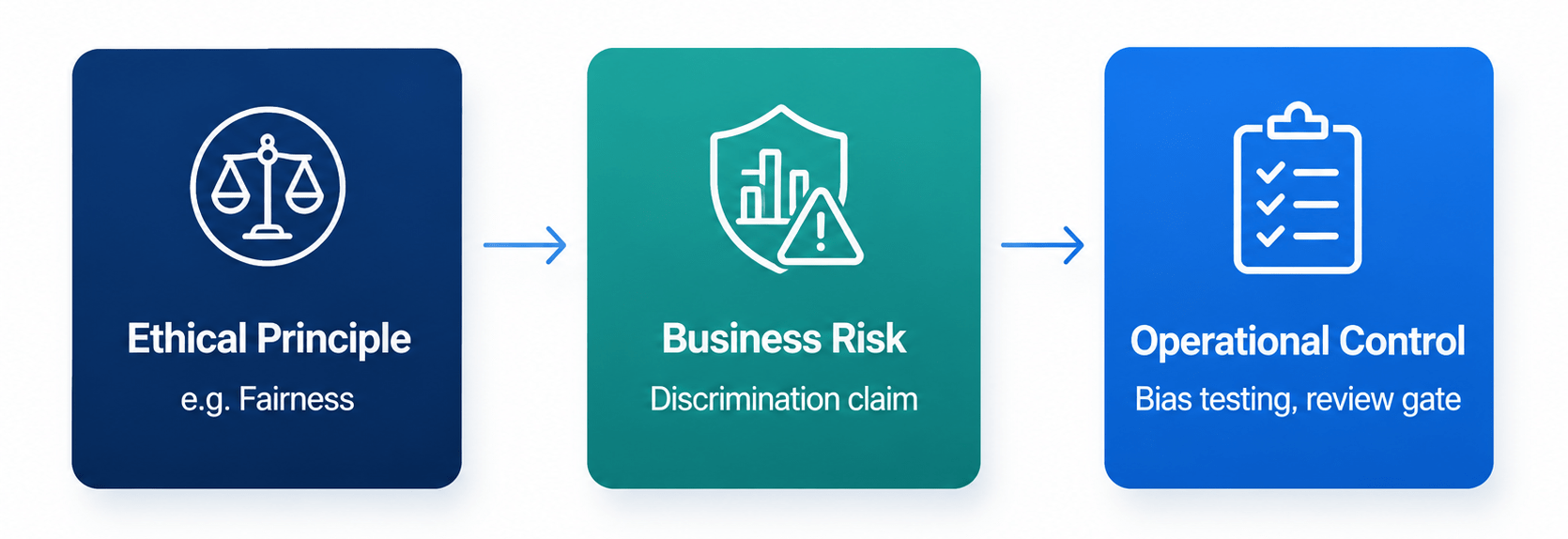 The figure illustrates how ethical AI principles are translated into practical governance through business risks and operational controls.
- Linking each principle to a specific risk helps organizations prioritize governance efforts.
- Defining corresponding controls turns ethical commitments into measurable, auditable practices.
Takeaway: AI ethics concerns are a business-risk category with four layers – ethics, governance, risk management, and compliance. Treat unethical AI as a multi-category harm, and use materiality factors, not intuition, to judge which use cases need the strongest controls.
2. The Core AI Ethics Risks Businesses Must Manage
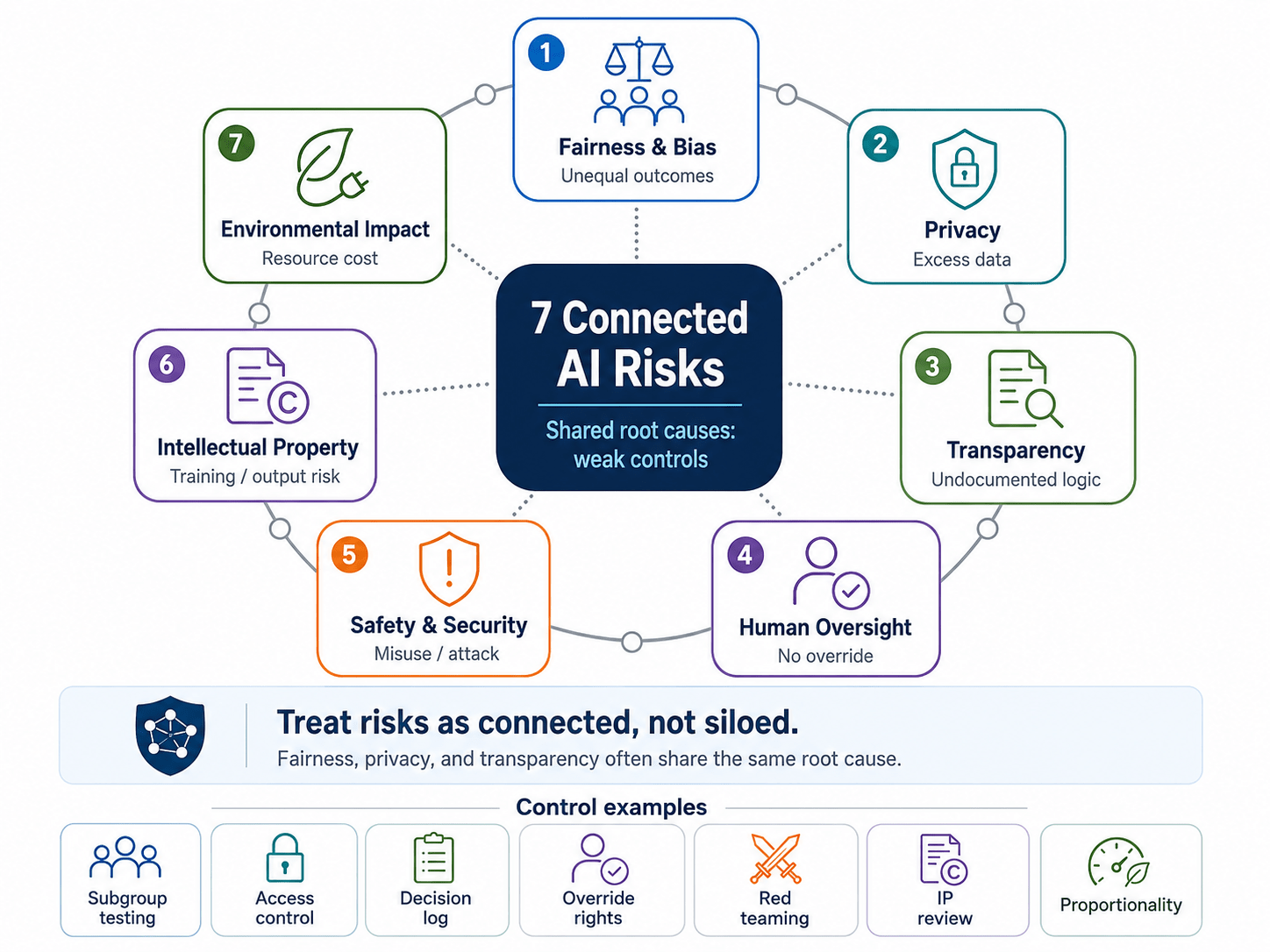
Seven risk categories cover the ethical risk surface most businesses face: fairness, privacy, transparency, human oversight, safety, intellectual property, and environmental impact. These risks interconnect. A privacy failure can also create a fairness failure if the data collected skews toward one group.
2.1 Fairness, bias, and discrimination
AI bias enters a system through four channels: biased training data, flawed measurement of outcomes, model design choices, and deployment conditions the model was never tested against. ProPublica’s investigation into the COMPAS recidivism tool found the algorithm misclassified Black defendants as high risk at a higher rate than white defendants, a widely cited example of measurement bias compounding data bias. Fairness has no single universal metric; businesses must define which fairness definition fits their context and document that choice.
2.2 Privacy, data protection, and surveillance
AI systems that process personal data, biometric identifiers, or workplace monitoring feeds create privacy risk whenever collection exceeds purpose, consent is weak, or access controls are loose. Clearview AI’s practice of scraping billions of photos without consent, which the ACLU challenged in court, shows how a technically capable system can still violate privacy expectations and trigger legal action. Ethical privacy expectations and jurisdiction-specific legal obligations are related but not identical; businesses must satisfy both.
2.3 Transparency, explainability, and accountability
Explainability means a business can give a person a understandable reason for an AI-driven decision that affects them. Model explainability, user disclosure, decision documentation, and organizational accountability are four separate requirements, not one technical feature. An accountability chain should run from business owner to model owner to reviewer to a named escalation owner, so no decision lacks a responsible person.
2.4 Human oversight and overreliance on automated decisions
Businesses can choose among three oversight models: human-in-the-loop, where a person approves each decision; human-on-the-loop, where a person supervises and can intervene; and human-out-of-the-loop, where the system acts without a check. Higher-stakes decisions need stronger oversight models. Automation bias, where people over-trust an AI output and stop scrutinizing it, undermines even a well-designed oversight model unless reviewers keep the authority and training to challenge the system.
2.5 Safety, security, and malicious misuse
Safety risk covers accidental harm, system failure, adversarial attack, and intentional misuse in a single category, because the business response, monitoring, testing, and incident response, overlaps across all four. Deepfakes and AI-generated misinformation sit inside this category as examples of misuse rather than as a separate concern. Businesses that treat AI safety and cybersecurity as connected disciplines, rather than separate teams, close gaps faster; see how SmartDev’s approach to AI-driven cyber defense applies this principle.
2.6 Intellectual property and content provenance
Generative AI creates two distinct IP risk zones: input risk, from training or prompting with copyrighted or confidential material, and output risk, from distributing AI-generated content that resembles protected work. Businesses should treat these as separate review steps rather than one blanket policy, and involve legal counsel for jurisdiction-specific questions rather than assuming a single global answer.
2.7 Environmental and societal impact
Large model training and inference consume meaningful electricity and water for cooling. Businesses should treat environmental cost as a proportionality question: does the expected business value of a given model justify its resource cost, compared with a smaller model or a more efficient deployment pattern? Avoid citing unverified emissions figures; instead request disclosures directly from your AI infrastructure and model providers.
| Risk | Primary harm | Example trigger | Control category |
|---|---|---|---|
| Fairness & bias | Unequal outcomes | Unrepresentative training data | Subgroup testing, disparate-impact review |
| Privacy & surveillance | Rights violation | Excess data collection | Data minimization, access control |
| Transparency | Loss of trust, non-compliance | Undocumented model logic | Explainability report, decision log |
| Human oversight | Unchecked automated harm | No override authority | Review workflow, override rights |
| Safety & security | Physical, financial, reputational harm | Adversarial input, misuse | Red teaming, incident response |
| Intellectual property | Legal claim, lost protection | Unreviewed training data or output | IP review checklist, human curation |
| Environmental impact | Resource cost, reputational risk | Oversized model for a simple task | Proportionality check, provider disclosure |
Takeaway: Treat the seven risk categories as connected, not siloed. A fairness gap, a privacy gap, and a transparency gap often share the same root cause: an AI system deployed without documented, tested controls.
3. How to Assess AI Ethics Risk Before Deployment
A four-factor assessment tells a team what level of governance a specific AI use case needs, before deployment, instead of applying one-size-fits-all controls to everything. This is a decision framework, not a legal certification.
A practical AI use-case risk assessment
Ask four questions for every use case: Who is affected, and how many people? What decision does the system influence, and can a wrong outcome be reversed? What data does it use, and how sensitive is that data? How autonomous is the system, and how much does a human control the final action? Answering all four, backed by a data map and model documentation, produces a defensible risk score rather than a guess.
Risk levels: low-, medium-, and high-impact AI use cases
| Risk level | Example | Documentation needed | Review threshold | Monitoring |
|---|---|---|---|---|
| Low | Internal marketing copy draft | Basic use-case log | Team lead sign-off | Periodic spot check |
| Medium | Internal analytics dashboard with automated flags | Model card, data source list | Product owner + one reviewer | Quarterly metric review |
| High | Loan approval, hiring screen, medical triage | Full impact assessment, bias test results | Legal, compliance, and independent reviewer | Continuous monitoring, incident alerts |
These examples are illustrative starting points; they are not universal regulatory classifications, and your own legal or compliance team should confirm the applicable category for a specific use case.
When independent review or escalation is needed
Escalate a use case to legal, compliance, privacy, security, or an independent ethics reviewer whenever any of these triggers apply: the system affects a legally protected group, the decision is hard to reverse, the data includes health, financial, or biometric information, or the system operates with limited human control. SmartDev’s AI consulting services and AI proof-of-concept engagements both build this triage step in before a pilot moves toward production.
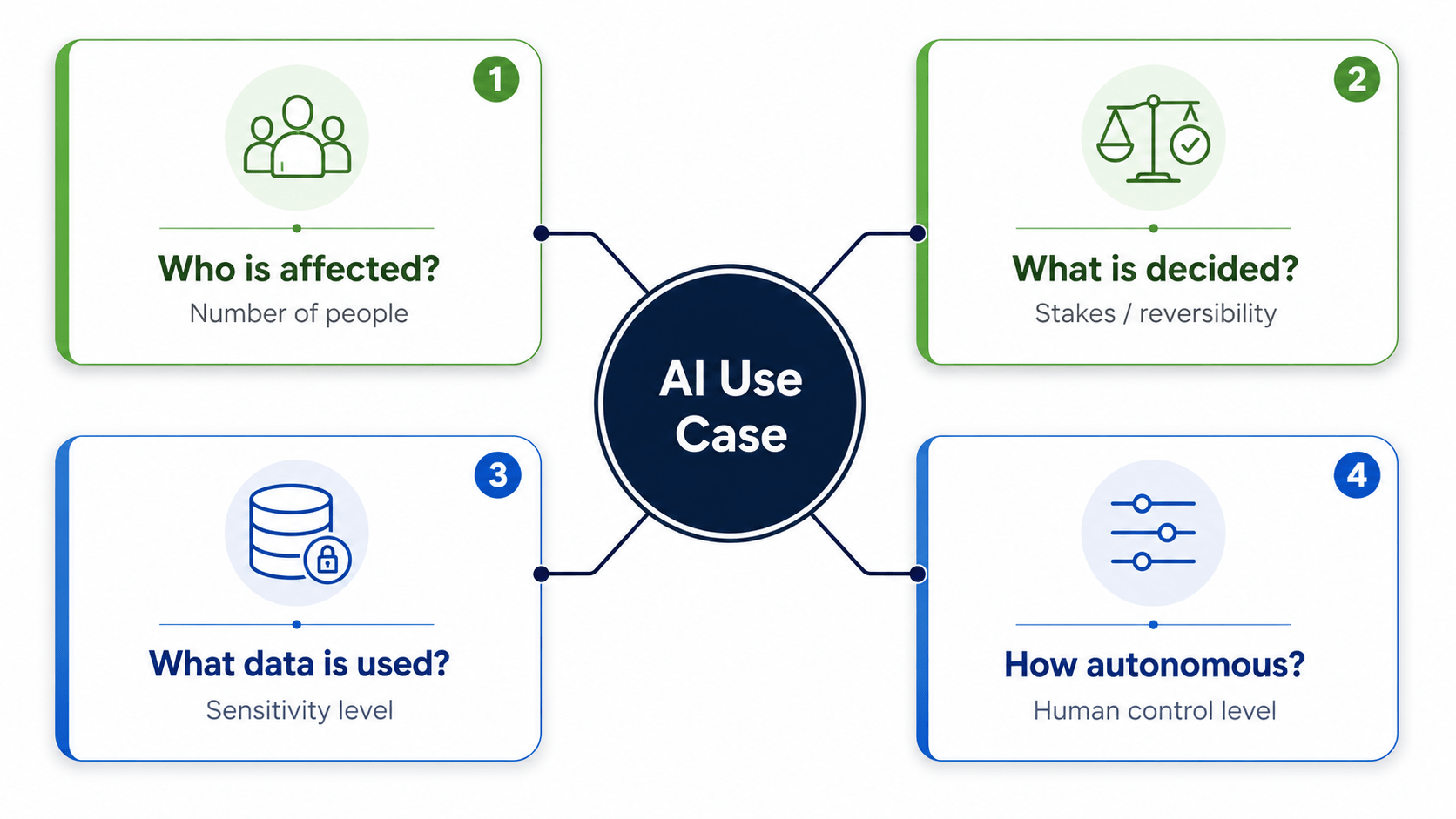 The figure presents a practical framework for assessing AI use case risk across four key dimensions.
- Evaluating impact, decision stakes, data sensitivity, and human autonomy provides a structured basis for risk classification.
- A consistent assessment helps organizations apply governance controls that are proportionate to the level of risk.
Takeaway: Score every AI use case against people affected, decision stakes, data sensitivity, and autonomy before deployment. Let the score, not habit or urgency, decide whether the use case needs basic sign-off or independent review.
4. Responsible AI Governance: From Principles to Operating Practice
Responsible AI governance is a lifecycle discipline that runs from defining a use case through monitoring it after launch, not a policy document or a one-time model review. The lifecycle has eight stages: define, assess, design, test, approve, deploy, monitor, and respond.
Establish governance, ownership, and accountability
Assign a named owner to each role: executive sponsor, product owner, data or model owner, legal and compliance, security, risk, and an independent reviewer for high-impact cases. Undefined ownership is the most common governance failure; a responsibility matrix closes that gap by naming exactly who signs off at each stage.
Build ethics, privacy, and security into AI design
Design-time controls connect requirements gathering, data governance, privacy-by-design, and threat modeling before a line of model code exists. Set the intended-use boundary explicitly, so the team knows which use cases the model was built and tested for, and which fall outside that boundary. SmartDev’s data engineering governance practices apply this same design-first discipline to the pipelines that feed a model.
Test for bias, reliability, and harmful outcomes
Before release, test performance by subgroup, run stress tests against edge cases, red-team the system for adversarial misuse, analyze error patterns, and complete a dedicated safety evaluation. Treat this evidence the same way you treat security testing: a required gate, not an optional step. SmartDev’s machine learning development services build this evidence collection into the delivery pipeline.
Design effective human oversight and appeal paths
Give reviewers real override authority, not a rubber-stamp button, and set clear thresholds for when a case must reach a human. Build an appeal path so an affected person can contest an automated decision, and keep records of every override so the team can spot patterns in what the model gets wrong.
Govern data, models, vendors, and third-party tools
Vendor AI carries the same risk as internally built AI, plus a due-diligence gap. Assess vendors on data handling, security posture, permitted use restrictions, documentation quality, monitoring access, and contractual accountability before signing. SmartDev’s AI tech stack guide covers how to evaluate models, APIs, and platform vendors as part of one coherent architecture rather than isolated purchases.
Monitor, audit, document, and respond after launch
Governance continues after deployment through drift monitoring, periodic audits, documented incident response, and a defined model retirement process. SmartDev’s MLOps services and the compliance audit trail approach used in regulated workflow automation both show how monitoring and audit evidence work together in production.
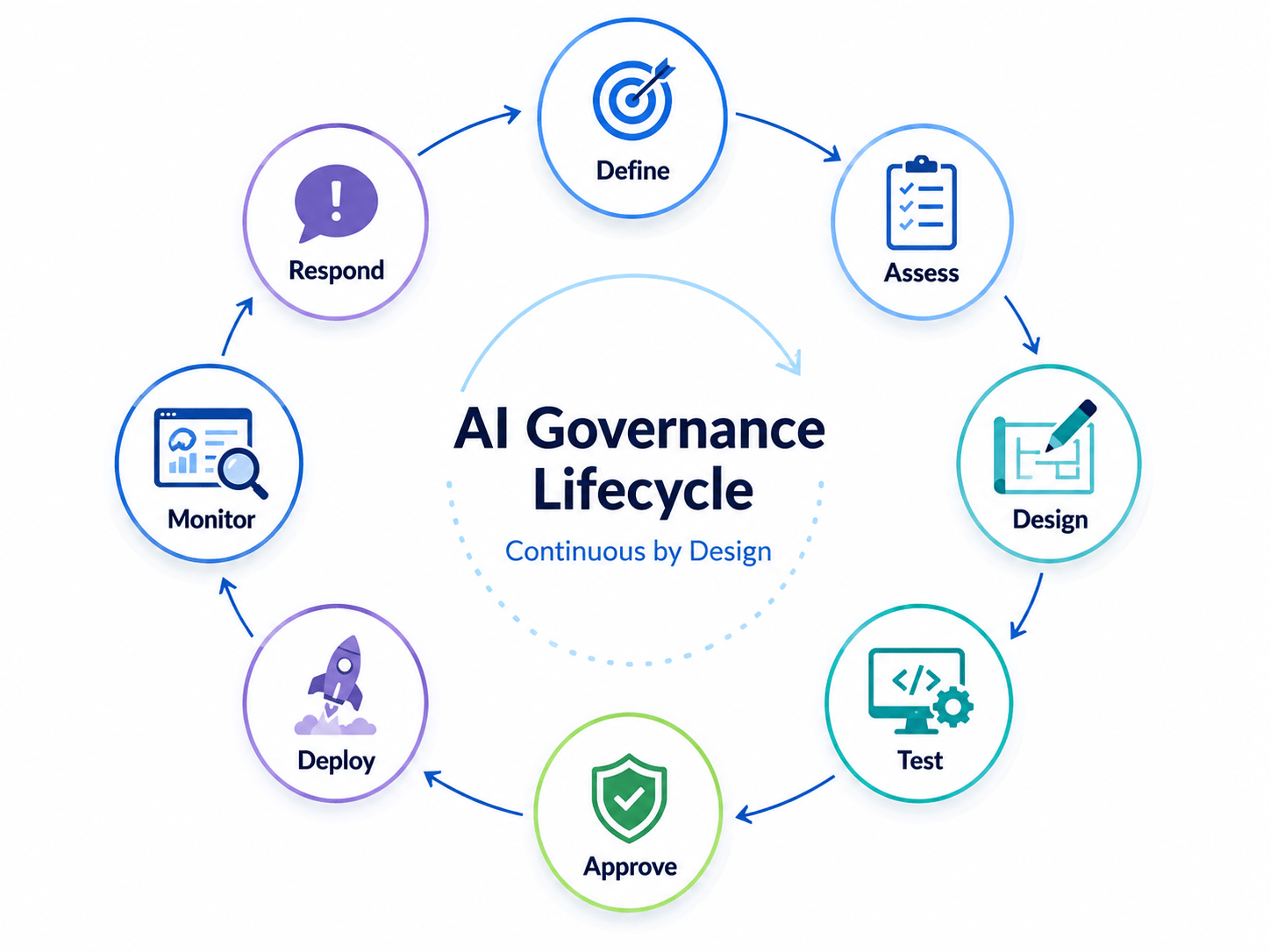 The figure illustrates the ethical AI lifecycle as a continuous governance process spanning eight interconnected stages.
- Governance extends beyond deployment, with monitoring and incident response continuously informing future development and risk assessments.
- Treat each stage as an ongoing control point to ensure AI systems remain compliant, trustworthy, and adaptable throughout their lifecycle.
Takeaway: Responsible AI governance succeeds when every stage, from definition to post-launch monitoring, has a named owner and documented evidence. A policy statement without lifecycle ownership will not hold up under audit or incident review.
5. Generative AI: Ethics Concerns Businesses Need to Address Now
Generative AI changes the speed and scale of content creation, but it does not remove accountability for output quality, data handling, or use-case design. Not every GenAI use case carries equal risk; an internal brainstorming assistant and a customer-facing legal-advice chatbot need very different controls.
Hallucinations, misinformation, and deepfakes
Separate three distinct problems: inaccurate output a model generates without intent to deceive, deceptive content a person creates using AI tools, and deliberate impersonation such as a deepfake video or voice clone. Each needs a different control: fact-checking and citation requirements for the first, content policy enforcement for the second, and authentication or detection tooling for the third.
Confidential data, prompts, and model access
Sensitive information can leak through prompts sent to external models, through logs retained by a vendor, through connected integrations, or through overly broad permissions granted to an AI tool. Review each pathway separately, and restrict what data classes are allowed to reach a third-party model at all.
Copyright, training data, and AI-generated content
Apply a decision framework with four checkpoints: does your business have rights to the inputs, has a human reviewed the output, is attribution required, and is the output intended for commercial use? Route uncertain cases to legal counsel rather than assuming generated content is automatically safe to publish or resell.
Prompt injection, misuse, and security controls
Model-level safeguards alone will not stop misuse. According to the OWASP Top 10 for LLM Applications, prompt injection remains the top-ranked risk for AI applications because a model cannot always distinguish a legitimate instruction from an instruction hidden inside untrusted content. Application-level defenses, such as input filtering, least-privilege tool access, and human approval for high-risk actions, matter as much as the model itself.
Human review for customer-facing and high-stakes outputs
Decide in advance which output categories may publish automatically, which need a human editor first, and which are prohibited from automation entirely. Customer-facing financial, medical, or legal content should default to mandatory human review until your evidence shows the model performs reliably within a defined boundary.
| GenAI risk | Practical safeguard |
|---|---|
| Hallucinated or false output | Retrieval grounding, citation checks, fact-review step |
| Confidential data exposure | Prompt data controls, access restriction, log retention limits |
| Copyright and provenance | Input rights check, human curation, disclosure of AI use |
| Prompt injection and misuse | Input/output filtering, least-privilege tools, adversarial testing |
| Unreviewed high-stakes output | Mandatory human review gate before publication |
SmartDev’s generative AI development services build these five safeguards into delivery from day one, and the guide to choosing between a custom model and a third-party AI API helps teams weigh control against speed when selecting a GenAI architecture.
Takeaway: GenAI risk is not uniform across use cases. Map each generative AI application against the five risk areas above, and set the human-review requirement based on how customer-facing and high-stakes the output actually is.
6. AI Ethics in High-Impact Business Contexts
The same seven risk categories apply everywhere, but the consequences, affected people, data sensitivity, and ability to correct harm, change sharply across industry context.
| Context | Primary harm type | Key risk trigger | Minimum safeguard |
|---|---|---|---|
| Hiring & workforce | Discriminatory screening, surveillance overreach | Automated resume ranking, monitoring tools | Human final decision, disclosed monitoring policy |
| Healthcare | Misdiagnosis, unequal care access | Underrepresented training data | Clinician review, documented model validation |
| Financial services | Unfair credit or fraud decisions | Proxy variables for protected traits | Bias audits, explainable decision output |
| Public sector & education | Wrongful denial of services, biased scoring | Opaque scoring models | Appeal process, independent oversight |
| Recommendation & marketing systems | Manipulation, misinformation amplification | Engagement-optimized ranking | Content moderation, transparency reporting |
Financial institutions face some of the sharpest scrutiny because credit and fraud decisions are high-stakes and heavily regulated; SmartDev’s work on safer compliance screening workflow design and the BFSI/Fintech industry practice show how AI-driven screening keeps human review anchored in the workflow. In healthcare, misdiagnosis risk is why validation and clinician review carry more weight than speed; see how the Healthcare & Medical Services industry page frames these constraints for AI-powered tools.
Takeaway: Do not apply one control level across every industry. Match safeguard strength to the harm type and correction difficulty in each specific context.
7. AI Ethics Failures: What Businesses Can Learn
Most well-documented AI ethics failures are governance failures as much as model failures. Each case below teaches a distinct, reusable lesson.
Bias and discriminatory outcomes
Amazon’s hiring algorithm case, described in Section 1, shows that bias testing must happen before deployment, not after complaints arrive. The lesson: run subgroup performance tests as a required release gate, not an optional audit.
Privacy, biometric data, and surveillance
Clearview AI’s facial-recognition database, built by scraping billions of photos without consent, drew legal action across multiple jurisdictions, as the ACLU’s case record documents. The lesson: technical feasibility is not permission. Biometric and surveillance systems need explicit consent and legal review before collection begins, not after a product ships.
Misleading AI capabilities and unsafe automation
Semi-autonomous driving systems involved in fatal crashes highlighted the gap between what a system can actually do and how it is marketed to users. The lesson: communicate system limitations clearly, and never let marketing language outrun documented, tested capability.
Lessons for governance, transparency, and accountability
| Case pattern | Missing control | Governance lesson |
|---|---|---|
| Biased hiring algorithm | Pre-deployment subgroup testing | Make bias testing a mandatory release gate |
| Non-consensual biometric database | Consent and legal review | Require legal sign-off before biometric data collection |
| Overstated automation capability | Clear limitation disclosure | Align product marketing with tested system boundaries |
Takeaway: Every recurring failure traces back to a missing control that existed as a known best practice at the time. Build your control checklist from these documented lessons rather than waiting to learn them firsthand.
8. AI Regulation, Standards, and Governance Frameworks
Legal obligations, government guidance, and voluntary standards form three distinct layers, and confusing them creates compliance gaps. Standards can support governance, but they do not substitute for legal advice or jurisdiction-specific compliance.
Laws and regulatory obligations: what varies by jurisdiction
The EU AI Act takes a risk-based approach, banning unacceptable-risk practices and imposing strict obligations on high-risk systems. Under the revised implementation timetable, obligations for stand-alone high-risk systems apply from December 2027, and obligations for high-risk systems embedded in other products apply from August 2028, according to the Act’s classification guidance. Requirements vary sharply by jurisdiction and sector, so avoid treating any single regime as a global compliance template.
Government principles and international guidance
Non-binding frameworks still shape procurement rules, enforcement priorities, and public expectations. The UNESCO Recommendation on the Ethics of Artificial Intelligence, adopted by member states as the first global standard-setting instrument on AI ethics, influences how national policies are drafted even where it carries no direct legal force.
AI management, risk, and ethics standards
ISO/IEC 42001 is a certifiable management-system standard that structures how an organization governs AI risk, impact assessment, and third-party oversight. Certification demonstrates a disciplined process; it does not, by itself, prove compliance with a specific law such as the EU AI Act.
| Layer | Example | Legally binding? | Business role |
|---|---|---|---|
| Regulation | EU AI Act | Yes, in scope jurisdictions | Mandatory compliance |
| Government guidance | UNESCO Recommendation | No | Shapes policy and procurement expectations |
| Voluntary standard | ISO/IEC 42001 | No, unless contractually required | Structures internal governance evidence |
Maintaining an AI regulatory watchlist
Track regulatory exposure by geography, sector, use case, and vendor, and assign an owner to review updates on a fixed cadence. SmartDev’s coverage of AI-powered regulatory change monitoring shows how financial institutions turn this into a continuous, auditable process instead of a quarterly scramble.
Takeaway: Keep law, guidance, and standards in separate columns of your compliance tracker. A standard proves process discipline; only a jurisdiction-specific legal review confirms compliance.
9. Building a Responsible AI Roadmap
A responsible AI program starts with use-case inventory and risk triage, not a broad ethics statement. The roadmap below sequences the practices from earlier sections into a phased plan with visible dependencies.
Prioritize the highest-risk use cases
Inventory every active and planned AI use case, then apply the four-factor assessment from Section 3 to rank them. Address high-impact use cases first; low-risk use cases can follow a lighter governance track.
Set minimum controls before production deployment
Require, at minimum, a named owner, documented testing evidence, and a human-review path for any use case ranked medium or high risk before it reaches production.
Define evidence, documentation, and review cadence
Decide what documentation each risk tier requires and how often it gets reviewed. High-risk use cases need continuous monitoring; low-risk use cases can rely on periodic spot checks.
Measure whether governance is working
Track leading indicators such as the percentage of use cases with a completed risk assessment, and lagging indicators such as incident counts and time-to-resolution, to see whether the program is actually reducing risk.
| Phase | Key activity | Depends on |
|---|---|---|
| 1. Inventory & triage | Catalog use cases, apply four-factor assessment | Section 3 method |
| 2. Minimum controls | Ownership, testing evidence, review gate | Phase 1 risk ranking |
| 3. Documentation cadence | Evidence standards per risk tier | Phase 2 controls |
| 4. Measurement | Leading and lagging governance metrics | Phases 1–3 in operation |
SmartDev supports each phase directly, from AI consulting for triage and design, through custom AI development for building controlled systems, to MLOps services for ongoing monitoring.
Takeaway: Sequence your roadmap: triage first, minimum controls second, documentation cadence third, measurement fourth. Skipping ahead to broad policy statements without this sequence usually produces governance that looks complete but is not operational.
10. Emerging AI Ethics Issues to Monitor
Track emerging AI ethics issues through the same governance foundations you already use: accountability, evidence, human control, and incident readiness.
Autonomous systems and safety-critical deployment
As AI systems take on more autonomous action in safety-critical settings, the same oversight-model choice from Section 2.4 becomes more consequential. Businesses deploying autonomous systems should document, in advance, exactly when a human must regain control.
AI agents, autonomy, and loss of control
AI agents that can call tools, access data, and take multi-step action independently raise a new class of control question: how much authority does an agent hold before a human checkpoint is required? SmartDev’s step-by-step guide to building AI agents addresses this scoping question directly during design.
Advanced AI, alignment, and broader societal risk
Long-horizon questions about highly capable AI systems remain unresolved research topics. Businesses should track this area for awareness without treating open research questions as settled operational guidance today.
Evolving questions around AI, identity, and human trust
As conversational AI becomes more capable, businesses should disclose clearly when a user is interacting with an AI system, and avoid designs that could mislead a person into believing they are speaking with a human.
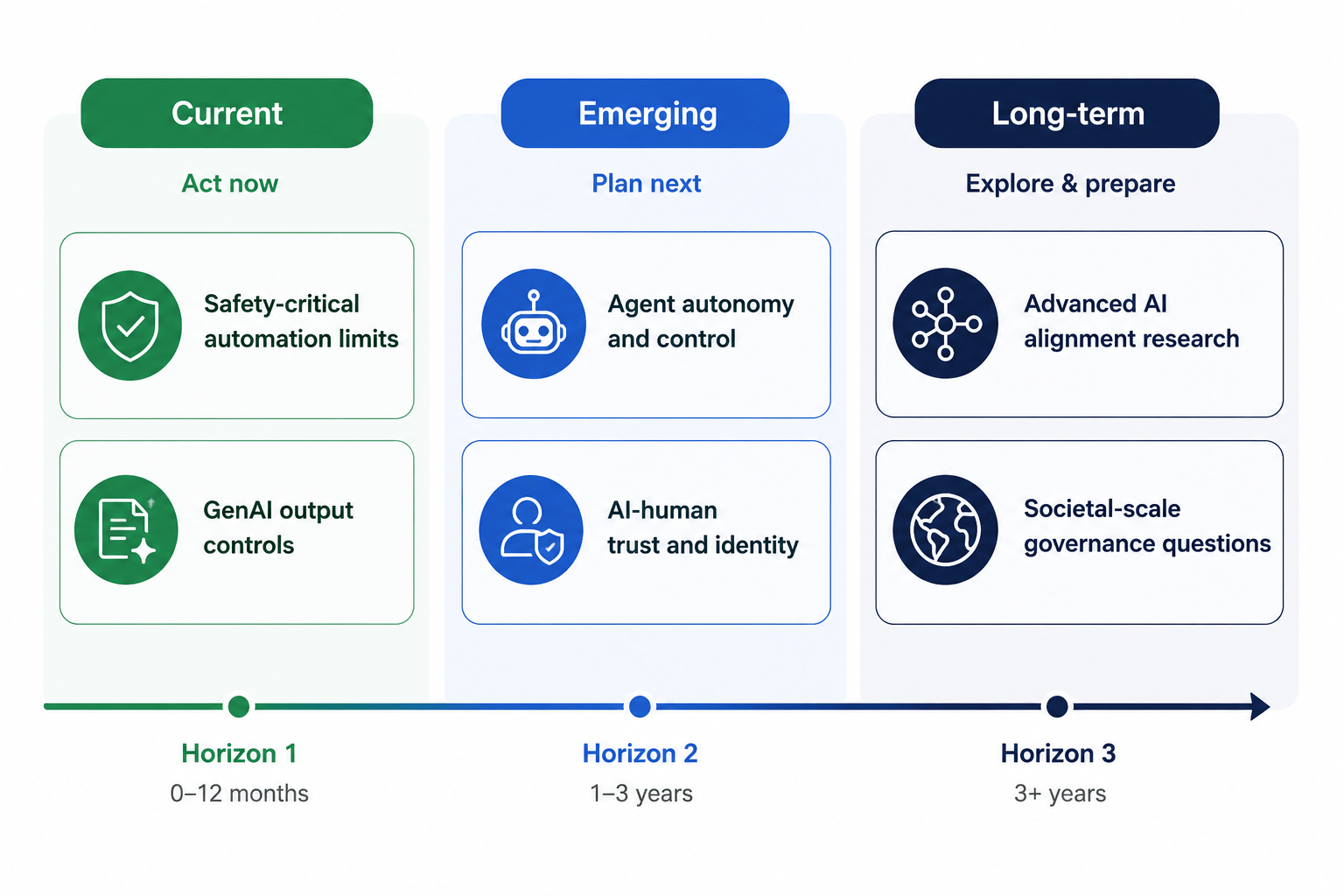 The figure organizes ethical AI priorities into current, emerging, and long-term challenges, helping organizations align governance efforts with evolving risk horizons.
What are the main ethical concerns in AI?
The main concerns are bias and discrimination, privacy and surveillance, weak transparency and accountability, gaps in human oversight, safety and security failures, intellectual property exposure, and environmental impact, detailed in Section 2.
Why is bias in AI a business risk?
Biased AI produces unequal outcomes, creates legal liability under anti-discrimination law, damages brand trust, and weakens the quality of decisions built on skewed data, as Section 2.1 explains.
What is responsible AI governance?
Responsible AI governance is the lifecycle discipline of defining, assessing, designing, testing, approving, deploying, monitoring, and responding to an AI system, with named ownership at each stage, covered fully in Section 4.
Which AI use cases need human oversight?
Use cases affecting many people, carrying high decision stakes, using sensitive data, or running with high autonomy need the strongest human oversight, as Sections 3 and 4 describe.
How can businesses reduce privacy and security risks when using generative AI?
Limit what data reaches prompts and logs, restrict model and plugin access, apply defenses against prompt injection, and require human review before high-stakes output ships, as Section 5 outlines.
Are AI standards enough for legal compliance?
No. Standards such as ISO/IEC 42001 support governance discipline, but they do not replace jurisdiction-specific legal obligations, as Section 8 explains.
Conclusion
Responsible AI is not a program separate from business delivery. It is the discipline of making AI decisions accountable, safe, fair, and controllable at every stage, from the first use-case idea to the system running quietly in production a year later. Risk identification, risk triage, lifecycle governance, generative AI controls, and regulatory awareness all connect into one operating model, not five unrelated initiatives.
Strong governance does not slow AI adoption down. It gives your organization the evidence and confidence to deploy valuable AI systems while keeping the accountability that protects your customers, your employees, and your business.
Ready to Strengthen Your AI Governance?
Understanding where your AI systems create the greatest governance and compliance risks is the first step toward responsible AI adoption. Contact SmartDev to assess your AI use cases, identify governance gaps, and develop a practical roadmap for secure, compliant AI. Whether you need AI governance consulting, proof-of-concept validation, or end-to-end AI implementation, our team can help you deploy AI with confidence.