

TL;DR:
- An AI control plane is a governance layer that sits above your AI agents — managing permissions, policies, and observability across multiple deployed models. It is not a model; it is infrastructure.
- Most organizations asking this question do not yet need a control plane. They need better context architecture, structured escalation logic, and observable workflows.
- The distinction matters: building a control plane when you need better engineering adds cost and complexity without solving the underlying problem.
Introduction
In December 2025, Forrester formally recognized the AI agent control plane as an emerging enterprise infrastructure category — a layer above individual AI agents designed to enforce policies, manage permissions, route workflows, and maintain observability across an organization’s entire AI deployment. The framing arrived at exactly the right moment. Enterprise AI deployments had grown complex enough that the question was becoming operationally real: how do you govern multiple agents running across multiple systems, making decisions that affect real data and real processes, with nobody watching every step?

The question is important. The answer, for most organizations currently evaluating it, is more nuanced than the vendor conversation suggests.
This article explains what an AI control plane actually is, when the architecture is genuinely warranted, and when the same problems can be solved at lower cost and risk through better engineering discipline — without an additional governance layer sitting on top of a system that has not yet addressed the foundational issues underneath it.
What an AI Control Plane Actually Is
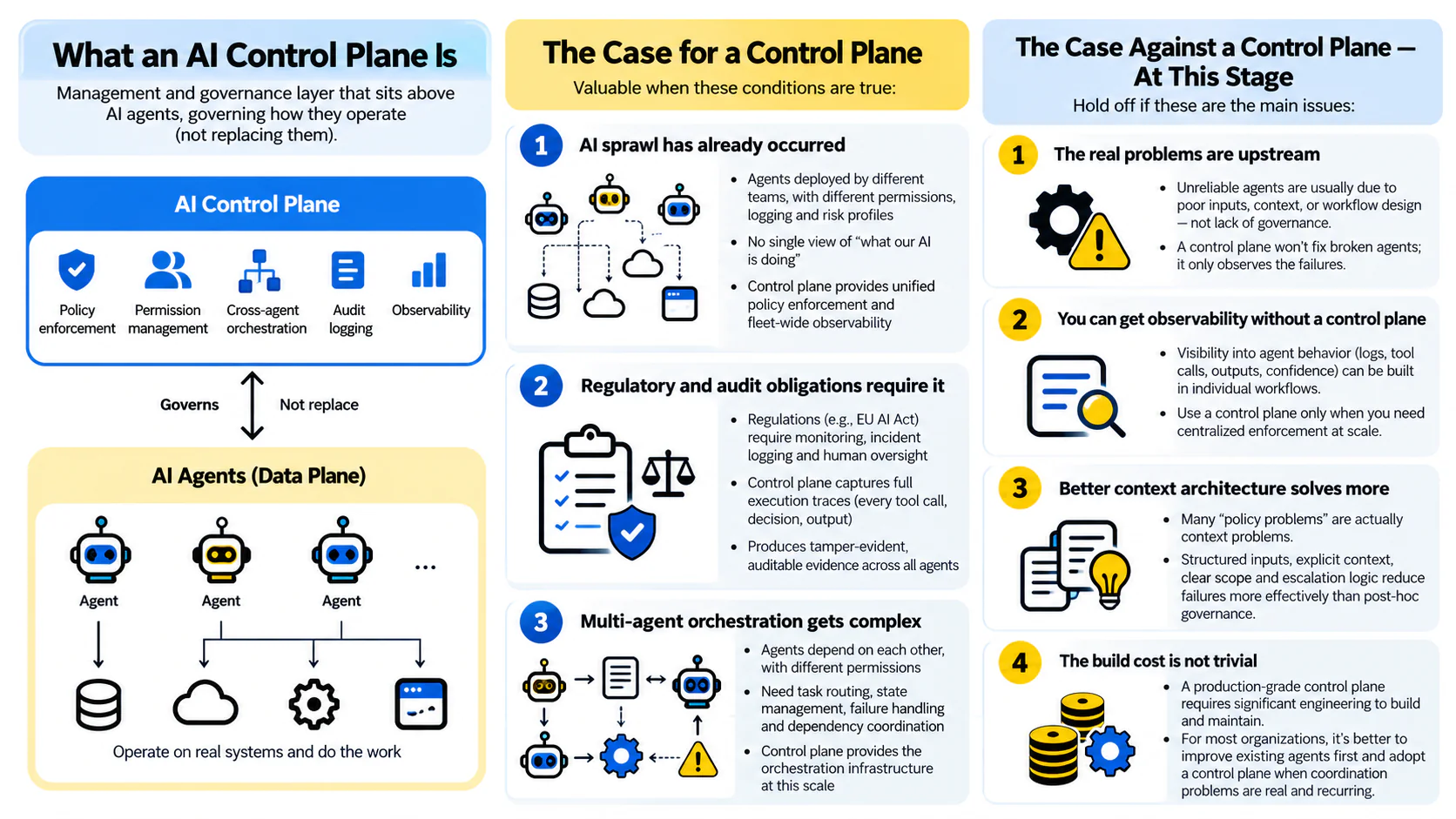
The term gets used loosely. In its most rigorous definition, an AI control plane is the management and governance infrastructure that sits above the data plane — the layer of AI agents actually doing work. It handles policy enforcement, permission management, cross-agent orchestration, audit logging, and system-wide observability. It does not replace the agents. It governs how the agents operate.
Deloitte’s analysis of the category frames it as analogous to the network control plane in traditional infrastructure: a centralized management layer that makes decisions about how traffic flows, what is permitted, and how the system responds to anomalies — without processing the traffic itself.
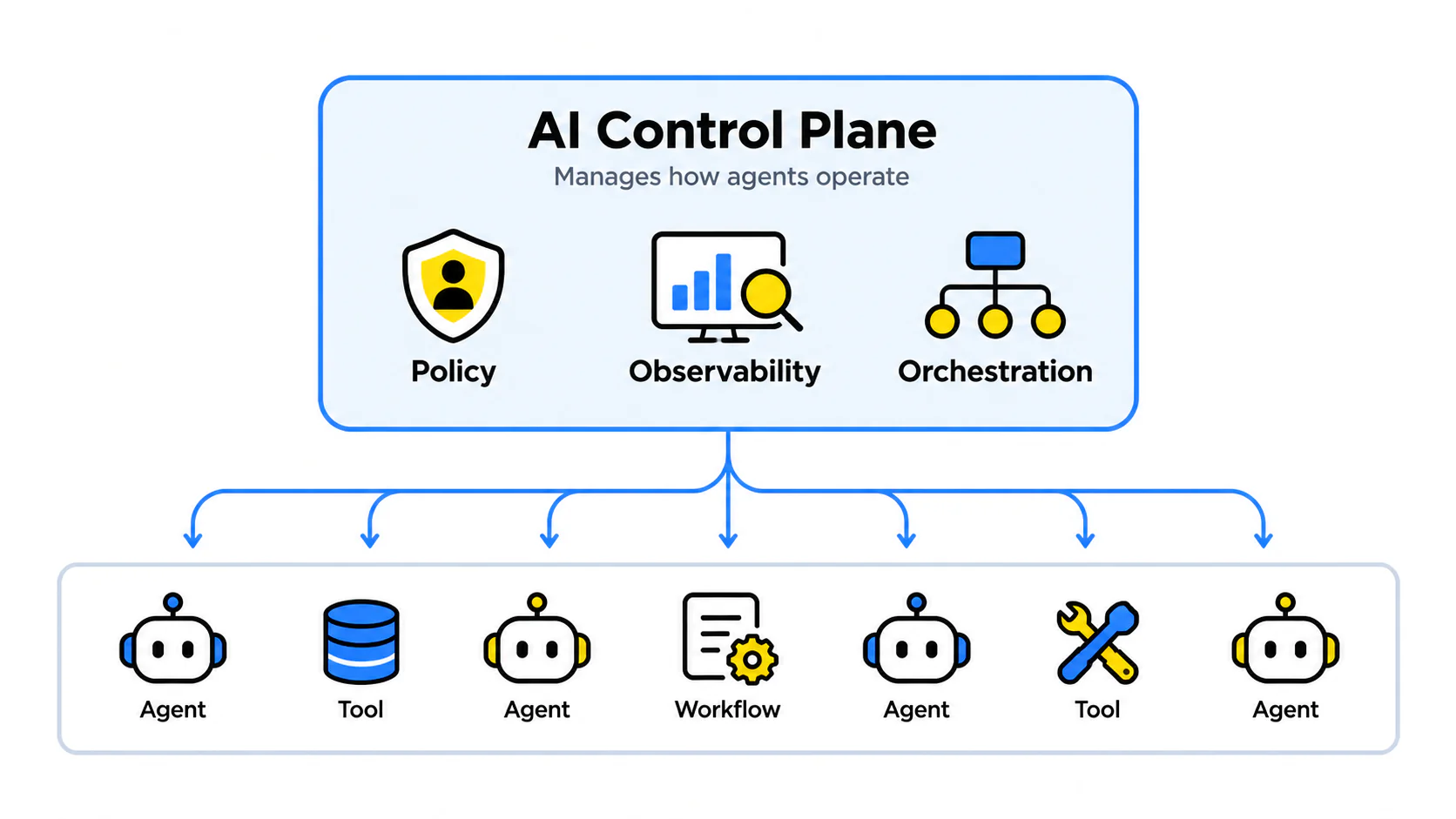
In practice, a control plane typically provides three categories of function. Policy enforcement determines what each agent is allowed to do: which systems it can write to, which actions require human approval, which data it can access. Observability captures what each agent actually did: full execution traces, tool calls, reasoning outputs, and decision logs across the entire fleet. Orchestration coordinates multi-agent workflows: routing tasks between agents, managing dependencies, handling failures, and maintaining state across a process that no single agent owns end to end.
These are genuine infrastructure problems. But they are infrastructure problems for a specific scale and complexity of deployment.
The Case for a Control Plane
When AI Sprawl Has Already Occurred
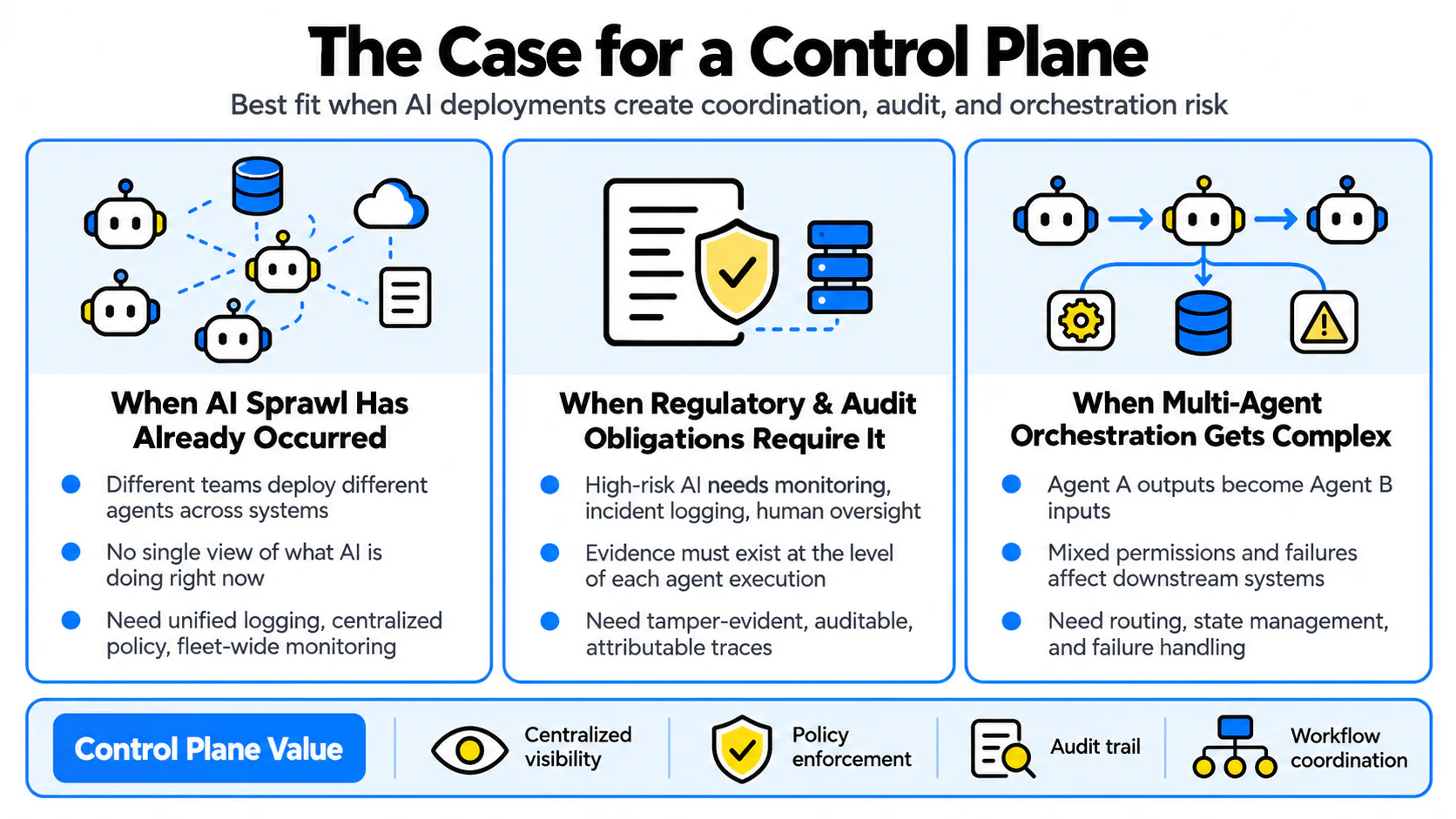
The control plane argument is strongest in organizations where AI agents have proliferated faster than governance frameworks. Different teams have deployed different agents against different systems, each with its own permission set, its own logging approach, and its own implicit risk profile. The question “what is our AI doing right now, across all of our systems?” does not have a clean answer because no single layer has visibility into all of it.
This is a genuine coordination problem, and patching individual agent configurations does not solve it at scale. A control plane’s cross-agent observability — unified logging, centralized policy enforcement, fleet-wide monitoring — addresses the problem at the right architectural level. Without it, AI sprawl tends to produce the kind of production incidents that Forrester’s agent control plane research flags as increasingly common: agents operating with broader permissions than intended, decisions propagating across downstream systems before anyone reviews them, no single team with accountability for cross-agent behavior.
When Regulatory and Audit Obligations Require It
The EU AI Act’s requirements for high-risk AI systems include post-market monitoring, incident logging, and evidence that human oversight was maintained throughout the system’s operation. Those requirements are architectural, not procedural. An organization cannot satisfy them by adding documentation around a system that was not built to produce it. The logging must exist at the level of the agent’s execution — every tool call, every decision, every output — and it must be tamper-evident, auditable, and attributable.
A control plane that captures full execution traces across all deployed agents produces this evidence as a natural output of operation, rather than requiring the client team to instrument each agent individually and reconcile the logs afterward. For organizations operating high-risk AI systems under regulatory obligation, this audit trail capability alone can justify the architectural investment.
When Multi-Agent Orchestration Gets Complex
Single-agent deployments are relatively manageable without dedicated governance infrastructure. An agent with a defined scope, a documented permission set, and an observable output is not hard to monitor with standard tooling. The complexity curve changes sharply when multiple agents interact: when Agent A’s output becomes Agent B’s input, when different agents have different permission levels operating on the same dataset, when a failure in Agent C affects the state that Agent D receives.
At this level of multi-agent orchestration complexity, a control plane’s orchestration capabilities — routing, state management, failure handling, dependency coordination — address structural problems that individual agent configuration cannot. The question is whether your current deployment is actually operating at this level of complexity, or whether you are building for a scale that does not yet exist.
The Case Against a Control Plane — At This Stage
The Governance Problem Is Often Upstream
The most common situation in which organizations begin evaluating control plane infrastructure is not complexity at scale — it is that individual agents are not performing reliably, and the assumption is that a governance layer will stabilize them.
It will not. A control plane that enforces policies on top of agents with poor context architecture, undefined escalation logic, and no structured data layer adds overhead to a broken system. Atlan’s analysis of AI agent failures notes that most agent reliability problems trace to input quality, context debt, and workflow design — not to the absence of fleet-level governance. Fixing those problems requires engineering work at the agent level. A control plane sitting above them does not fix the agent; it observes the agent failing with better instrumentation.
Before reaching for control plane infrastructure, organizations benefit from auditing whether the engineering problems are already there: Are inputs structured before they reach the agent, or is the agent expected to resolve ambiguity on its own? Does the agent have a defined escalation path for low-confidence outputs, or is it expected to produce an answer regardless? Is the agent’s context window managed explicitly, or does it grow unbounded until reasoning degrades? These are engineering questions with engineering answers.
Observability Does Not Require a Control Plane
One of the most common reasons organizations reach for control plane tooling is the need for better visibility into what their agents are doing. That is a legitimate need. It does not necessarily require a full control plane architecture.
Fiddler’s analysis of AI control plane architecture distinguishes between observability — capturing what the system did — and control — enforcing what the system is allowed to do. Observability can be implemented at the individual workflow level without centralized governance infrastructure. Structured logging of tool calls, intermediate outputs, confidence scores, and escalation decisions is achievable through workflow design alone. If the core need is visibility, instrumenting existing workflows may be the right starting point, with control plane infrastructure added when the scale of the deployment genuinely requires centralized enforcement.
Context Architecture Solves More Than You Think
Much of what control plane marketing describes as policy problems are actually context problems. An agent that takes wrong actions because it has insufficient context is not a governance failure — it is an engineering failure in context design. Defining context explicitly, structuring inputs before they reach reasoning steps, managing what the agent knows at each point in a workflow, and setting clear scope boundaries through prompt architecture addresses a large proportion of the reliability problems that prompt organizations to consider control plane tooling.
The 2025 adaptive governance preprint on arXiv documents that structured context management — explicitly defining what information an agent needs and how it should be provided — reduces failure rates in multi-step agentic workflows more reliably than post-hoc policy enforcement. Governance that operates on outputs cannot substitute for architecture that prevents the problem from occurring in the first place.
The Build Cost Is Not Trivial
A production-grade AI control plane is not a product you install — it is infrastructure you build and maintain. It requires engineering work to define the policy model, integrate with existing agent deployments, configure observability pipelines, implement enforcement logic, and maintain the layer as the agents it governs evolve. That is a meaningful operational commitment, both in initial engineering investment and in ongoing maintenance as the AI deployment landscape changes.
For most mid-market organizations currently evaluating their AI governance posture, that investment is better directed at improving the agents that already exist than at building governance infrastructure for a scale of deployment they have not yet reached. The right time to build a control plane is when the coordination problems it solves are real and recurring — not as a preemptive architecture for complexity that has not yet materialized.
Decision Framework: Control Plane vs. Better Engineering
| Diagnostic question | Indicates control plane | Indicates better engineering |
|---|---|---|
| How many agents are deployed? | Dozens, across multiple teams and systems | A few, owned by one team |
| Is there a centralized audit requirement? | Yes — regulatory or enterprise-wide | No — internal quality monitoring is sufficient |
| Are agents interacting with each other? | Yes — multi-agent orchestration with dependencies | No — agents operate independently |
| Where are failures occurring? | Coordination, permissions, cross-agent consistency | Individual agent output quality, context handling |
| Who owns AI governance? | Central function with cross-team authority | Individual teams owning their own deployments |
| What is your timeline for scaling? | Significant agent expansion planned in near term | Stable or modest growth expected |
What Better AI Engineering Actually Means
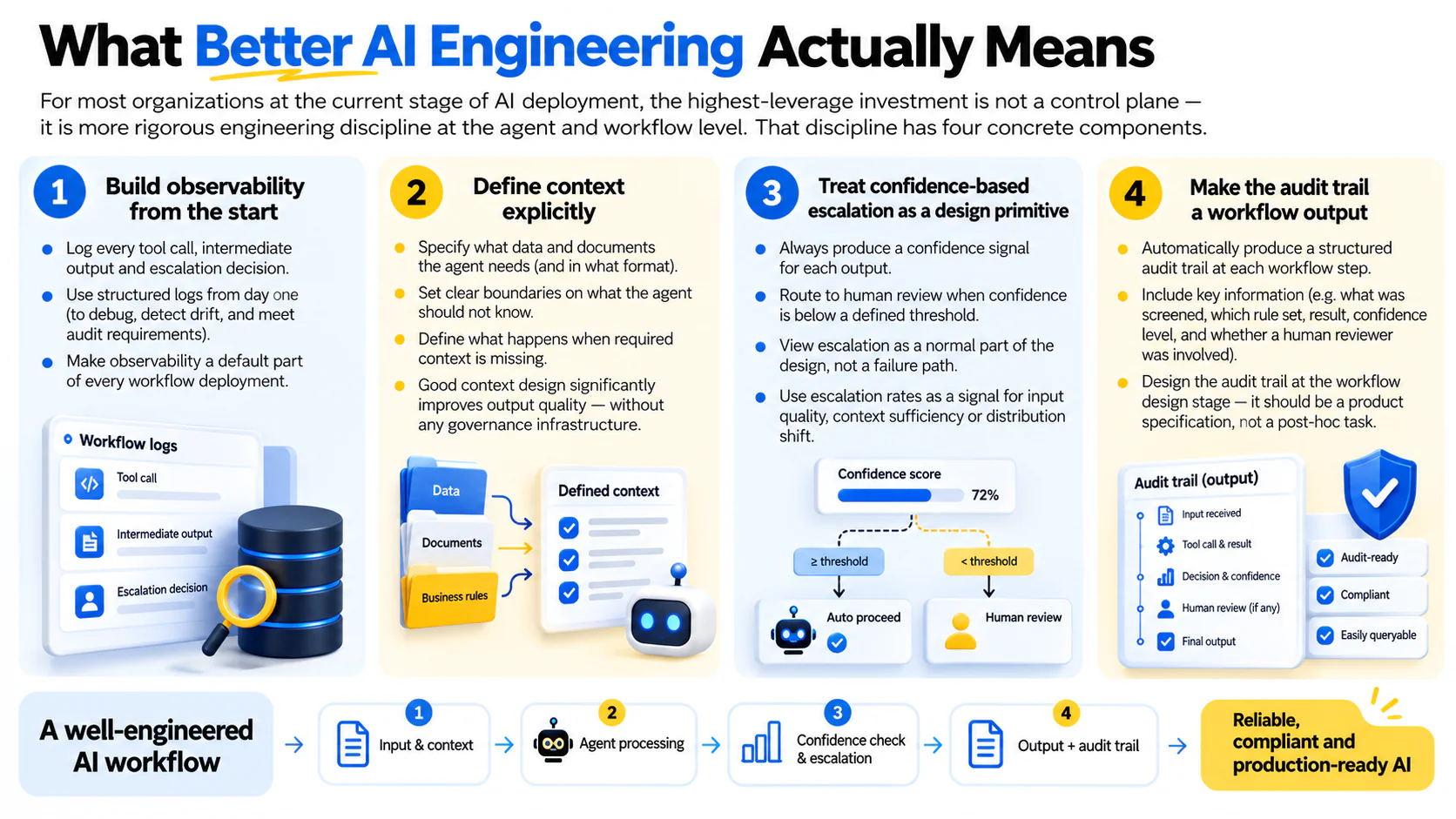
For most organizations at the current stage of AI deployment, the highest-leverage investment is not a control plane — it is more rigorous engineering discipline at the agent and workflow level. That discipline has four concrete components.
Build Observability From the Start
Observability for AI workflows is not a feature you add later — it is an architectural commitment you make when the workflow is designed. Every tool call, every intermediate output, every escalation decision should be logged in a structured format from the first deployment. The logs serve multiple purposes: debugging individual failures, detecting performance drift, demonstrating compliance with audit requirements, and building the dataset that drift detection models are trained on.
SmartDev’s AI workflow automation layer treats structured logging as a default component of every workflow deployment, not an optional add-on. The governance record that results from that logging is available for internal audit, regulatory review, or due diligence without a separate documentation project running alongside the operational system.
Define Context Explicitly
Context is not what you give the agent. It is what the agent knows at each reasoning step — and in most poorly performing AI workflows, the problem is not that the agent is reasoning incorrectly, it is that the agent is reasoning over context that is insufficient, ambiguous, or structured in a way that does not match the task it is being asked to perform.
Defining context explicitly means: what documents or data does this agent need? In what format should those inputs arrive? What is the agent not supposed to know — information that would distort its reasoning or expand its scope beyond the intended task? What happens when required context is missing? Each of those questions has a defined answer in a well-engineered workflow and an implicit, ad-hoc answer in a poorly engineered one. The difference in output quality is significant and does not require any governance infrastructure to address. The agent evaluation gap is often a context gap in disguise.
Treat Confidence-Based Escalation as a Design Primitive
One of the most consistently neglected engineering decisions in AI workflow design is the escalation model. Most initial deployments treat escalation as a failure path — the agent routes to human review when something goes wrong. A better framing treats escalation as a confidence threshold design — the agent is always producing a confidence signal, and the escalation path is the normal response to a confidence signal below a defined threshold, not an exception condition.
This distinction has operational consequences. When escalation is a failure path, a rising escalation rate looks like system failure. When escalation is a confidence design, a rising escalation rate is a signal about input quality, context sufficiency, or distribution shift — information that can be acted on before it becomes a production incident. AI workflow validation frameworks that define escalation thresholds explicitly during pre-deployment testing establish this as a designed feature from the start.
Make the Audit Trail a Workflow Output
Every workflow produces outputs. The audit trail should be one of them — not a compliance artifact assembled after the fact, but a structured log produced automatically at each workflow step, in a format that can be queried and presented to an auditor without additional processing.
This requires deciding, at workflow design time, what the audit trail needs to contain. For compliance screening workflows operating under supply chain compliance automation obligations, the audit trail needs to document what was screened, against which rule set, with what result, at what confidence level, and whether a human reviewer was involved. For financial services workflows operating under compliance workflow automation requirements, it needs to capture decision rationale and escalation history. The audit trail is a product specification problem, not a tooling problem.
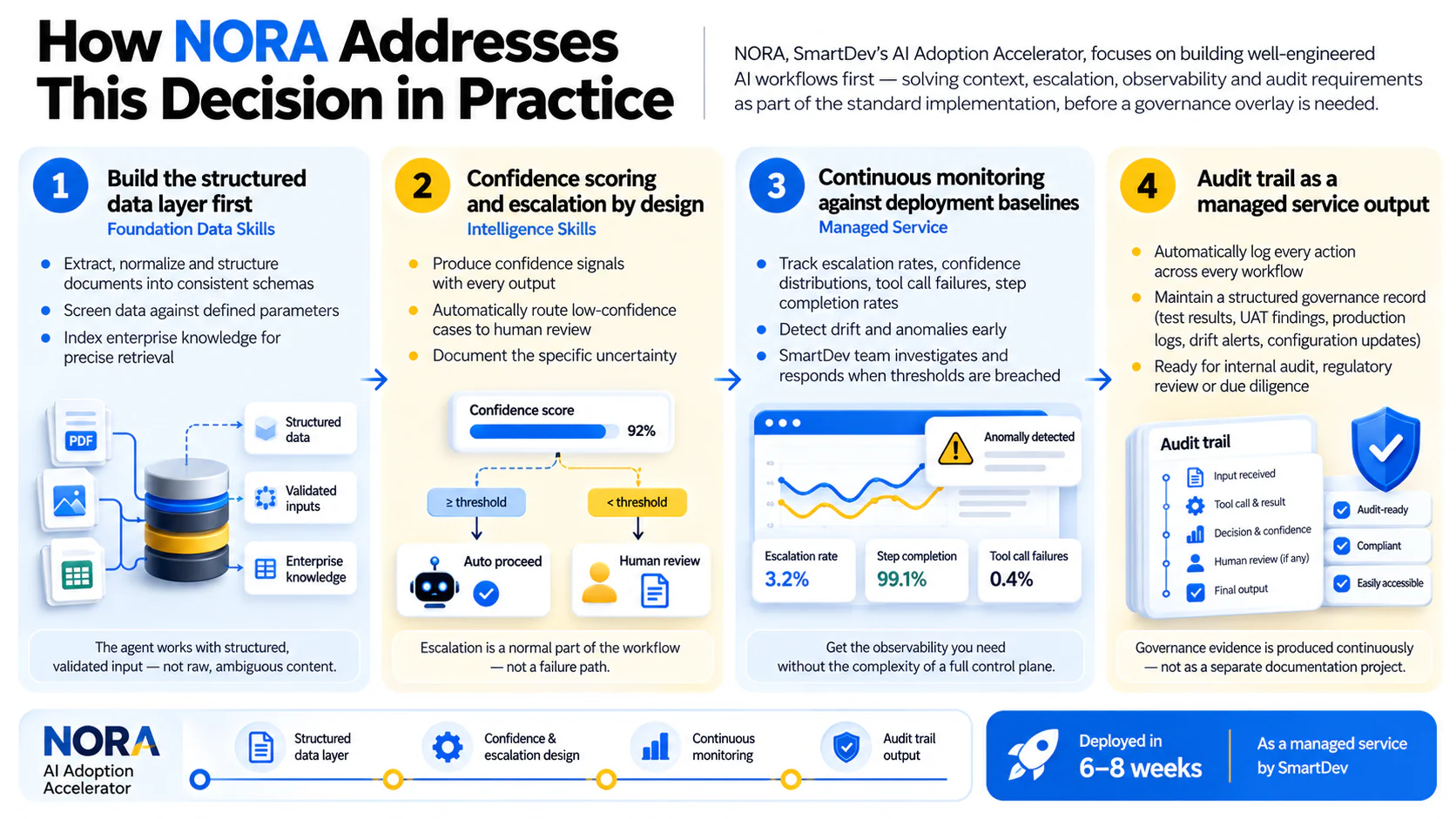
How NORA Addresses This Decision in Practice
NORA, SmartDev’s AI Adoption Accelerator, is designed around the principle that most organizations need better-engineered AI workflows before they need a governance overlay. NORA’s deployment approach addresses the foundational problems — context architecture, escalation design, observability, and audit trail production — as part of the standard implementation, rather than treating them as optional enhancements or post-launch add-ons.
Building the Structured Data Layer First
NORA’s Foundation Data Skills — Information Extraction, Data Screening, and Unified Data Indexing — exist specifically to address the context problems that make AI agents unreliable. Before any reasoning or decision-making happens, NORA’s data layer ingests, normalizes, and structures the inputs the agent will operate on. Documents are extracted into consistent schemas. Data is screened against defined parameters. Enterprise knowledge is indexed in a format the agent can retrieve with precision.
This is context architecture as engineering discipline. The agent receives structured, validated input rather than raw, ambiguous content. The difference in output consistency is significant — and it does not require a control plane to achieve. It requires engineering work at the data preparation layer that most AI deployments skip because it is less visible than the agent reasoning layer, even though it is where most reliability problems originate.
Confidence Scoring and Escalation as Default Architecture
Every NORA workflow is designed with explicit confidence thresholds and escalation paths before a single document is processed in production. The Intelligence Skills layer — Enterprise Search & Answer, Risk Assessment — produces confidence signals alongside every output. Those signals determine the escalation path automatically: high-confidence outputs proceed through the workflow; low-confidence outputs are routed to human review with the specific uncertainty documented.
This architecture means that when escalation rates change in production — when more documents are being flagged for human review than the deployment baseline anticipated — the signal is immediately interpretable. It reflects a change in input characteristics, a context gap, or a shift in the distribution of incoming data that the agent was not configured to handle. AI model drift detection built into the managed service catches this pattern and triggers a defined response before it becomes an operational problem.
Continuous Monitoring Against Deployment Baselines
NORA’s managed service includes continuous monitoring of production performance against the baselines established during pre-deployment validation. Escalation rates, output confidence distributions, tool call failure rates, and step completion rates are tracked on a defined cadence. When a metric breaches a defined threshold, the SmartDev team investigates and responds — without requiring the client to maintain their own AI operations function.
This monitoring layer provides the observability that organizations often cite as a control plane requirement, without the architectural overhead of a full control plane. For organizations operating a small number of well-defined workflows — which describes the majority of organizations that contact SmartDev about AI governance — this approach delivers the visibility and accountability that governance requires at a fraction of the complexity and cost.
Audit Trail as a Managed Service Output
Every action NORA takes across every workflow is logged automatically in a structured format and maintained as part of the managed service governance record. Pre-deployment test results, UAT findings, production monitoring reports, drift alerts, configuration update logs — all of it is documented without requiring the client to instrument a separate documentation system or reconcile logs from multiple sources.
This compliance audit trail is produced as a natural output of NORA’s operation. It is available for internal audit, regulatory review, or due diligence on request. For organizations with regulatory obligations under the EU AI Act, CSRD, or industry-specific oversight frameworks, this means the governance evidence exists continuously — not as a project that assembles documentation before an audit and then stops.
NORA deploys this full stack in 6 to 8 weeks as a managed service. If your organization is evaluating AI governance infrastructure and wants to understand where engineering discipline ends and control plane investment begins for your specific deployment, contact SmartDev to discuss your architecture and requirements.
Conclusion
The AI control plane is a real infrastructure category that solves real coordination problems — at the right scale and the right stage of AI deployment. For organizations running dozens of agents across multiple teams, with regulatory obligations that require centralized audit evidence and multi-agent orchestration complexity that no individual team owns end to end, a control plane is worth the architectural investment.
For most organizations currently asking the question, the answer is different. The problems they are experiencing — unreliable agent outputs, insufficient governance evidence, unclear escalation logic, performance degradation after deployment — are engineering problems with engineering solutions. Better context architecture, explicit confidence-based escalation, structured observability from the start, and audit trails built into the workflow rather than assembled after the fact address the underlying issues without adding an additional governance layer to a system that has not yet addressed the foundational ones.
The decision framework is straightforward: if the problem is agent quality, fix the agents. If the problem is fleet coordination across a genuinely complex deployment, build the control plane. Most organizations are still in the first scenario — and the fastest path to reliable AI in production runs through better engineering, not through governance infrastructure built for a scale that has not yet arrived.
Explore more from SmartDev: