TL;DR:
- ESG reporting has shifted from voluntary disclosure to mandatory obligation across the EU, UK, Singapore, and beyond — and advisory firms are absorbing the operational cost of that shift on behalf of every client they serve.
- Manual ESG data collection, framework mapping, and gap analysis do not scale across a multi-client portfolio without proportional headcount increases.
- AI workflow automation changes the economics: data extraction, regulatory cross-mapping, gap flagging, and audit trail generation happen automatically, at client-portfolio scale, without a parallel increase in analyst hours.
Introduction
A single ESG report is already a significant undertaking — materiality assessment, data collection across operational systems, framework mapping, gap analysis, draft review, and assurance preparation. Now multiply that by 20, 50, or 100 client engagements running simultaneously, each under different frameworks, different jurisdictions, and different filing deadlines.
The advisory firm is no longer doing ESG reporting. It is running an ESG reporting factory — with analyst capacity as the binding constraint and regulatory complexity growing faster than headcount can absorb it.

The regulatory environment has made that bottleneck worse. The EU Corporate Sustainability Reporting Directive (CSRD), the ISSB’s IFRS S1 and S2 sustainability disclosure standards, and a growing set of jurisdiction-specific requirements — including California’s SB 253, Singapore’s SGX-ACRA ISSB alignment, and the UK’s Sustainability Disclosure Standards — have moved ESG from a reputational exercise to a legal compliance function across multiple client tiers simultaneously.
According to the Global Sustainable Investment Alliance, sustainable investment assets surpassed $30 trillion, and ESG-mandated assets are projected to reach $35 trillion globally — a scale that makes accurate, consistent, audit-ready disclosure a direct financial requirement, not an afterthought.
Advisory firms that serve clients across these jurisdictions now face a structural problem: the reporting workload has multiplied, but the tools most firms use to manage it — spreadsheets, email-based data requests, document templates reviewed manually — have not. This article explains what that gap costs in practice, and how AI workflow automation closes it without requiring firms to rebuild their advisory model from scratch.
Where Manual ESG Workflows Break Down for Advisory Firms
The Data Collection Bottleneck
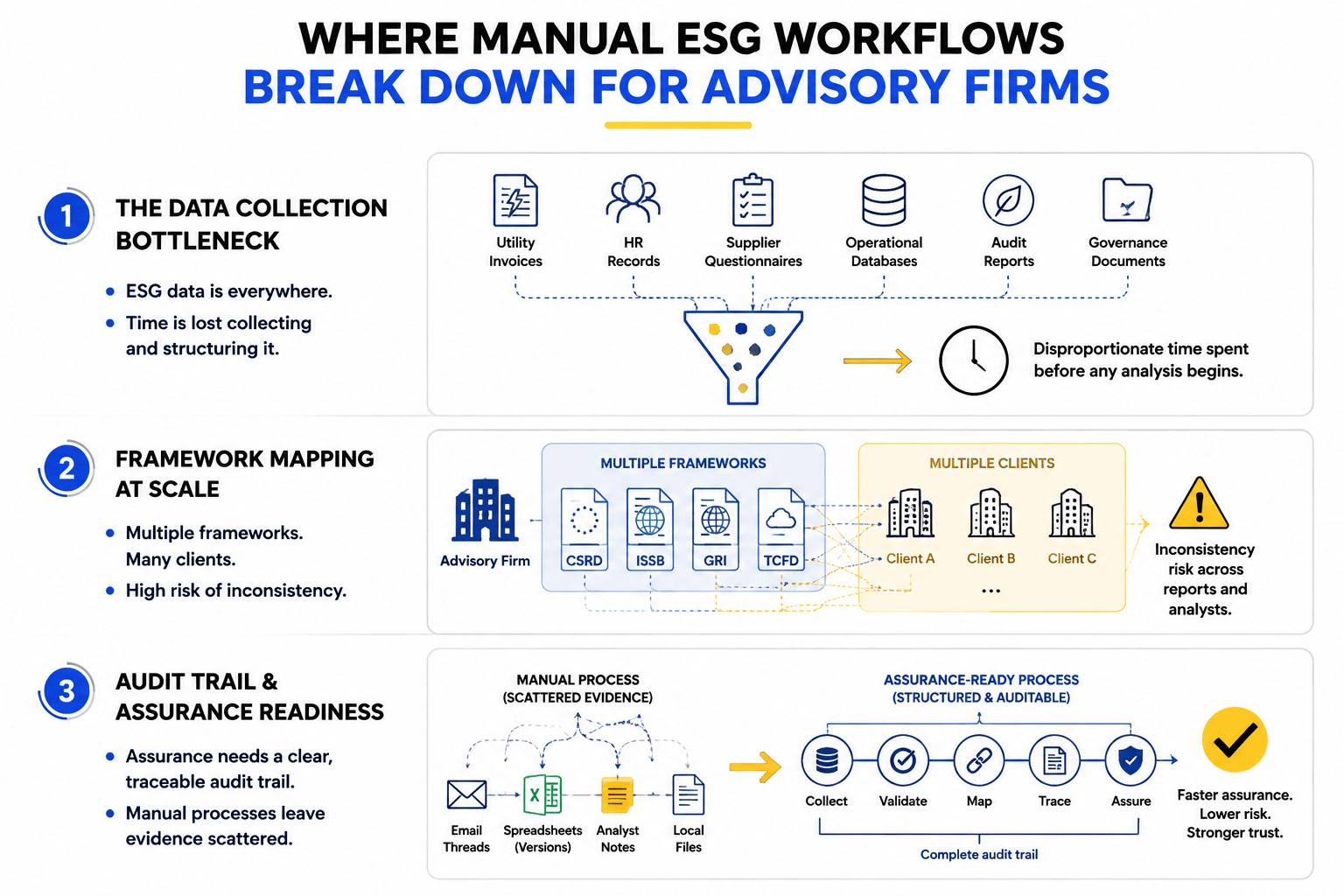
ESG data does not arrive pre-structured and ready to report. It is distributed across utility invoices, HR records, supplier questionnaires, operational databases, environmental audit reports, and governance documentation — held in different formats, different systems, and different parts of the client organization. Before an advisory firm can begin any analytical work, it must collect, validate, and structure that data across every client engagement it is running simultaneously.
Research on ESG data challenges confirms that ESG consultants routinely spend a disproportionate share of engagement time on data gathering and structuring rather than on the analysis and advisory work that actually differentiates the engagement. This is not an efficiency problem specific to any one firm — it is a structural characteristic of manual ESG data workflows.
The data is fragmented by design: it lives in operational systems that were built to manage the business, not to produce sustainability disclosures. Extracting it manually, validating it against framework requirements, and organizing it into a reportable structure is labor-intensive regardless of how experienced the analyst is.
Framework Mapping at Scale
An advisory firm managing clients across CSRD, ISSB, GRI, and TCFD simultaneously must maintain working familiarity with each framework’s data requirements, apply the correct framework to each client’s reporting obligations, and cross-map shared data points without duplicating data collection or creating inconsistencies between reports filed under different frameworks.
Doing this manually for one client is manageable. Doing it accurately and consistently across 30 or 50 clients, with different framework obligations, different reporting timelines, and different materiality profiles, produces the conditions for error. The analyst responsible for client A’s CSRD mapping is not necessarily the analyst who mapped client B’s ISSB filing the previous quarter. Without a systematic framework enforcing consistent cross-mapping logic, the firm’s output quality depends on individual analyst knowledge rather than institutional process.
Audit Trail and Assurance Readiness
ESG reporting is moving toward third-party assurance requirements that parallel financial audit in rigor. CSRD mandates limited assurance for the first reporting periods, with a pathway toward reasonable assurance over time. ISSA 5000, the international standard for sustainability assurance, is being adopted as the basis for auditor engagement. This means ESG reports filed by advisory clients will face external scrutiny of the underlying data and the process by which it was collected, validated, and mapped to framework requirements.
Manual processes are not assurance-ready by default. An assurance provider asking an advisory firm to demonstrate how a specific ESRS data point was collected, validated, and traced back to a primary source will find that the evidence exists in email threads, spreadsheet versions, and analyst notes rather than in a structured, auditable record. Reconstructing that record for assurance purposes is expensive and time-consuming.
The ESG Regulatory Landscape Advisory Firms Must Navigate
The first challenge advisory firms face is that their clients are not subject to a single ESG reporting standard. They operate across a patchwork of overlapping, partially harmonized, and actively evolving frameworks — each with its own materiality methodology, data point requirements, and assurance obligations.
CSRD and the European Sustainability Reporting Standards
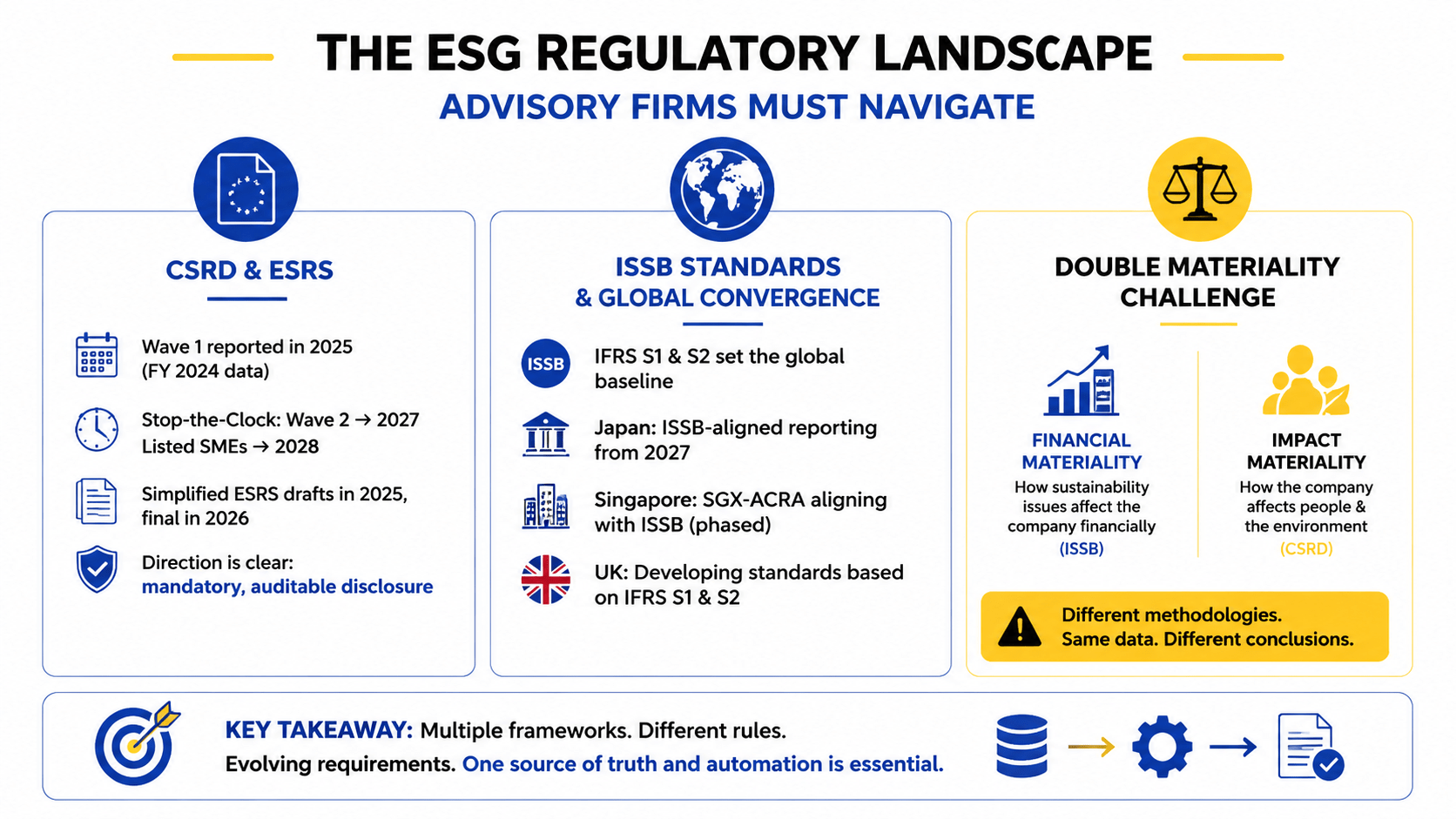
The CSRD is the most far-reaching mandatory ESG reporting framework currently in force. It requires in-scope companies to report against the European Sustainability Reporting Standards (ESRS), which cover environmental, social, and governance topics with significantly greater granularity than prior voluntary frameworks. Wave 1 reporters — large public-interest entities with over 500 employees — filed their first reports in 2025 based on FY 2024 data.
Importantly, the European Commission introduced a “Stop-the-Clock” mechanism in 2025 that defers CSRD application for Wave 2 companies to financial years starting on or after January 1, 2027, and for listed SMEs to January 1, 2028. EFRAG issued draft simplified ESRS in 2025, with finalization expected in 2026.
Advisory firms should treat CSRD scope and timelines as subject to ongoing adjustment — the official CSRD legislative tracker is the authoritative source. What is not subject to adjustment is the direction of travel: mandatory, auditable ESG disclosure is coming for a larger share of the advisory client base, and the data infrastructure to support it needs to be in place before filing deadlines arrive.
ISSB Standards and Global Convergence
The ISSB’s IFRS S1 (general sustainability-related disclosures) and S2 (climate-related disclosures) standards are providing the convergence layer that brings jurisdictions outside the EU into alignment. Japan’s Sustainability Standards Board has mandated ISSB-aligned reporting for large listed companies from 2027.
Particularly, Singapore updated its climate disclosure roadmap in August 2025. All listed companies must report Scope 1 and 2 emissions from FY2025. STI constituents face broader ISSB-based disclosures from the same year. Non-STI listed companies above S$1bn follow from FY2028; smaller listed and large non-listed companies from FY2030. On 27 July 2026, ACRA opened a public consultation on Singapore Sustainability Disclosure Standards — the framework is still actively evolving, and advisory firms with Singapore-listed clients should monitor consultation outcomes before finalizing their reporting approach.
As Aranca’s 2026 ESG reporting analysis notes, this growing convergence means that advisory firms with multi-jurisdiction clients will increasingly manage ISSB-based requirements alongside CSRD, rather than treating them as separate tracks.
The Double Materiality Challenge
CSRD requires companies to apply double materiality — assessing both how sustainability issues affect the company financially (financial materiality) and how the company’s activities affect people and the environment (impact materiality). This methodology is substantively different from the single materiality approach used under ISSB, which focuses on investor-relevant financial materiality only.
Advisory firms serving clients with both EU and non-EU reporting obligations must apply different materiality methodologies to the same client’s underlying data depending on which framework governs which disclosure. Managing that distinction manually across a multi-client portfolio creates significant inconsistency risk — the same underlying data point may be classified differently across two reports for the same client if the materiality logic is applied by different analysts without a systematic framework enforcing the distinction.
How AI Workflow Automation Changes the Economics
Automated Data Extraction Across Source Types
The first place AI workflow automation delivers measurable value in ESG advisory is at the data collection layer. Rather than analysts manually extracting emissions data from utility invoices, pulling headcount figures from HR exports, and transcribing supplier questionnaire responses, an automated extraction layer reads source documents and populates the relevant fields in a structured ESG data model automatically.
This capability directly addresses the bottleneck that ESG consultants identify as their primary time constraint: the hours spent gathering and organizing data that could instead be spent on analysis, materiality assessment, and client advisory.
When extraction is automated, an analyst opening a client engagement file finds structured, validated data ready for framework mapping rather than a collection of raw source documents still requiring manual processing.
The efficiency gain compounds across a multi-client portfolio. An advisory firm handling data extraction manually for 40 client engagements simultaneously may have 4 to 6 analysts spending the majority of their time on collection work.
When extraction is automated, that analyst capacity redirects toward the interpretation and advisory work that generates the actual value clients are paying for. This is what AI workflow automation means in practice for knowledge-intensive advisory businesses: not replacing analysts, but removing the mechanical layer that prevents them from doing analytical work.
Regulatory Cross-Mapping Without Manual Maintenance
AI workflow automation applies framework mapping logic systematically rather than relying on each analyst to apply it correctly from memory. When a client’s GHG emissions data is extracted and structured, the system identifies which reporting frameworks apply to that client, maps the data point to the relevant disclosure requirements, and flags where the same underlying data satisfies multiple requirements.
Crucially, when framework requirements change — as they frequently do during this period of active regulatory development — the mapping logic is updated in one place, and the update propagates across every client engagement using that framework.
Under a manual workflow, a change to ESRS data point requirements requires every analyst working on CSRD engagements to be briefed, to update their own templates, and to reconcile any work already in progress. The inconsistency risk during that transition period is significant. Under an automated workflow, the update is a configuration change that takes effect immediately and uniformly.
Gap Analysis and Disclosure Readiness Scoring
One of the highest-value outputs an advisory firm can deliver to a client preparing for mandatory ESG reporting is an honest assessment of where their current data and processes fall short of framework requirements — and what they need to do, in what order, to close those gaps before their filing deadline.
Producing that assessment manually requires an analyst to review the client’s current data against every applicable ESRS or ISSB data point, identify missing or insufficient information, assess the materiality of each gap, and prioritize remediation actions.
AI-powered gap analysis compresses that process significantly. When the client’s structured data is mapped against framework requirements automatically, the system generates a gap report that identifies exactly which data points are missing, which are present but insufficiently granular, and which are available but require validation before they meet assurance standards.
Document Drafting and Report Generation
ESG reports are document-intensive outputs that follow defined structural conventions for each framework. CSRD-compliant reports must address specific ESRS disclosure requirements in a defined order. ISSB-aligned reports follow the S1 and S2 structure. GRI reports use the GRI Universal Standards structure with sector-specific additions.
Generating first drafts of these documents manually — assembling structured data into the correct narrative and tabular format for each framework — is time-consuming for experienced analysts and error-prone for less experienced ones.
Automated document drafting generates structured first drafts based on the client’s validated data and the applicable framework template. The analyst receives a draft that is structurally correct and data-populated, requiring review, interpretation, and narrative refinement rather than construction from a blank template.
For an advisory firm producing 20 to 30 ESG reports across a reporting season, the time saved at the drafting stage is operationally material — the difference between meeting client deadlines at current headcount and needing to scale the team specifically for reporting season.
What Automation Handles vs. Where Human Expertise Remains Essential
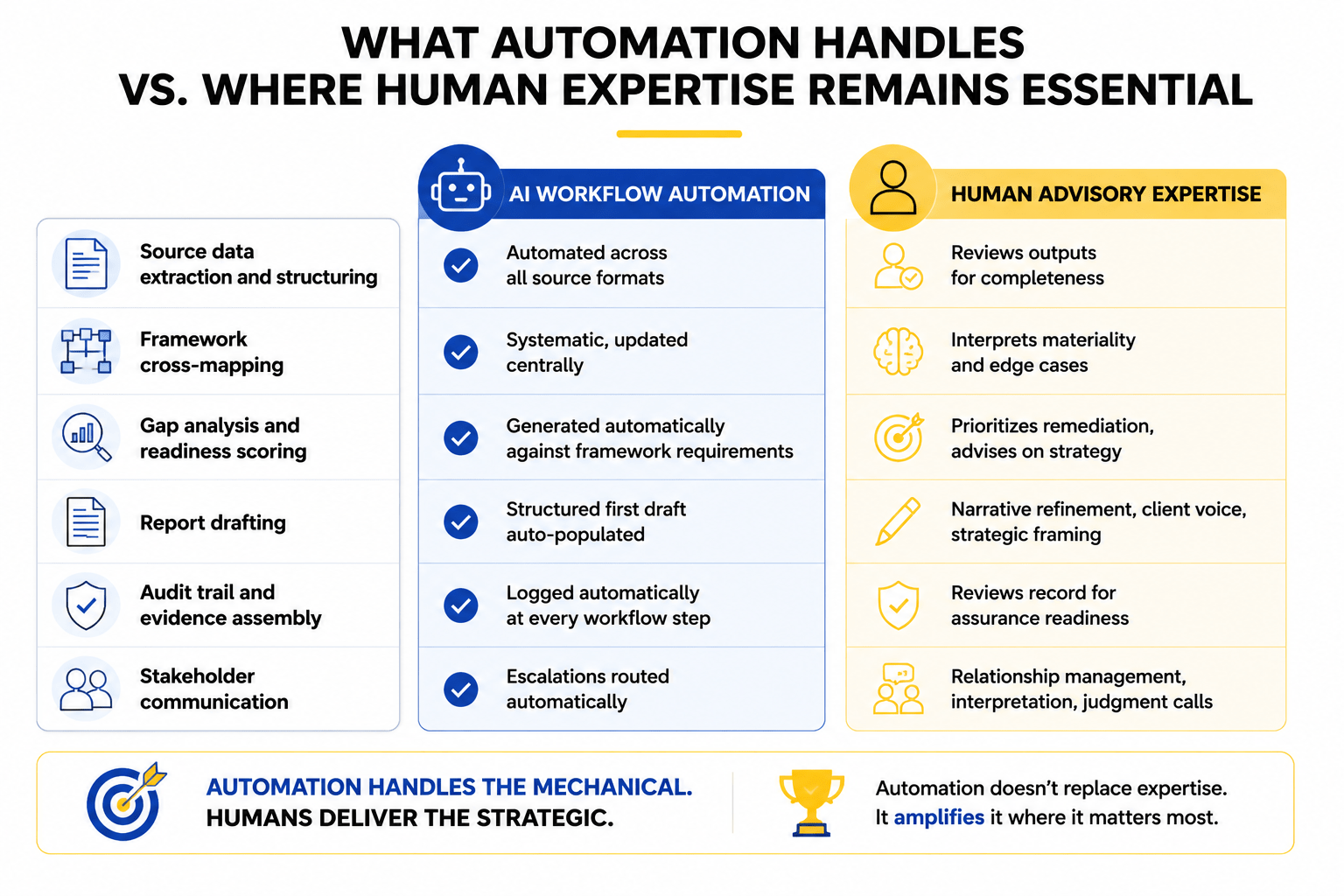
AI workflow automation does not replace ESG advisory expertise. It removes the mechanical layer that currently prevents advisory professionals from applying that expertise at the scale and speed the market now requires. The distinction between what automation handles well and where human judgment is irreplaceable is important for advisory firms evaluating where to invest in automation first.
| Task | AI workflow automation | Human advisory expertise |
|---|---|---|
| Source data extraction and structuring | Automated across all source formats | Reviews outputs for completeness |
| Framework cross-mapping | Systematic, updated centrally | Interprets materiality and edge cases |
| Gap analysis and readiness scoring | Generated automatically against framework requirements | Prioritizes remediation, advises on strategy |
| Report drafting | Structured first draft auto-populated | Narrative refinement, client voice, strategic framing |
| Audit trail and evidence assembly | Logged automatically at every workflow step | Reviews record for assurance readiness |
| Stakeholder communication | Escalations routed automatically | Relationship management, interpretation, judgment calls |
The tasks in the left column are where most advisory analyst time currently goes. Automating them does not diminish the advisory firm’s value — it concentrates that value in the right column, where experienced professionals are genuinely difficult to replicate and where clients most clearly perceive the difference between firms.
How NORA Brings AI Workflow Automation to ESG Advisory Operations
NORA, SmartDev’s AI Adoption Accelerator, is designed for exactly the operational profile that ESG advisory firms present: high document volume, multiple framework requirements running in parallel, a need for consistent systematic logic across client engagements, and an assurance-readiness obligation that requires structured documentation of every step.
Rather than a fixed product that advisory firms must adapt their processes to, NORA provides a framework of reusable AI components configured to the specific workflows, frameworks, and client data structures each firm uses.
The implementation does not require the advisory firm to rebuild its engagement model — it adds an automation layer to the processes already in place, replacing the mechanical steps with systematic AI execution while leaving the judgment-intensive steps with the analysts who are qualified to perform them.
Foundation: Structuring Client ESG Data at Scale
NORA’s Foundation Data Skills address the data collection bottleneck directly. The Information Extraction capability reads source documents across all client-submitted formats — utility invoices, HR exports, supplier questionnaires, audit reports, governance documents — and extracts the relevant ESG data fields into a structured client data model automatically.
Data Screening applies validation logic to identify fields that are present but insufficient, data points that conflict across source documents, and submissions that fall outside expected ranges for the client’s sector and size. Unified Data Indexing organizes extracted data across the ESRS, ISSB, and GRI data point structures simultaneously. As a result, the same underlying data is available for cross-framework mapping without redundant collection.
For advisory firms running AI-powered document intake across a multi-client portfolio, this foundation layer compresses data collection from a multi-week manual process to an automated workflow that produces structured, validated data within hours of client submission.
Intelligence: Framework Mapping and Gap Detection
With structured data in place, NORA’s Intelligence Skills apply the analytical logic that previously required an experienced analyst to execute manually for each client. The Enterprise Search and Answer capability allows advisory professionals to query a client’s complete ESG data record directly and receiving structured answers drawn from live client records.
Rather than an analyst manually comparing the client’s data against a framework checklist, the advisory team receives a live readiness assessment that reflects the client’s current data position against current framework requirements — the starting point for strategic advisory conversation rather than a preparatory step before it can begin.
Execution: Automated Client Communication and Draft Generation
Document drafting automation generates structured first drafts of ESRS, ISSB, and GRI disclosure sections based on the client’s validated data. These drafts give advisory analysts a reliable starting point for narrative refinement and strategic input. Instead of replacing expert judgment, NORA reduces manual drafting effort, eliminates the blank-page challenge, and ensures all required data points are covered before analysts add their insights.
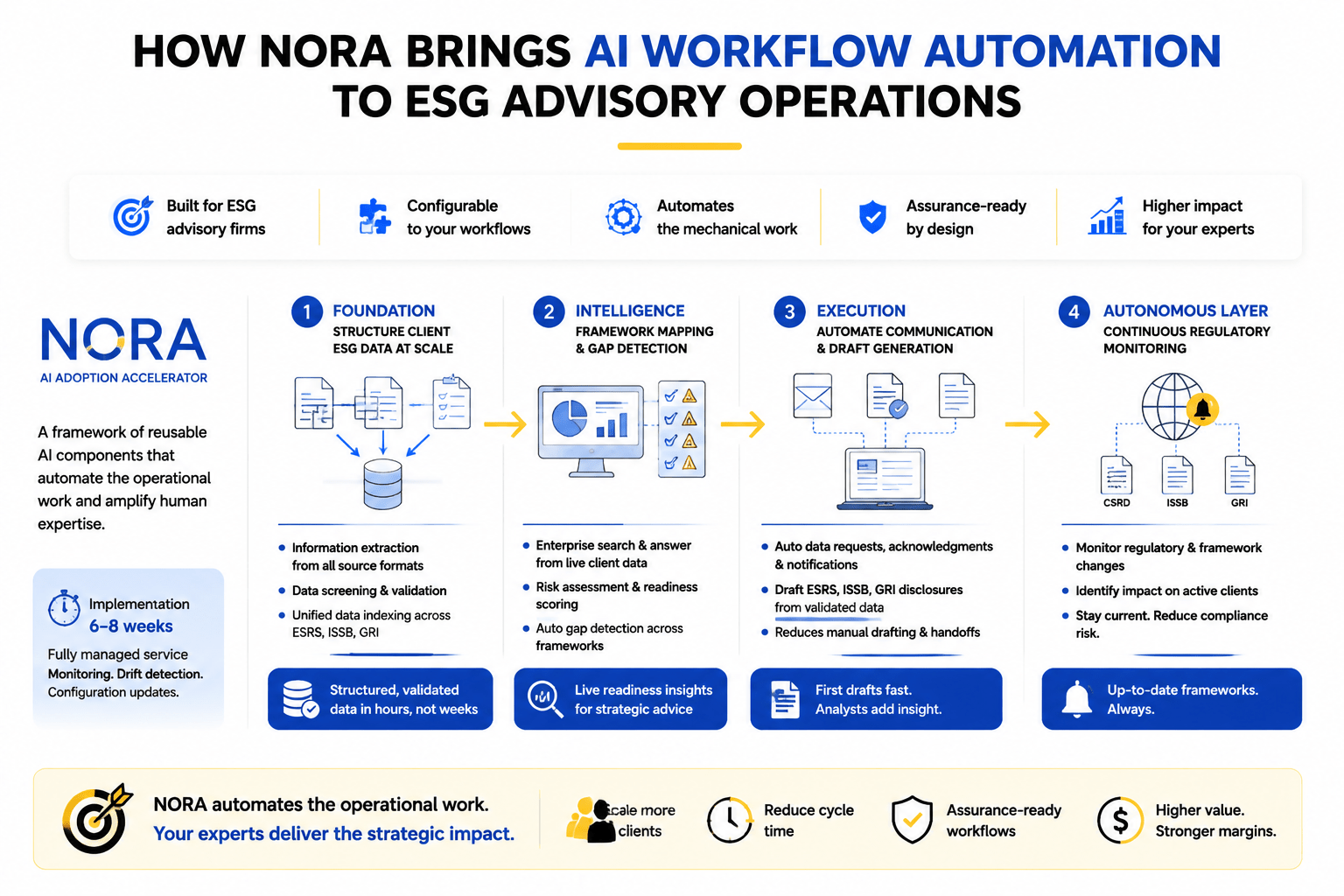
Autonomous Layer: Continuous Regulatory Monitoring
The ESG regulatory environment does not stand still between reporting cycles. Framework requirements, materiality guidance, and assurance standards change frequently. New jurisdiction-specific obligations also emerge over time. Advisory firms must continuously monitor these updates to ensure they support clients using the latest regulatory frameworks.
NORA’s Autonomous Layer applies trigger-based monitoring to regulatory change feeds, alerting the advisory team when a framework update affects active client engagements.
When EFRAG finalizes simplified ESRS, the system identifies which clients are in scope and flags the implications for their current data collection and reporting workflows automatically. This continuous monitoring means the advisory firm’s framework knowledge is current by default, not dependent on individual analysts tracking regulatory developments in their own time.
NORA delivers this full capability stack as a fully managed service, deployed in 6 to 8 weeks, with ongoing monitoring, drift detection, and configuration updates included. For advisory firms facing reporting season pressure and a growing client ESG workload, contact SmartDev to discuss what an automated ESG reporting workflow looks like for your specific client portfolio and framework mix.
NORA with 6-8 weeks execution
NORA, SmartDev’s AI Adoption Accelerator, deploys a working ESG workflow automation layer in 6 to 8 weeks — structured as follows:
Weeks 1–2 — Discovery and scoping. SmartDev maps the firm’s current ESG data workflows: source document types, applicable frameworks per client segment, current data collection methods, and assurance requirements. This produces a configuration specification for the automation layer.
Weeks 3–5 — Build and integration. NORA’s extraction, mapping, and gap analysis components are configured to the firm’s specific framework mix and client data structures. Integration with existing document management systems, client portals, or data repositories is completed and tested.
Weeks 6–8 — UAT, validation, and go-live. The advisory team runs the configured workflow against live client data in a controlled environment. Extraction accuracy, framework mapping logic, and escalation routing are validated against defined acceptance criteria. Go-live follows sign-off.
Post-deployment, NORA operates as a fully managed service — monitoring, framework updates, and configuration adjustments are handled by SmartDev, not the advisory firm’s internal team.
Conclusion
ESG reporting obligations have crossed the threshold from voluntary commitment to mandatory compliance across most major markets, and the trajectory is toward more requirements, more granularity, and more rigorous assurance — not fewer.

Advisory firms that absorb each new requirement through additional analyst hours are building a cost structure that grows proportionally with the regulatory burden. Firms that build an automated workflow layer now are building a cost structure that scales with client volume rather than with regulatory complexity.
The case for AI workflow automation in ESG advisory is not that it replaces experienced analysts. It is that the operational model advisory firms currently use — manual data collection, analyst-by-analyst framework mapping, spreadsheet-based gap tracking, and manually assembled assurance documentation — was built for a simpler reporting environment and cannot efficiently serve the one that now exists.
Automation handles the mechanical layer. Advisory professionals handle the judgment layer. That division is where the competitive differentiation between advisory firms will increasingly be visible, as the firms that have built the infrastructure demonstrate materially faster, more consistent, and more assurance-ready outputs than those still relying on manual processes.
Explore more from SmartDev: