

TL; DR:
- The 2021 MAS Technology Risk Management (TRM) Guidelines do not provide a dedicated AI risk management framework. Instead, they establish broader technology governance, cybersecurity, resilience, and third-party risk principles that also apply to AI systems.
- MAS built AI-specific expectations on top of TRM through separate guidance: the 2018 FEAT Principles, the 2024 AI Model Risk Management paper, and the November 2025 Guidelines on AI Risk Management (AIRG) consultation paper.
- The AIRG applies to every MAS-regulated financial institution, but implementation scales with the size of the firm and the materiality of its AI use.
- Boards and senior management carry direct accountability for AI governance under the proposed guidelines. This is not a task IT can own alone.
- Financial institutions need four things fast: an AI inventory, a materiality assessment method, full lifecycle controls, and audit-ready documentation.
- SmartDev builds and hardens the automation systems that make this documentation possible, from document processing to compliance with automation platforms.
Introduction
Financial institutions across Singapore now embed AI into lending decisions, fraud detection, and daily compliance workflows. However, many compliance teams still confuse two distinct regulatory documents: the Technology Risk Management (TRM) Guidelines and the newer MAS AI Risk Management Guidelines. This confusion creates real compliance gaps, and those gaps surface during audits rather than during planning.
The stakes keep rising because AI adoption is accelerating far faster than most governance functions can absorb. Boards approve pilot budgets in weeks, while risk committees still work through documentation cycles measured in quarters. That mismatch is precisely where regulatory exposure builds quietly, long before an examiner asks the first question. Understanding exactly what MAS expects, and where that expectation sits within the broader supervisory framework, therefore becomes a competitive necessity rather than a compliance checkbox.
This article clarifies what the MAS TRM Guidelines actually require, and shows where they intersect with MAS’s dedicated AI risk framework. It also outlines a practical implementation roadmap and explains how workflow automation can support continuous, audit-ready evidence collection, the kind of ongoing documentation an examiner asks to see. We close by introducing NORA, SmartDev’s AI Adoption Accelerator, as one example of what that supporting infrastructure looks like in practice for financial institutions.
What Are the MAS TRM Guidelines?
From 2001 to 2021: Two Decades of Evolution
The Monetary Authority of Singapore first issued the TRM Guidelines in 2001 and revised the framework substantially in 2013, then again on 18 January 2021. The 2021 revision addressed cloud reliance, API security, and faster software delivery cycles, following public consultation conducted in 2019, as summarized in this Lexology legal analysis of the 2021 TRM Guidelines.
Each version reflected how institutions built and operated technology at the time. The 2013 edition established baseline expectations for system resilience and outage reporting. The 2021 edition reflected cloud infrastructure, third-party APIs, and much faster software release cycles. Those practices were far beyond what the 2013 guidelines anticipated. Together, both editions form a record of MAS’s evolving technology risk priorities. They show what MAS considered the most pressing risks at each stage. Institutions should treat the current guidelines as a moving governance baseline, not a document to satisfy once and file away.
Who Must Comply
The guidelines apply to banks licensed under the Banking Act, payment services licensees under the Payment Services Act 2019, capital markets intermediaries regulated under the Securities and Futures Act, and licensed insurers. Because MAS designed the guidelines to be principles-based rather than prescriptive, institutions must interpret and apply them proportionately, based on their size, complexity, and risk exposure. MAS treats the document as risk management principles and best-practice standards, not as rigid technical specifications, according to the official MAS guidelines page. This flexibility matters directly for AI and machine learning deployments, since it lets institutions calibrate controls to actual risk rather than a one-size-fits-all rulebook.
How Singapore’s Approach Compares Regionally
MAS’s principles-based approach stands out among regional regulators. Bank Negara Malaysia addresses AI risk within its broader technology risk framework, while the EU AI Act classifies many financial AI systems as high risk and imposes prescriptive requirements. Among Southeast Asian regulators, MAS provides some of the region’s most detailed AI-specific supervisory guidance. See our regional compliance comparison of AI risk frameworks for a broader comparison. For multinational institutions, aligning with MAS creates a strong governance baseline. However, it does not replace jurisdiction-specific compliance assessments across other Southeast Asian markets.
The figure below shows how the MAS Technology Risk Management (TRM) Guidelines and the AI Risk Management Guidelines sit together under one supervisory framework.
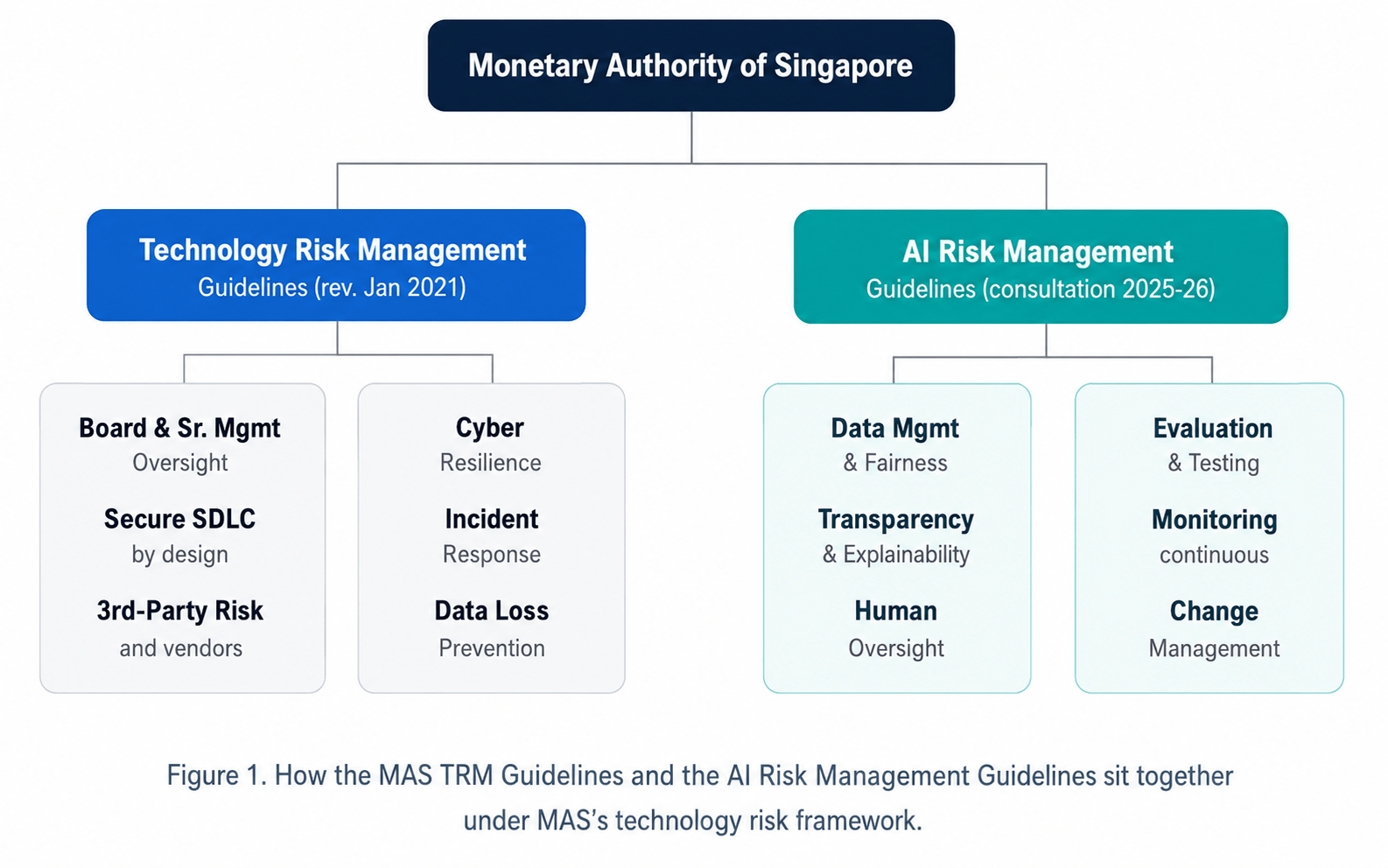
Together, the two frameworks establish a unified set of expectations covering governance, security, data management, human oversight, model evaluation, and continuous monitoring. Mapping internal controls against these domains helps institutions identify ownership gaps and strengthen audit readiness before regulatory reviews.
Takeaway: The TRM Guidelines are principles-based, proportionate, and apply broadly across banks, payment firms, capital markets, intermediaries, and insurers. Compliance depends on demonstrating sound judgment, not simply checking boxes against a fixed rulebook.
Core Pillars of the TRM Guidelines Relevant to AI Deployment
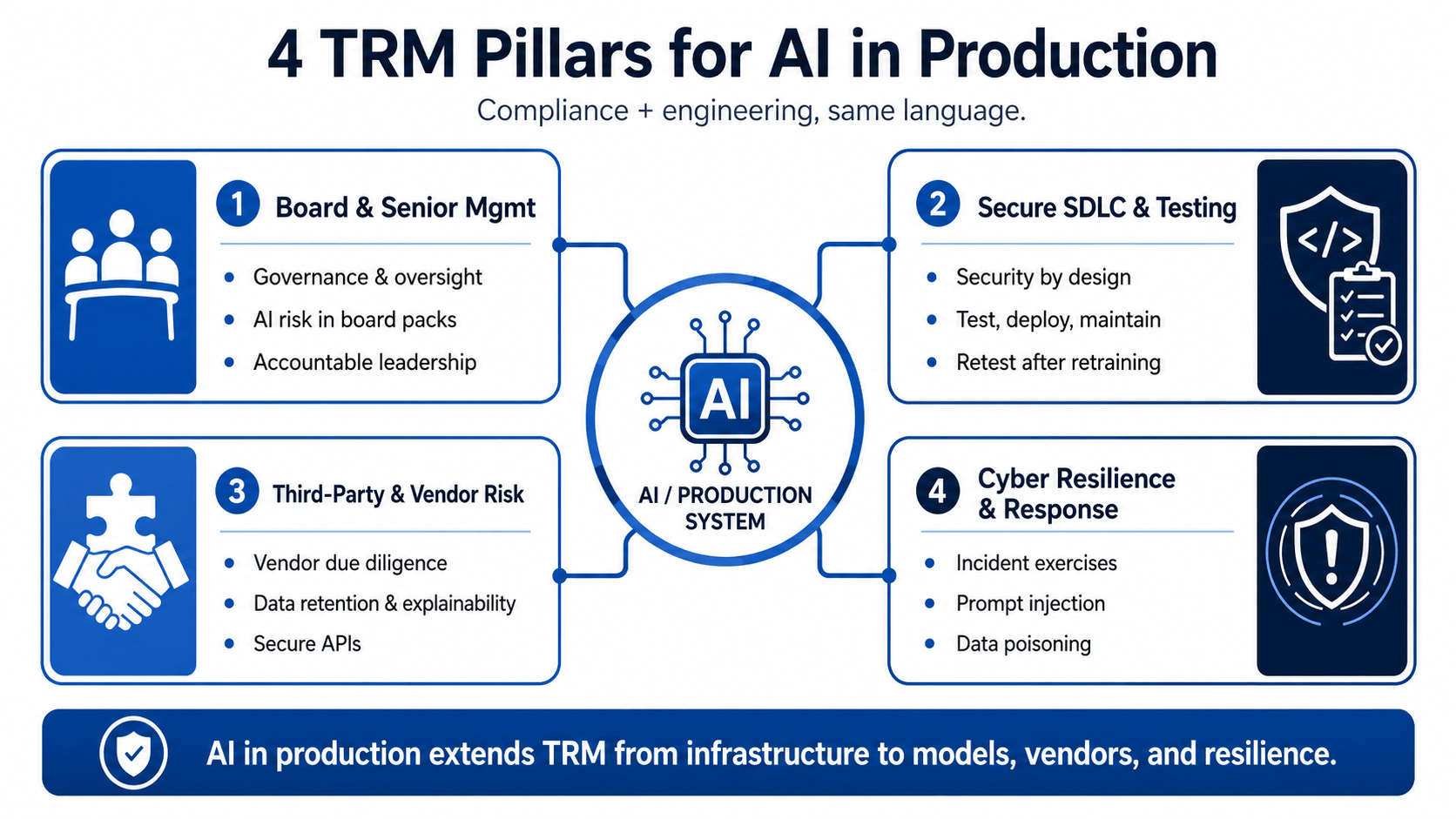
Four pillars of the TRM Guidelines carry the most weight once an institution introduces AI into production systems. Understanding each pillar helps compliance and engineering teams speak the same language during design reviews.
Board and Senior Management Accountability
The 2021 revision increased responsibilities for boards and senior management regarding technology risk governance and oversight. Institutions should appoint a Chief Information Officer and a Chief Information Security Officer with sufficient expertise. When institutions deploy AI, this accountability extends naturally: boards must understand model risk with the same rigor they apply to infrastructure risk.
In practice, this means board packs need a dedicated AI risk section, not a single line item buried inside a broader technology update. Directors need enough technical literacy to ask pointed follow-up questions rather than simply accepting a green status report.
Secure Software Development and Testing
The guidelines require secure software development practices built into IT project plans, covering design, implementation, testing, deployment, and maintenance. AI systems, especially generative and agentic models, need this same discipline: security-by-design reviews, structured testing, and clear documentation across every development phase.
Unlike traditional software, AI models require continuous retesting after retraining or fine-tuning. Their behavior can change even when the underlying code stays the same.
Third-Party and Vendor Risk
This pillar matters most for AI deployment because most institutions license AI capabilities from external vendors rather than build models from scratch. Institutions must vet third parties by considering their cybersecurity posture, industry reputation, and track record, and must establish security standards for developing secure APIs.
Vendor questionnaires limited to SOC 2 or ISO 27001 miss the point. Those certifications confirm baseline security controls but not AI-specific governance. They reveal nothing about model training, retained data, or output explainability. Our related article on why your AI vendor is now a MAS third-party risk unpacks this pillar in far more depth.
Cyber Resilience and Incident Response
MAS expects financial institutions to strengthen cyber resilience through incident response planning, cyber exercises, and threat intelligence sharing. As AI becomes part of critical business processes, institutions should apply the same resilience practices to AI-specific threats, including prompt injection and data poisoning.
Although the TRM Guidelines do not explicitly identify these AI attack vectors, the same resilience principles apply. Testing only traditional network intrusion scenarios may leave AI-enabled workflows exposed. AI attacks can target model behavior or data integrity rather than conventional IT infrastructure.
Takeaway: These four pillars were designed for traditional IT systems, yet they map naturally to AI governance. Board oversight becomes model oversight. Secure development becomes model testing. Vendor due diligence extends to AI vendors. Incident response also covers adversarial AI attacks.
Common Compliance Gaps in AI Deployment
Many financial institutions underestimate how quickly AI adoption outpaces governance. According to IBM’s 2025 Cost of a Data Breach Report, shadow AI contributed to roughly one-fifth of data breaches. Meanwhile, Gartner projects that more than 40% of enterprises will face a security or compliance incident tied to unauthorized AI use by 2030. These figures show the gap is measurable, not hypothetical.
Shadow AI and Unvetted Vendors
Teams often adopt AI tools without formal review because the tools solve an immediate operational problem. Under MAS expectations, however, this shortcut becomes a governance failure rather than a harmless convenience, since accountability never transfers to the vendor.
Explainability Blind Spots
Many AI models operate as a “black box,” which makes it difficult to justify decisions during regulatory review. Customers should understand when AI influences decisions that affect them, such as credit approvals or insurance pricing, yet few institutions can currently demonstrate this clearly.
Fragmented Audit Trails
Compliance teams frequently cannot produce a complete, timestamped chain from data intake through AI-assisted decision to final action. As a result, auditors must piece evidence together manually, which slows every review cycle and increases regulatory risk.
Worse, when evidence is scattered across five disconnected systems, no one can confirm the record is complete. This quietly undermines the credibility of every compliance control and the institution’s reports.
Takeaway: Each gap above shares a common root cause: governance that reacts to AI adoption instead of anticipating it. Institutions that close these gaps early spend far less time reconstructing evidence later, under far more regulatory pressure.
A Practical Roadmap for Compliant AI Deployment
Institutions that succeed treat compliance as a design input from day one, not an afterthought bolted on before an audit.
Governance First
Establish a cross-functional AI governance committee before scaling AI use across the organization. Assign clear ownership for AI risk materiality assessments, and schedule periodic reviews, since AI risk profiles evolve quickly as new models and vendors enter the stack.
Build Lifecycle Controls into Delivery
Rather than retrofitting controls after deployment, embed data management, fairness testing, and monitoring directly into delivery pipelines. This approach reduces rework significantly and keeps pace with MAS’s proportionate, risk-based expectations. Our guide to how an AI Adoption Accelerator model works walks through this delivery approach in more detail.
Prepare for Auditors Before They Arrive
Auditors increasingly ask how organizations govern AI, not merely whether they use it. They examine data protection, model trust, security controls, and regulatory alignment together. Institutions that document this evidence continuously, instead of reconstructing it during the audit itself, move through review cycles far faster. See our related piece on building a regulatorily defensible compliance audit trail for a practical breakdown.
The figure below lays out this roadmap as three sequential stages.
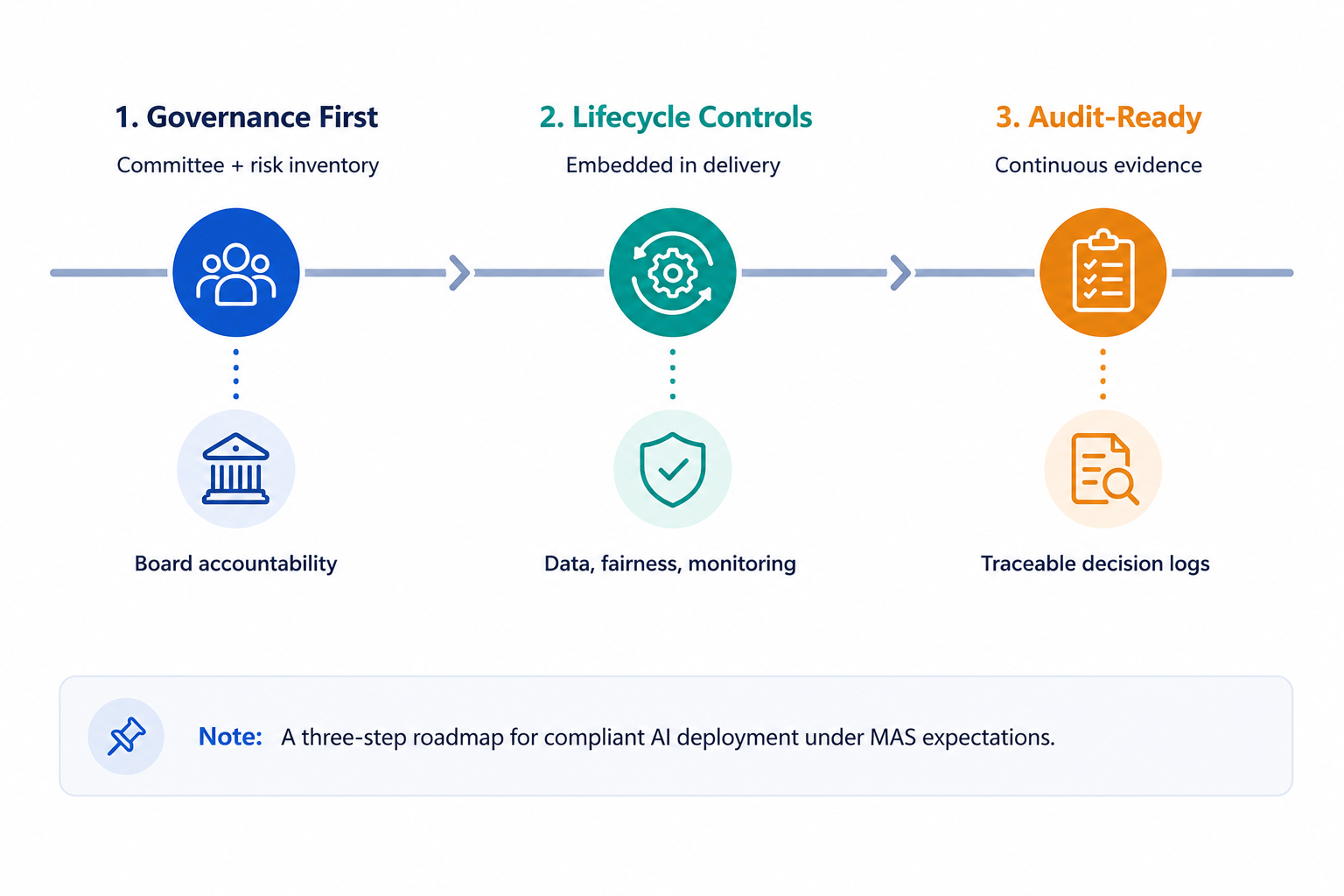
Establish governance foundations first, then embed controls throughout the AI lifecycle before focusing on audit readiness. Treat each stage as a distinct implementation milestone with clear ownership, ensuring governance evolves into a continuous operational capability rather than a one-time compliance exercise.
Takeaway: Sequence matters. Institutions that jump straight to audit preparation without first fixing governance and lifecycle controls end up documenting gaps rather than closing them, which auditors notice immediately.
NORA – SmartDev’s AI Adoption Accelerator
NORA is SmartDev’s AI Adoption Accelerator: a structured, four-layer platform of pre-built, reusable AI components combined with a proven delivery methodology. Instead of building AI infrastructure from scratch on every engagement, NORA gives financial institutions a fast, low-disruption path from raw enterprise data to autonomous, audited action.
A Progressive Capability Stack, Layer by Layer
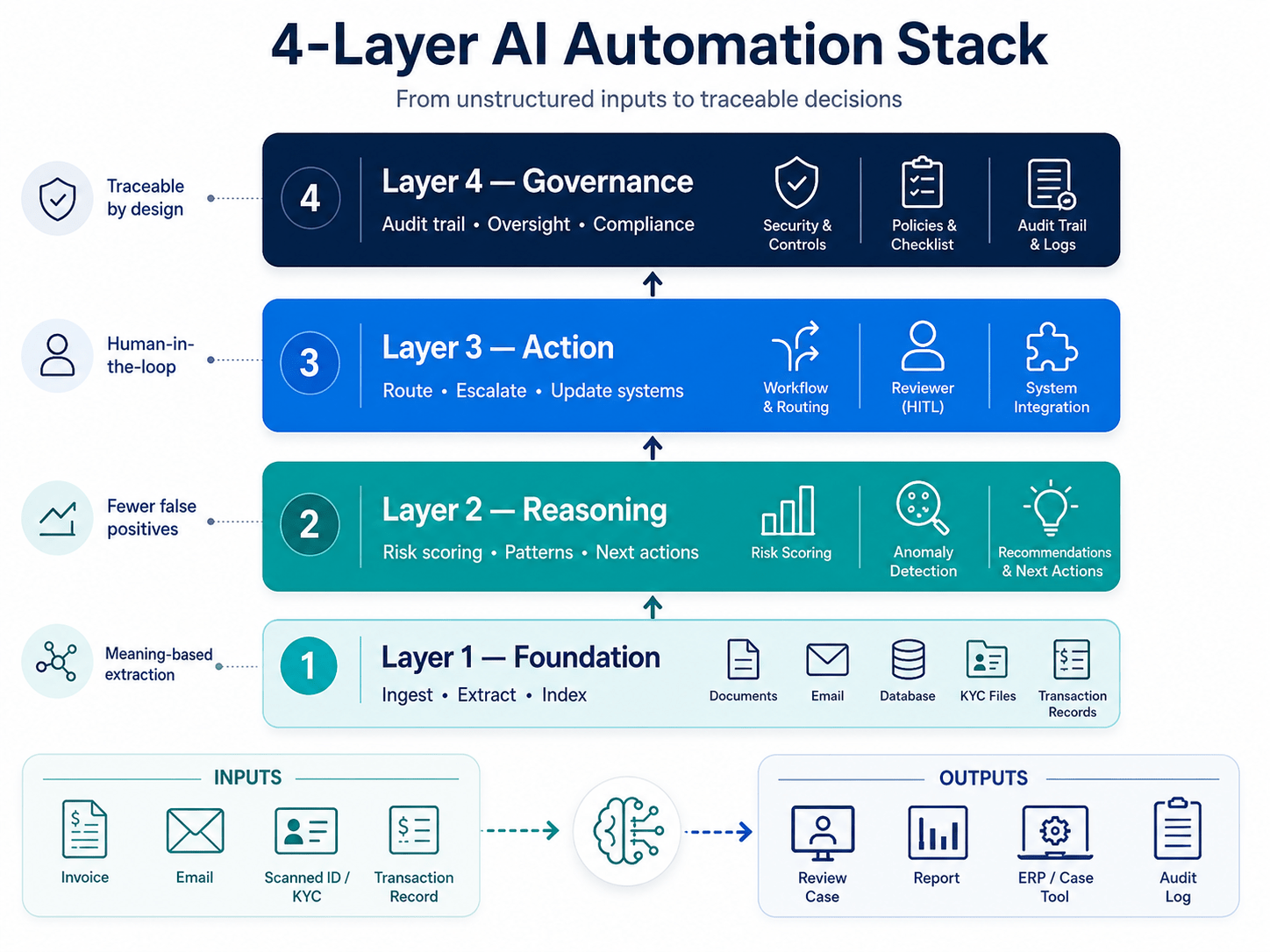
The stack reads from bottom to top because it reflects how raw enterprise data becomes an auditable, defensible decision. Each layer relies on the quality of the one below it. A weak foundation can undermine every layer above. Institutions do not need to deploy all four layers at once. They can start with the first two and expand as confidence grows. That is why NORA is designed as an expandable capability stack, not a one-time implementation project.
Layer 1 – Foundation
This layer converts unstructured inputs, including invoices, emails, scanned KYC files, and transaction records, into structured data. Its core functions include document intake, field-level extraction, and indexing for retrieval. Unlike legacy OCR, it interprets fields by meaning rather than fixed positions. For example, it recognizes that “Gross Weight” and “BRUT WT” represent the same value. Because every downstream risk score depends on this output, institutions should test this layer rigorously during pilot deployments.
Layer 2 – Reasoning
This layer turns the structured data from Layer 1, plus reference data such as sanctions lists and historical transactions, into risk insight: scoring, pattern and anomaly detection, and recommended next actions. Static rule engines match fixed thresholds and generate heavy false positives; this layer instead reads behavioral patterns over time, which cuts false positives without missing genuine risk. This is also the layer a Chief Compliance Officer scrutinizes hardest, since an unexplained risk score gets rejected during legal and risk review almost immediately.
Layer 3 – Action
This layer turns Layer 2 recommendations into actions across connected business systems. It routes cases, escalates high-risk items, drafts reports, and updates ERP or case-management systems. It also cross-checks documents against existing business data. This catches mismatches before a reviewer opens the file. The layer defines how human-in-the-loop review works in practice. Low-risk cases are processed automatically, while high-risk cases are escalated for human review.
Layer 4 – Governance
This is the oversight layer, sitting above the other three. It makes every decision traceable instead of processing individual cases. The audit trail is generated automatically as the workflow runs, not as a separate reporting task. It also supports ongoing oversight under frameworks such as GDPR and ISO 27001. Because the audit trail builds itself during execution, this layer enables NORA’s typical six-to-eight-week delivery timeline. Learn more in our companion article on closing the AI readiness gap, which explains how organizations typically choose their starting layer.
Built for Compliance Workflows
For compliance-specific use cases, NORA is a fully managed service that designs, builds, and operates AI-assisted compliance workflows for financial institutions. It combines document intake, sanctions and PEP screening, adverse media checks, confidence scoring, human review escalation, and final disposition logging. Every decision automatically generates a structured, timestamped, and audit-ready record. Learn how NORA makes every decision regulatorily defensible, or explore how the same governance approach supports AI-native compliance for RegTech firms.
Time to Value
NORA’s compliance audit trail capability typically goes live in six to eight weeks, following a one-week discovery phase that maps the existing process and defines the logging standard, with full return on investment generally realized within six to nine months. Our AI Delivery Blueprint white paper and the guide to what an AI Adoption Accelerator is walk through the underlying methodology in more detail.
Takeaway: A governance policy document and a working audit trail are two different deliverables. NORA’s four layers exist precisely to close that gap: Foundation and Reasoning produce the insight, Action executes on it, and Governance turns the whole chain into the defensible record a regulator will actually ask to see.
Frequently Asked Questions
Does the MAS TRM Guidelines cover artificial intelligence directly?
No. The 2021 TRM Guidelines focus on general technology and cyber risk. MAS addresses AI specifically through the FEAT Principles, the AI Model Risk Management paper, and the AI Risk Management Guidelines (AIRG) consultation paper.
Are the proposed AI Risk Management Guidelines mandatory yet?
As of this writing, the AIRG remains a consultation paper. Institutions should prepare now because its core expectations are unlikely to change substantially. These include board accountability, AI inventories, and lifecycle controls once the guidance is finalized.
Does using a third-party AI vendor reduce our compliance obligations?
No. MAS is explicit that financial institutions remain accountable for AI outcomes even when a third-party vendor supplies the underlying model. See our related piece on why your AI vendor is now a MAS third-party risk.
What size of financial institution does the AIRG apply to?
All MAS-regulated financial institutions fall within scope, from small payment service providers to major banks. Implementation depth scales with institution size and the materiality of its AI use, not the type of license alone.
How long does it take to get an audit-ready AI compliance workflow live?
With SmartDev’s NORA, the compliance audit trail capability typically goes live within six to eight weeks. The implementation begins with a one-week discovery phase. Most organizations realize full ROI within six to nine months.
Conclusion
The MAS TRM Guidelines were never intended to regulate AI on their own. AI-specific expectations build on this foundation through FEAT, model risk management guidance, and the AIRG. Together, they create a connected governance framework for AI. Institutions aligning with this framework will adapt more quickly when the final guidelines are released.
Getting Started with SmartDev
SmartDev’s BFSI/FinTech practice has already delivered systems that map directly onto the pillars covered above. Our AI-powered invoice processing case study shows document AI running with full audit visibility. Our AI agent transformation case study in fintech demonstrates human-oversight design for autonomous systems. Our insurance document processing case study covers the reliance and materiality questions insurers face daily.
Beyond NORA, our AI consulting services help institutions translate MAS’s proportionality principle into practical governance. They develop structured use-case inventories and risk-tiering models. Our AI development services, machine learning development services, and MLOps services build and maintain monitoring, explainability, and audit-trail infrastructure. Regulators increasingly expect these capabilities across enterprise AI systems. Our generative AI development services apply the same governance discipline to large language model deployments.
Ready to see where your AI governance actually stands against MAS’s expectations?
Contact SmartDev today to schedule a working session with our BFSI and AI compliance specialists. Bring your current AI use cases, and we’ll map them against the TRM and AIRG control framework together.