

TL;DR
- AMS definition: Application Management Services (AMS) provide ongoing support, maintenance, security, performance management, and continuous improvement across the application lifecycle.
- Core AMS activities: Services typically include application monitoring, troubleshooting, patching, upgrades, performance tuning, incident response, integration, and customization.
- AMS delivery models: Organizations can manage AMS in-house, outsource it to a provider, or use a hybrid model across on-premises, cloud, and multi-cloud environments.
- Best-fit applications: AMS is most valuable for business-critical applications that require high availability, specialized expertise, and support for growing technical complexity.
- AMS success factors: Effective AMS depends on clear SLAs, defined escalation procedures, security ownership, measurable KPIs, strong governance, and transparent provider contracts.
Introduction
Business-critical applications must remain stable, secure, responsive, and adaptable as user demands, technologies, and operational priorities change. Break-fix support alone is no longer sufficient, particularly when application failures, slow performance, security gaps, or outdated integrations can disrupt essential business processes.
In this article, Application Management Service, or AMS, refers specifically to the structured management, support, maintenance, and continuous improvement of business applications throughout their operational lifecycle. AMS combines day-to-day application support with monitoring, optimization, security management, upgrades, integration, and long-term alignment with business needs.
This guide explains what AMS includes, how different delivery models work, where it creates value, and which risks organizations should consider. It also provides a practical framework for evaluating AMS providers, service-level agreements, technical capabilities, and long-term fit, helping both definition seekers and service buyers make more informed decisions.
What Are Application Management Services (AMS)?
Application Management Services (AMS) refer to the ongoing management, support, maintenance, and improvement of business applications after they enter operational use. In an outsourced model, IBM defines AMS as transferring responsibility for managing and supporting enterprise applications to a specialist third-party provider. However, organizations may also perform these responsibilities internally or divide them between internal teams and an external provider through a hybrid model.
AMS helps organizations keep applications available, secure, reliable, and suitable for changing business requirements. Its scope can cover monitoring and incident resolution as well as upgrades, performance optimization, security management, functional enhancements, modernization, and service governance. The precise responsibilities depend on the application portfolio, operating model, service agreement, and level of support required.
AMS operates within the broader application lifecycle. Application Lifecycle Management covers an application from planning and development through deployment, support, maintenance, change, and eventual retirement. AMS is primarily concerned with the operational and improvement stages of that lifecycle, although a mature engagement may also support modernization or replacement planning.
What AMS Includes: A Five-Part Scope Framework
The scope of Application Management Services can be understood through five connected responsibilities: run, maintain, improve, modernize, and govern. Not every AMS agreement includes all five. Some providers focus mainly on operational support, while others manage applications more comprehensively across their lifecycle.
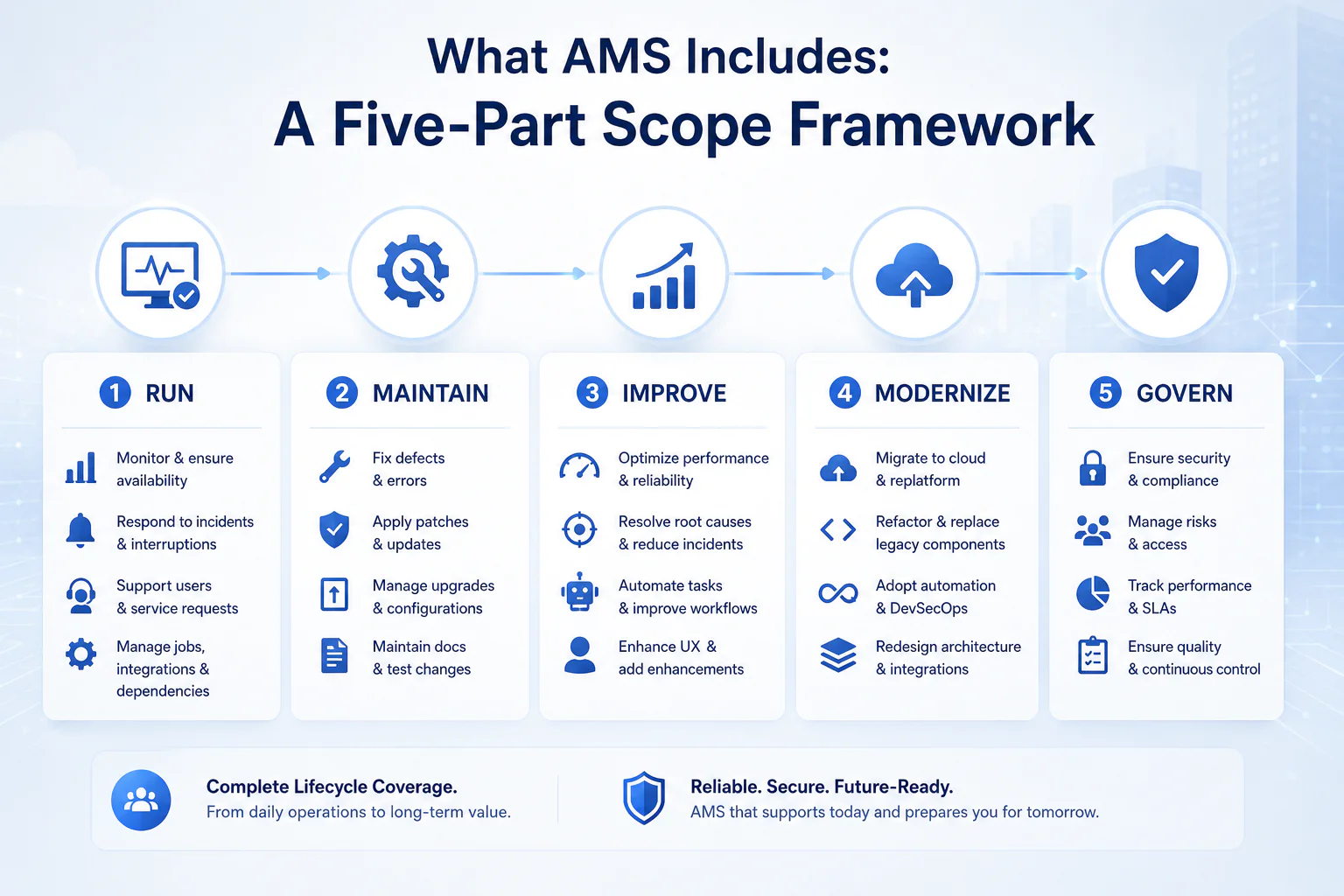
1. Run
The run responsibility covers the daily operation and support of an application. Its goal is to keep the system available, responsive, and usable for employees, customers, and connected platforms.
Typical activities include:
- Monitoring availability, performance, errors, and integrations
- Responding to incidents and user requests
- Troubleshooting technical and functional issues
- Managing production jobs, dependencies, and critical escalations
Run services are commonly measured through availability, response time, resolution time, incident volume, and compliance with agreed support hours.
2. Maintain
The maintain responsibility keeps the application technically stable and prevents avoidable deterioration as platforms, security requirements, APIs, and vendor products change.
Key activities include fixing defects, applying patches and upgrades, maintaining configurations and integrations, testing changes, and addressing compatibility or end-of-support risks.
Regular maintenance reduces operational disruption, security exposure, and technical debt.
3. Improve
The improve responsibility enhances an existing application without necessarily replacing it. The focus may include performance, reliability, usability, automation, scalability, or business-process efficiency.
Common improvements include:
- Optimizing slow functions and database queries
- Eliminating recurring incidents through root-cause remediation
- Improving integrations, workflows, and user experience
- Automating repetitive tasks and preparing for higher demand
This distinguishes mature Application Management Services from basic support: the goal is not only to restore service, but also to strengthen the application over time.
4. Modernize
The modernize responsibility addresses applications that remain valuable but can no longer meet current business, technical, security, or scalability requirements.
Modernization may involve refactoring legacy components, migrating to cloud or hybrid environments, replacing unsupported technologies, redesigning integrations, or introducing DevSecOps and automation practices.
Because modernization often requires significant architectural change, it may sit outside the standard AMS contract. However, the provider should identify modernization risks and help plan the appropriate response.
5. Govern
The govern responsibility defines how AMS performance, risk, ownership, and change are managed. Strong governance creates accountability, visibility, and consistent service delivery.
It typically covers:
- Service scope, ownership, and service-level agreements
- Incident, problem, change, and release management
- Security, compliance, capacity, and technical-debt reviews
- Documentation, knowledge transfer, and service improvement planning
- Coordination across internal teams, vendors, and application owners
Governance connects operational support, maintenance, security, and improvement into one structured service model.
This five-part structure defines the scope of an AMS agreement – which responsibilities are included and where the contract’s boundaries sit. It answers what the provider is responsible for, not how that responsibility gets carried out on a daily basis. That operational side is covered by a second framework, built around eight connected capabilities.
How AMS Differs from Related IT Services
AMS vs. Regular IT Support
Regular IT support usually addresses broad technology issues such as account access, workplace devices, connectivity, standard software, and user-reported incidents. It is often organized around restoring service after a problem occurs.
AMS is application-specific and lifecycle-oriented. An AMS team needs knowledge of the application’s architecture, code, configurations, databases, integrations, users, and business processes. It may resolve incidents, but it also monitors application health, manages changes, improves performance, reduces recurring problems, and plans for future requirements.
In simple terms, regular IT support asks, “How do we fix this user’s immediate issue?” AMS asks, “How do we keep this application reliable, secure, adaptable, and valuable over time?”
AMS vs. Application Support
Application support is a component of AMS, not a complete synonym for it.
Application support normally focuses on user requests, incident resolution, troubleshooting, defect correction, and operational assistance. AMS can include all of these activities but may extend further into optimization, enhancement, security, release management, modernization, governance, and strategic planning.
A service limited to ticket handling and bug fixing should therefore be described as application support rather than comprehensive Application Management Services.
AMS vs. Software Development
Software development focuses primarily on designing, building, testing, and deploying new applications or major software capabilities. AMS focuses on operating, maintaining, and improving applications that are already in use.
The boundary is not always absolute. An AMS team may develop minor enhancements, automate workflows, update integrations, or modify existing features. However, a major product build, complete redesign, or large-scale replacement normally belongs within a separate application-development or modernization project.
AWS distinguishes the software development lifecycle from the broader application lifecycle: development represents one stage, while lifecycle management continues through production, support, maintenance, and eventual retirement.
| Comparison | Primary Focus | Typical Scope | Key Distinction from AMS |
|---|---|---|---|
| Regular IT Support | Resolving general technology issues | Accounts, devices, connectivity, standard software, and user incidents | Reactive and broad; AMS is application-specific, proactive, and focused on long-term reliability, security, and value. |
| Application Support | Keeping an application operational | User requests, troubleshooting, incident resolution, defect fixes, and operational assistance | Application support is one component of AMS. AMS also covers optimization, releases, security, governance, modernization, and planning. |
| Software Development | Building new applications or major capabilities | Design, coding, testing, and deployment | Development creates or significantly changes software, while AMS manages applications already in use. |
| Application Management Services | Managing the full operational lifecycle of an application | Monitoring, support, maintenance, enhancement, security, releases, governance, and modernization planning | AMS combines daily support with continuous improvement and lifecycle management. |
| Key Takeaway | AMS goes beyond fixing incidents | It keeps existing applications reliable, secure, adaptable, and valuable throughout their operational lifecycle. | It connects operational support, maintenance, improvement, governance, and modernization within one service model. |
How AMS Scope Is Defined
There is no universal AMS package. The service scope should be defined according to the organization’s applications, risks, capabilities, and operating requirements.
An AMS agreement should clarify:
- Which applications, environments, and integrations are covered
- Whether support includes Level 1, Level 2, and Level 3 responsibilities
- Required service hours and on-call coverage
- Incident priorities, response times, and resolution targets
- Responsibility for security, compliance, upgrades, and releases
- The boundary between support, enhancement, and project work
- Performance measures, reporting processes, and review frequency
- Ownership of documentation, source code, tools, and knowledge
- Responsibilities retained by internal IT and business teams
AMS may be delivered by an internal team, fully outsourced to a managed service provider, or operated through a hybrid model. The correct approach depends on the criticality of the applications, available internal expertise, desired level of control, regulatory obligations, and the risks the organization is prepared to transfer.
Ultimately, Application Management Services should not be treated as a generic support package. They are a defined operating model for running, maintaining, improving, modernizing, and governing business applications according to agreed responsibilities and measurable service expectations.
When “AMS” Means Something Else: Clarifying the IT Context
The acronym AMS is used in multiple industries and contexts, which can lead to confusion if it is not clearly defined. While this article focuses on Application Management Services, the same abbreviation may refer to entirely different concepts depending on the domain.
For example, AMS can also stand for:
- Asset Management System – used in industries such as manufacturing, utilities, and logistics to track and manage physical assets
- Advanced Metering System – commonly used in energy and utilities for smart metering infrastructure
- Association Management System – software platforms used by membership-based organizations to manage members, events, and communications
- Airspace Management System – used in aviation and defense contexts
- Automated Manifest System – used in shipping and customs processing
Because of this overlap, it is important to clarify the meaning of AMS in any technical or business discussion. In IT and enterprise services, AMS almost always refers to Application Management Services, particularly when discussing outsourcing, managed services, or application lifecycle operations.
When reviewing vendor proposals, service agreements, or technical documentation, organizations should confirm that AMS is being used in this specific sense. Misinterpretation can lead to incorrect assumptions about scope, responsibilities, or expected outcomes.
In summary, while AMS is a widely used acronym, its meaning depends on context. Within IT service management and enterprise application operations, it should be understood as Application Management Services, encompassing the structured approach to running, maintaining, improving, modernizing, and governing business applications over time.
How AMS Has Evolved From Reactive Support to Proactive Application Operations
Application management has evolved as business applications have become more connected, cloud-based, and critical to daily operations. Traditional support mainly restored service after failures. Modern Application Management Services add prevention, automation, observability, security, resilience, continuous improvement, and modernization planning.
Not every application requires this model. Reactive support may remain suitable for stable, low-risk systems. Proactive AMS becomes more valuable when applications are critical, integrated, regulated, frequently updated, or expected to support growth.
Traditional Application Support: The Reactive Model
Traditional application support begins when a user reports an error or a system stops working. A ticket is created, assigned, investigated, and closed after service is restored.
This approach remains necessary, but it provides limited protection against recurring or emerging problems. Teams may repeatedly fix symptoms while delaying upgrades, patches, and root-cause analysis. Basic monitoring may confirm that an application is online without revealing declining performance across databases, integrations, or user journeys.
Ticket volume, response time, and resolution time remain useful measures. However, they do not show whether the application is becoming more secure, resilient, efficient, or adaptable.
Modern AMS: Prevention, Automation, Observability, and Continuous Improvement
Modern Application Management Services manage application performance and business value throughout the operational lifecycle. Incident response remains important, but it is combined with proactive monitoring, automation, resilience engineering, security management, controlled change, and optimization.
IBM associates modern application management with AI, intelligent automation, DevSecOps, platform engineering, site reliability engineering, and predictive issue detection. Accenture also positions AMS as a model for continuous lifecycle improvement rather than routine maintenance alone.
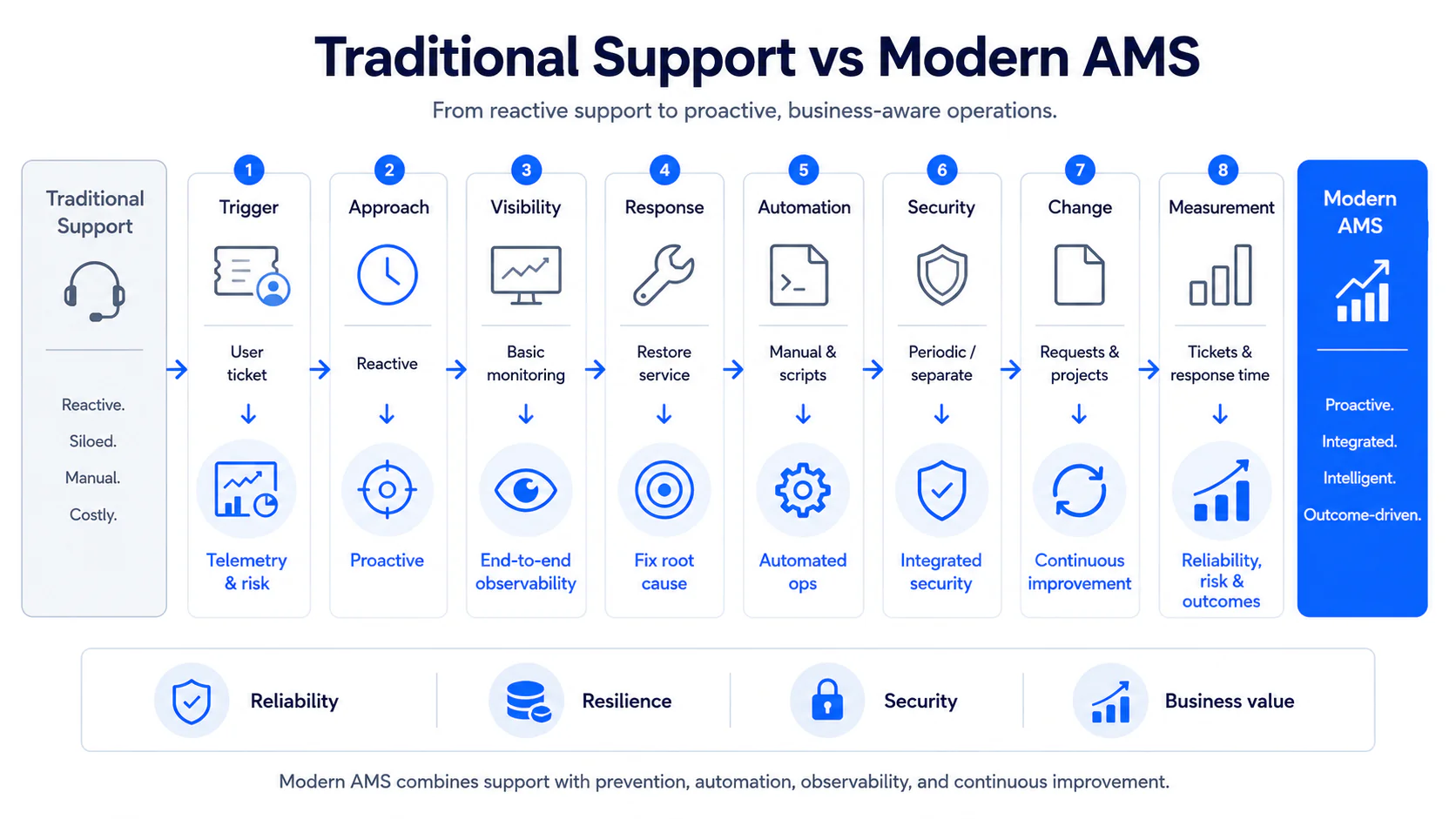
Traditional Support Versus Modern AMS
| Area | Traditional application support | Modern Application Management Services |
|---|---|---|
| Primary trigger | A user reports a problem or an application fails | Monitoring, telemetry, trends, risks, and business events trigger action |
| Operating approach | Reactive and ticket-driven | Proactive, preventive, and continuously improving |
| Visibility | Basic availability and infrastructure monitoring | End-to-end observability across applications, dependencies, integrations, and user journeys |
| Incident response | Restore service and close the ticket | Restore service, assess impact, investigate root causes, and prevent recurrence |
| Automation | Limited scripts and manual intervention | Automated monitoring, diagnostics, remediation, testing, deployment, and routine operations |
| Security | Security work handled separately or periodically | Security, patching, vulnerability management, and compliance integrated into operations |
| Application change | Changes handled as separate requests or projects | Controlled and continuous release, enhancement, optimization, and modernization |
| Measurement | Ticket counts, response times, and resolution times | Reliability, resilience, experience, change performance, risk, cost, and business outcomes |
| Business alignment | Focused mainly on operational continuity | Prioritized according to application criticality, customer impact, risk, and business goals |
Proactive Monitoring and Observability
Traditional monitoring shows whether an application is available. Observability explains how the application behaves and why problems occur.
Modern AMS combines logs, metrics, traces, and user-experience data across the application stack. This helps teams detect performance degradation before it becomes an outage. For example, observability may reveal that slow transactions originate from a database bottleneck or unstable integration.
Prevention and Root-Cause Management
Modern AMS aims to prevent recurring incidents rather than repeatedly correct visible symptoms. It connects Incident Management with structured problem management.
Incident Management restores normal service after disruption. Problem management investigates underlying causes such as faulty code, misconfiguration, or unstable integrations. Together, they reduce incident frequency and limit future business impact.
Automation and AI-Assisted Operations
Automation improves the speed and consistency of monitoring, maintenance, deployment, diagnostics, and incident handling. It also reduces the manual effort required for predictable operational tasks.
AI – Assisted tools help prioritize alerts, detect anomalies, and identify patterns across complex environments. Specialists can then focus on issues that require deeper technical knowledge or business judgement.
Resilience Rather Than Availability Alone
Availability measures whether users can access an application. Resilience measures how effectively the application withstands disruption and recovers from failure.
Modern AMS strengthens resilience through capacity planning, failover design, recovery testing, and reliability engineering. The required level should reflect business criticality. Revenue-generating and customer-facing systems usually require stronger controls than low-impact internal tools.
Security Integrated Into Application Operations
Modern AMS treats security as an ongoing operational responsibility. Patching, vulnerability management, access control, secure releases, and monitoring should be integrated into regular application processes.
Compliance activities may include audit support, risk tracking, and incident escalation. Responsibilities must be clearly divided between internal teams, AMS providers, and technology vendors.
Continuous Optimization
Applications may become slower, more expensive, or less reliable as usage and complexity increase. Continuous optimization addresses this deterioration before it affects business operations.
Performance tuning improves response times and resource efficiency. Scalability planning prepares systems for increased demand. Cost optimization reduces unnecessary infrastructure and software consumption without weakening service quality.
Continuous Change and Application Modernization
Modern AMS connects application operations with ongoing change. Applications must adapt to new business requirements, regulations, integrations, and technologies.
Smaller changes may include defect fixes and functional enhancements. Structural improvements may address architecture, integrations, or technical debt. Larger modernization decisions may involve replatforming, refactoring, replacing, consolidating, or retiring applications.
AMS teams provide operational evidence to support these decisions. They can identify which components create the greatest cost, risk, or performance limitations.
Strategic and Business-Aware Application Operations
Modern AMS prioritizes work according to business impact, risk, and urgency. Technical activity should support the applications and processes that matter most.
Business impact may involve revenue, customer experience, employee productivity, or operational continuity. Risk includes security, compliance, dependencies, and technical debt. Priorities may also change during product launches, peak periods, or rapid growth.
The Business Outcomes Modern AMS Is Designed to Influence
Modern AMS should not be judged only by ticket volume. Its value should be measured through improvements in reliability, performance, security, change delivery, cost control, and user experience.
More Reliable Business Operations
Proactive monitoring and preventive maintenance reduce avoidable disruption. Availability, incident frequency, and recovery time show whether operational reliability is improving.
More Predictable Application Performance
Continuous monitoring helps applications remain stable under changing demand. Response time, error rate, and throughput indicate whether performance remains consistent.
Stronger Operational Resilience
Resilient applications recover quickly when failures occur. Recovery success, failover performance, and resilience testing show how effectively systems handle disruption.
Faster and Safer Change
Automation and DevOps practices support more frequent and reliable releases. Deployment frequency, change success rate, and rollback frequency measure both speed and stability.
Reduced Security and Compliance Exposure
Integration security practices reduce application risk through timely patching, vulnerability management, secure configuration, and stronger audit readiness.
Useful indicators include unresolved vulnerabilities, patching time, security incidents, and audit outcomes.
Better Use of Internal Technology Capacity
AMS reduces the operational workload placed on internal teams. Employees can spend more time on architecture, innovation, transformation, and strategic business priorities.
Greater Cost Visibility and Control
A structured AMS model clarifies responsibilities, resource use, and service scope. This helps organizations identify inefficiencies and manage application costs more effectively.
Better Modernization Decisions
Operational data helps organizations decide whether to maintain, upgrade, replace, or retire applications. These decisions should reflect performance, cost, risk, technical debt, and future business requirements.
Improved Customer and Employee Experience
Reliable and responsive applications create smoother customer journeys and employee workflows. Reduced downtime and stronger performance also improve trust in business systems.
Choosing the Appropriate Level of AMS Modernization
The appropriate AMS model depends on application criticality, complexity, risk, and rate of change. Stable, low-impact applications may only require responsive support and scheduled maintenance.
Critical or frequently changing applications benefit from proactive monitoring, automation, stronger governance, and continuous improvement. Regulated and highly integrated systems may also require advanced security, observability, and resilience practices.
Modern AMS is therefore not traditional support with additional tools. It is a structured approach to managing application reliability, security, performance, adaptability, and long-term business value.
Core Components of Application Management Services
Application Management Services (AMS) provide a structured and repeatable way to keep business applications stable, secure, and aligned with changing business and technology needs. Rather than focusing on isolated tasks, AMS establishes an operating model that ensures applications continue to deliver value throughout their lifecycle.
A typical AMS model includes eight connected capabilities: observe, respond, maintain, support, optimize, protect, integrate, and improve. These capabilities should not be treated as separate silos. Instead, they form a continuous cycle where insights from one activity inform and strengthen the others. For example, monitoring may detect an issue, incident management restores service, problem analysis identifies the root cause, and maintenance or improvement activities prevent recurrence.
While the five-part framework defines what’s in scope, the following model describes how that scope is actually delivered day to day. These eight capabilities – observe, respond, maintain, support, optimize, protect, integrate, and improve – are the operating rhythm behind each of the five responsibilities above.
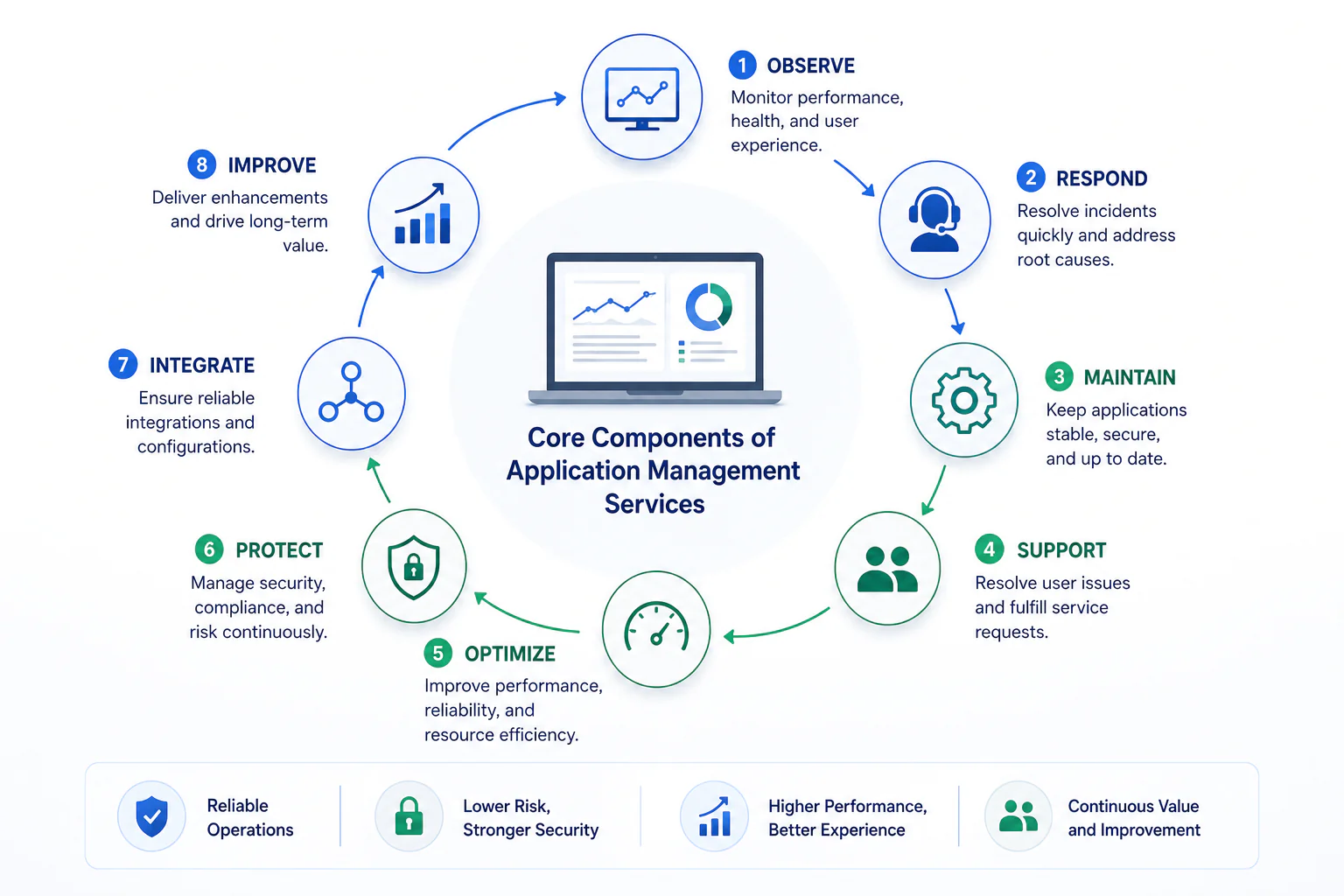
Observe: Application Monitoring and Observability
Monitoring and observability provide continuous visibility into application health, performance, dependencies, and user experience. While traditional monitoring focuses on whether systems are running, observability goes further by helping teams understand why issues occur and how different components contribute to system behavior.
AMS teams track key operational signals such as metrics, logs, traces, and user experience data to detect problems early and diagnose them accurately. Effective monitoring should be designed around business-critical workflows rather than just system uptime. For example, an application may be technically available, but if users cannot complete transactions or workflows, it still represents a failure from a business perspective.
Responsibility for monitoring is typically shared. The AMS provider manages tools, dashboards, and alerting mechanisms, while the client defines which applications, processes, and performance thresholds are most critical. Success is measured not by the number of alerts generated, but by how quickly and accurately issues are detected and understood before they impact users.
Respond: Incident and Problem Management
Incident management focuses on restoring application service as quickly as possible when disruptions occur, while problem management aims to identify and eliminate the root causes of recurring or high-impact issues. These two functions are closely related but serve different purposes: one addresses immediate impact, and the other ensures long-term stability.
The AMS provider typically handles incident resolution, including triage, investigation, coordination, and communication during disruptions. In complex environments involving multiple teams or vendors, responsibilities must be clearly defined to avoid delays and confusion during critical incidents.
Performance in this area is measured by response speed, resolution time, and the ability to reduce recurring issues over time. Simply closing tickets is not sufficient; the real objective is to improve application reliability by preventing the same problems from happening again.
Maintain: Maintenance, Patching, and Upgrades
Maintenance ensures that applications remain stable, secure, and compatible with evolving technologies and dependencies. This includes correcting defects, applying security patches, updating components, and managing version upgrades across the application stack.
All maintenance activities should follow a controlled change process that includes proper assessment, testing, approval, and validation. This helps reduce the risk of introducing new issues while implementing necessary updates. Responsibilities are often shared across AMS providers, infrastructure teams, cloud providers, and software vendors, making coordination essential.
Success in maintenance is reflected in reduced technical risk, fewer incidents caused by outdated components, and applications consistently operating within supported and secure versions.
Support: Application Support and Service Requests
Application support ensures that users can effectively use the system to complete their work and resolve issues that affect day-to-day operations. This includes handling functional problems, answering user questions, and processing standard service requests such as access changes or configuration updates.
Support is often structured into multiple levels, ranging from basic request handling to advanced technical troubleshooting. Clear boundaries between incidents, service requests, and enhancement requests are important to ensure that each type of work is handled appropriately and efficiently.
The quality of support is measured by resolution speed, user satisfaction, and the ability to restore business operations quickly and consistently. Effective support not only resolves issues but also improves user confidence in the application.
Optimize: Performance and Reliability
Optimization ensures that applications remain responsive, scalable, and reliable as usage patterns and business demands evolve. This includes improving performance, managing capacity, and strengthening system resilience to handle both normal and peak workloads.
Some optimization efforts can be achieved through configuration tuning or infrastructure adjustments, while others may require deeper changes such as code improvements or architectural redesign. As a result, responsibilities are often shared between AMS providers, infrastructure teams, and development teams.
Key performance indicators include response time, system availability, throughput, and stability during peak usage. Effective optimization ensures that applications continue to deliver consistent performance without unnecessary cost or risk.
Protect: Security and Compliance
The protection component focuses on reducing security, privacy, and compliance risks as part of daily application operations. This includes managing vulnerabilities, controlling access, protecting sensitive data, and supporting audit and regulatory requirements.
Security responsibilities are typically distributed across multiple teams, including AMS providers, cybersecurity teams, and business stakeholders. Clear ownership and coordination are critical to ensure that risks are identified, prioritized, and addressed in a timely manner.
AMS providers support the execution of security controls and processes, but overall accountability remains with the organization. Effectiveness is measured by how quickly risks are mitigated, how well critical vulnerabilities are resolved, and how consistently compliance requirements are met.
Integrate: Integration and Configuration Management
Modern applications rely on multiple interconnected systems, making integration and configuration management essential for maintaining reliable operations. Integration management ensures that data flows and system interactions function correctly, while configuration management controls how applications behave in different environments.
Failures often occur at integration points, such as APIs or data exchanges, even when individual systems are functioning properly. Therefore, clear ownership, monitoring, and coordination across teams are essential to quickly identify and resolve issues.
Even small configuration changes can have significant impacts on application behavior, business processes, or data accuracy. Success in this area is measured by stable data flows, low failure rates, and accurate end-to-end processes across connected systems.
Improve: Enhancement and Modernization
Improvement ensures that applications continue to meet evolving business needs and user expectations over time. This includes implementing small enhancements, improving usability, addressing technical debt, and adapting applications to new requirements.
AMS teams are well positioned to identify improvement opportunities based on operational insights such as recurring issues, user feedback, and performance limitations. However, larger changes or modernization efforts often require separate projects with dedicated resources and governance.
The focus of improvement should be on delivering meaningful outcomes, such as better user experience, reduced manual effort, increased efficiency, and fewer recurring issues. Continuous improvement helps ensure that applications remain relevant and valuable in a changing environment.
How the Components Work Together
These eight components form a continuous and interconnected cycle that supports the full lifecycle of application management. Monitoring helps detect issues early, incident response restores service, maintenance ensures stability, support enables users, optimization improves performance, protection reduces risk, integration maintains connectivity, and improvement drives long-term value.
A strong AMS model is not defined by the number of services offered, but by how effectively these activities work together. When properly integrated, they create a cohesive system that delivers reliable, secure, and adaptable applications aligned with business goals.
Choosing an AMS Operating Model
An Application Management Services (AMS) operating model defines who manages applications, what they are responsible for, where systems run, and how performance is governed.
The right model depends on factors such as application criticality, compliance needs, internal skills, architecture complexity, service hours, and desired level of control. AMS can be delivered in-house, outsourced, or through a hybrid approach. Separately, applications may run on-premises, in the cloud, or across hybrid environments. In short, the delivery model defines who does the work, while the environment model defines where it runs.
Should AMS Be Managed In-House or Outsourced?
There is no single best option.
In-house AMS suits organizations that need strong control, deep business knowledge, or must meet strict regulatory requirements. Outsourced AMS is more suitable when specialized skills, scalability, or faster setup are needed. A hybrid model often works best, combining internal ownership with external operational support.
The decision should be based on trade-offs, not assumptions about cost or control.
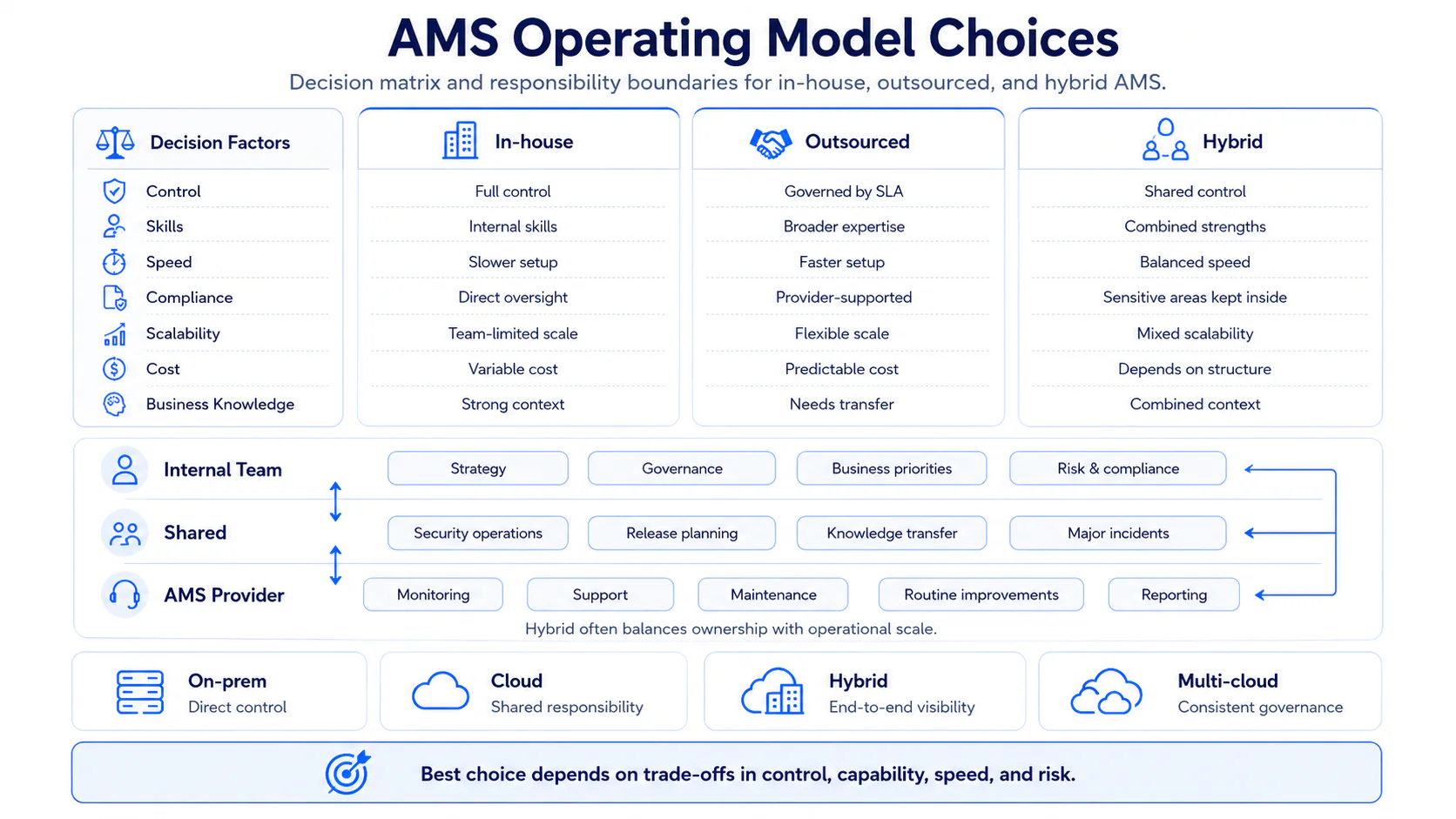
AMS Operating-Model Decision Matrix
| Decision factor | In-house AMS | Outsourced AMS | Hybrid AMS |
|---|---|---|---|
| Control | Full internal control | Managed via contracts and governance | Shared control |
| Skills | Depends on hiring capability | Access to broader expertise | Combined strengths |
| Speed | Slower to build | Faster to deploy | Balanced |
| Compliance | Direct oversight | Supported via provider controls | Sensitive areas retained internally |
| Scalability | Limited by staffing | Flexible via provider | Mixed |
| Cost | Variable due to staffing and tools | Predictable but needs scope clarity | Depends on structure |
| Business knowledge | Strong internal context | Requires knowledge transfer | Combined |
| Maturity needed | High internal capability | Strong vendor management | High coordination |
In-House AMS
In-house AMS relies on internal teams to manage monitoring, support, maintenance, and improvements. It offers strong control and deep understanding of business processes.
This model works well when applications are sensitive, tightly linked to internal operations, or require close collaboration with business teams. However, it demands significant investment in skills, tools, and processes. Organizations must handle staffing, training, coverage, and continuity.
Without proper documentation and cross-training, knowledge can become concentrated in a few individuals, creating risk.
Outsourced AMS
Outsourced AMS assigns responsibilities to a managed service provider. The provider may handle full operations or selected tasks such as support, monitoring, or maintenance.
This model is useful when internal expertise is limited, demand fluctuates, or rapid setup is needed. It provides access to established processes and broader capabilities.
However, risks include loss of knowledge, dependency on the provider, and unclear scope boundaries. These can be managed through strong governance, clear contracts, and retained internal ownership.
Outsourcing does not remove accountability. The organization still owns strategy, compliance, and risk decisions.
Hybrid AMS
Hybrid AMS splits responsibilities between internal teams and a provider. Internal teams typically retain strategy, governance, and business alignment, while the provider handles operational tasks.
This model balances control and capability but requires clear coordination. Shared tools, defined responsibilities, and strong communication are essential. Without them, issues may be passed between teams without resolution.
Choosing the Environment Model
The environment model defines where applications run. Options include on-premises, cloud, hybrid, or multi-cloud. Each has different operational and governance implications.
| Environment | Best suited to | Key consideration |
|---|---|---|
| On-premises | Systems needing direct control or local integration | Coordination across infrastructure teams |
| Cloud | Flexible, scalable applications | Clear shared responsibility |
| Hybrid | Mixed environments | End-to-end visibility |
| Multi-cloud | Diverse or regional needs | Consistent governance |
On-Premises AMS
On-premises systems run on infrastructure controlled by the organization. This suits legacy systems, local integrations, or strict data requirements.
AMS in this model often involves multiple teams managing different layers. Clear responsibility boundaries are essential. It is not inherently more secure; effectiveness depends on internal capability.
Cloud-Based AMS
Cloud AMS supports applications hosted on cloud platforms. While infrastructure is managed by the provider, responsibilities such as application configuration, security, and monitoring remain with the organization and AMS provider.
Cloud enables flexibility and automation but requires clear understanding of shared responsibilities and cost management.
Hybrid and Multi-Cloud AMS
Hybrid and multi-cloud environments combine different platforms, increasing flexibility but also complexity. Teams must manage multiple tools, integrations, and security models.
The key requirement is end-to-end visibility across systems. Monitoring individual components is not enough; the full business process must be observable.
These models should only be used when justified by clear business needs.
Defining the AMS Service Scope
A clear scope is critical. Terms like “application support” are too vague.
The scope should define which applications are covered, their importance, environments, integrations, users, and service hours. It should also distinguish between application support and infrastructure responsibilities.
Integration Ownership must be clearly defined to avoid gaps. Similarly, user support, maintenance, and enhancement work should be separated to prevent scope disputes.
Defining Responsibility Boundaries
Applications often involve multiple teams and vendors. Responsibilities must be defined clearly across processes such as monitoring, incident response, changes, and communication.
A RACI model can help clarify roles, but it must be applied to real operational scenarios, not just documented at a high level.
Governance and Performance Management
Governance ensures the AMS model works effectively over time.
Operational governance focuses on daily activities like incidents and changes. Service governance reviews performance and improvements, often monthly. Strategic governance looks at long-term direction, including roadmap and investment decisions.
Service Levels and Cost Predictability
Service levels should reflect application importance and provider control. Common metrics include availability, response time, and incident resolution.
Cost predictability depends on clear scope. Fixed pricing is only reliable when inclusions and exclusions are well defined. Contracts should explain capacity, additional charges, and transition costs.
Knowledge, Transition, and Exit Requirements
Knowledge management is essential. Documentation, runbooks, and system records must be maintained and updated.
During transition, structured knowledge transfer is required. The contract should also define exit procedures, including documentation handover and support for provider replacement.
Avoiding vendor lock-in is part of good design.
Selecting the Right AMS Operating Model
Before choosing a model, organizations should consider application criticality, internal capabilities, required control, compliance needs, system complexity, and cost expectations.
The best AMS model is not defined by structure alone, but by how well it balances control, capability, scalability, and cost, supported by clear ownership and governance.
Where AMS Delivers Value: Use Cases and Examples
Application Management Services deliver the greatest value when applications are critical to revenue, customer experience, regulatory compliance, or daily operations. In these environments, application failures are not merely technical inconveniences. They can interrupt transactions, delay services, expose sensitive data, and damage customer trust.
The role of AMS varies by industry and application type. Retailers often prioritize scalability during peak demand, healthcare providers focus on availability and data protection, while financial institutions require resilient transaction processing and strict operational controls. AMS is also particularly valuable for organizations managing legacy systems, complex integrations, and gradual modernization initiatives.
Retail & Ecommerce: Managing Demand Spikes and Customer-Facing Applications
Retail and eCommerce applications must remain responsive during seasonal sales, promotional campaigns, product launches, and unexpected increases in customer traffic. A platform that performs normally during an average week may experience significant strain during Black Friday, holiday periods, flash sales, or sudden spikes driven by marketing campaigns.
AMS helps retailers prepare for and manage these fluctuations through continuous monitoring, capacity planning, performance optimization, and structured incident response. Instead of focusing only on infrastructure uptime, AMS ensures that critical customer journeys – such as browsing, searching, adding items to cart, and completing payments – function smoothly under pressure.
In practice, AMS teams monitor storefront availability and response times, track checkout and payment performance, and identify bottlenecks such as slow database queries or overloaded services. They also oversee integrations with payment gateways, inventory systems, and fulfillment platforms, ensuring that all components of the transaction flow operate reliably. During high-value sales periods, AMS supports rapid incident escalation and coordinates system changes around business calendars to minimize disruption.
Modern AMS approaches go beyond isolated system monitoring by focusing on end-to-end customer transactions. A platform may appear operational while customers experience failed payments, inaccurate inventory, or interrupted checkout processes. By monitoring complete workflows, AMS helps identify issues that directly affect revenue and customer satisfaction.
Retail environments also involve multiple interconnected systems. A single order may depend on the storefront, payment provider, inventory system, warehouse platform, customer database, and delivery service. AMS plays a key role in coordinating these dependencies and identifying failures that occur across system boundaries.
For retail organizations, AMS supports consistent digital experiences, faster recovery from disruptions, and better preparation for demand fluctuations. While it cannot eliminate all risks, it significantly improves the organization’s ability to respond effectively when issues arise.
Healthcare: Availability, Security, and Compliance-Sensitive Applications
Healthcare organizations rely heavily on applications to manage patient records, appointments, clinical workflows, billing, diagnostics, and communication. These systems often handle sensitive personal and medical data while supporting time-critical activities, making availability, security, and traceability essential.
AMS in healthcare environments focuses on maintaining stable operations while supporting strict data protection and compliance requirements. Applications commonly supported include electronic health record systems, patient portals, scheduling platforms, telemedicine services, pharmacy systems, and billing applications.
In this context, AMS involves continuous monitoring of application availability and integrations, timely incident response, and structured maintenance activities such as patching and upgrades. It also supports identity and access controls, maintains audit records, and ensures that sensitive data is handled appropriately across environments.
Healthcare systems often depend on multiple interconnected platforms exchanging information in real time. An application may remain technically available while a failed integration prevents laboratory results, insurance data, or patient updates from reaching the correct destination. For this reason, AMS must monitor end-to-end data flows rather than focusing solely on individual systems.
It is important to note that while AMS providers execute operational tasks, healthcare organizations retain responsibility for regulatory compliance, clinical risk, and data governance. Clear definitions of responsibility between providers, internal teams, and external vendors are essential to ensure safe and compliant operations.
AMS delivers value in healthcare by improving application continuity, reducing operational uncertainty, and introducing structured processes for managing systems that cannot rely on reactive support alone.
Financial Services: Transaction Reliability and Regulated Operations
Financial institutions, including banks, fintech companies, insurers, and payment providers, depend on applications that process large volumes of transactions and sensitive financial data. Failures in these systems can disrupt payments, affect customer access, compromise reporting accuracy, and create regulatory risks.
AMS in financial services must therefore balance operational reliability with strong security, traceability, and controlled change management. Applications supported typically include digital banking platforms, payment systems, customer onboarding tools, lending platforms, insurance systems, and fraud detection solutions.
In practice, AMS teams monitor transaction success rates, latency, and error patterns to ensure that financial processes are completed accurately and within acceptable timeframes. They respond to incidents affecting customer services, manage patches and upgrades, and maintain operational records required for audits and regulatory reviews. Integration monitoring is also critical, as financial systems often depend on external networks, identity providers, and data platforms.
A key aspect of AMS in this sector is aligning monitoring with business outcomes. A system may report high availability while transactions are delayed, duplicated, or rejected. Effective AMS focuses on the integrity and completion of transactions rather than technical uptime alone.
Change management is equally important. Even small modifications to transaction logic, reporting rules, or integrations can introduce significant risks. AMS ensures that changes are tested, approved, documented, and monitored carefully to maintain system stability and compliance.
While AMS providers support operational execution, financial institutions remain responsible for overall risk management, compliance, and data protection. Clear governance structures and service agreements are necessary to define roles and ensure accountability.
Legacy Applications, Modernization, and Integration Complexity
AMS is especially valuable for organizations that rely on legacy applications which remain critical but are difficult to maintain, scale, or integrate. These systems may continue to support essential business processes but often depend on outdated technologies, limited documentation, and specialized knowledge.
Challenges in legacy environments typically include unsupported technologies, reliance on a small number of experts, limited monitoring visibility, recurring incidents, and complex or fragile integrations. Over time, maintenance effort increases while the ability to improve the system decreases.
AMS helps stabilize these environments by introducing structured monitoring, documentation, and support processes. This includes building application inventories, improving operational visibility, managing incidents systematically, and identifying technical risks. By reducing dependence on undocumented knowledge, AMS creates a more sustainable support model.
In addition to stabilization, AMS supports incremental modernization. Rather than replacing entire systems at once, organizations can gradually improve specific components, enhance integrations, update user interfaces, and automate operational processes. AMS teams, with their continuous involvement, provide valuable insights into system performance, recurring issues, and technical debt, helping organizations prioritize modernization efforts effectively.
Integration complexity is another area where AMS delivers significant value. Modern business processes often span multiple systems, including cloud services, enterprise platforms, databases, and external vendors. Failures frequently occur at the boundaries between these systems rather than within individual applications.
AMS addresses this by monitoring data exchanges, tracking failed transactions, managing integration credentials, and coordinating changes across system owners. It also supports end-to-end workflow validation and helps resolve issues involving third-party services. Clear responsibility boundaries are essential, as different teams or vendors may control different parts of the integration.
Overall, AMS enables organizations to maintain operational stability while navigating the challenges of legacy systems and complex, interconnected environments.
SmartDev Case Example: High-Availability Application Support
SmartDev supported a public relations platform that required reliable application availability during periods of high traffic and intensive real-time data processing. The platform was used for media monitoring and needed to remain accessible during critical events when demand could increase rapidly.
To meet these requirements, SmartDev provided continuous monitoring, operational support, incident response, and performance management. The focus was on early issue detection, rapid response, and maintaining stable performance under varying load conditions.
The engagement also involved coordinating across the application environment and its supporting infrastructure. Monitoring and operational processes were designed around the platform’s availability and processing needs rather than isolated technical components.
This case demonstrates how AMS can support a business-critical platform by combining proactive monitoring, structured incident management, performance oversight, and coordinated operations. While outcomes vary depending on context, the example highlights how a tailored AMS approach can enhance reliability and support operational continuity in demanding environments.
How to Identify Where AMS Can Create Value
Organizations can identify where AMS will be most effective by examining their application landscape and operational challenges. Key considerations include identifying applications that directly support customers or revenue, systems that require high availability, and areas where performance or recurring incidents are becoming problematic.
It is also important to assess which applications handle sensitive or regulated data, depend on complex integrations, or rely heavily on a limited number of internal experts. Legacy systems that require stabilization before modernization and teams overwhelmed by routine operational tasks are also strong indicators that AMS could provide value.
Ultimately, AMS delivers the greatest benefit when it is aligned with clear business risks or operational needs. The goal is not to outsource all application activities, but to apply the right level of operational support where it can reduce risk, improve reliability, and enhance overall system performance.
Benefits, Trade-Offs, and Success Measures
AMS can meaningfully improve reliability, visibility, expertise access, and responsiveness. These benefits are not automatic, however. They depend on application condition, service scope, provider capability, internal operating maturity, and governance quality.
Organizations should treat AMS as an operating-model decision, not simply a way to transfer support work. A successful engagement balances potential benefits against the risks of transition, external dependency, unclear accountability, security exposure, and poorly designed service measures.
Four questions matter more than the concept itself for every benefit below: what value AMS creates, how that value is delivered, who is accountable for it, and which metrics and governance cadence confirm it is actually happening. A benefit that cannot answer these four questions is a promise, not an outcome.
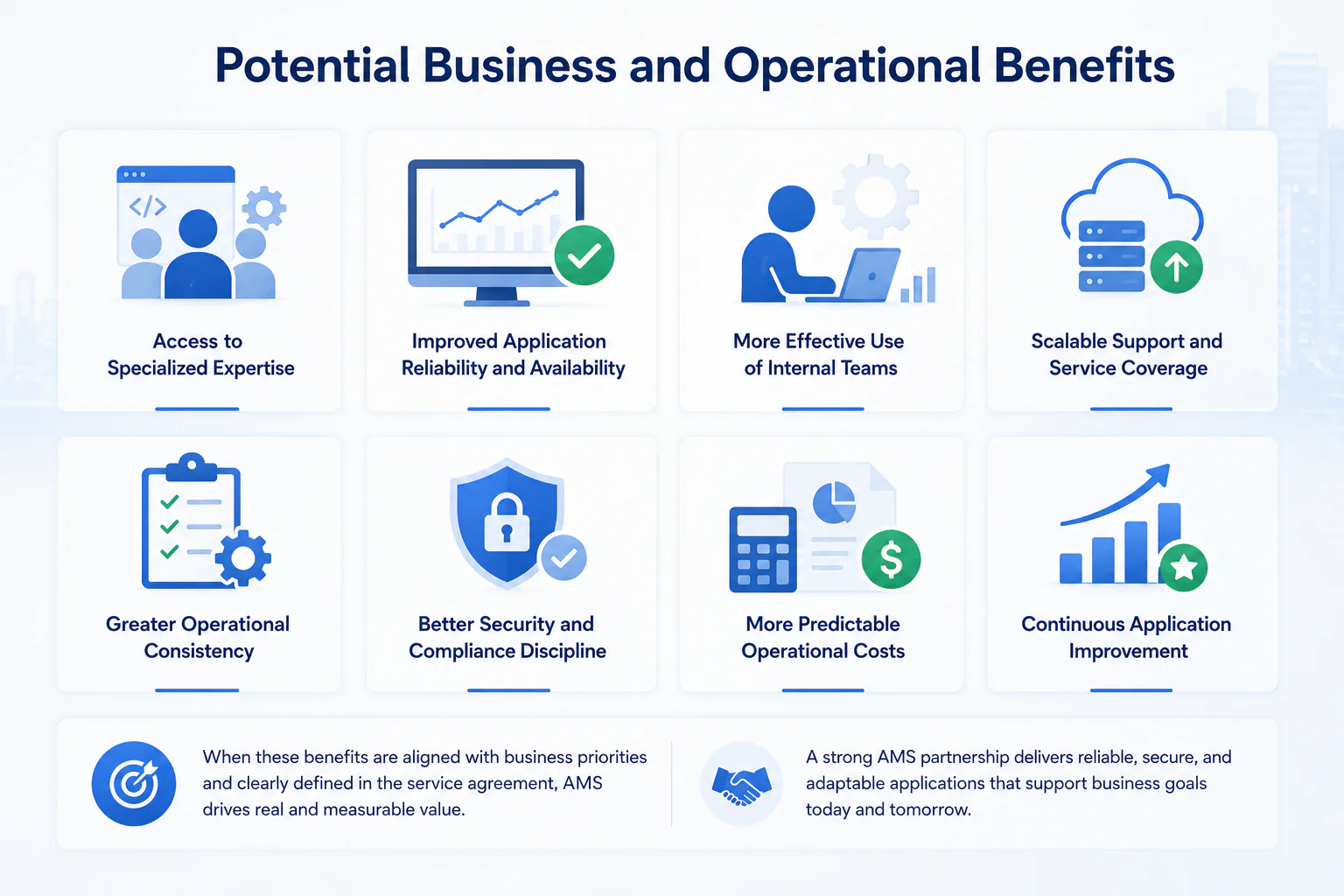
Potential Business and Operational Benefits
AMS supports several business and operational outcomes. This depends on responsibilities being aligned with application priorities and clearly defined in the service agreement.
Access to Specialized Application Expertise
AMS gives organizations access to specialist skills without permanent hiring. Complex applications require knowledge across domains such as engineering, databases, integrations, cloud, cybersecurity, DevOps, and performance. Maintaining all of these in-house is difficult, especially for skills needed only occasionally or outside standard hours.
This value is delivered through named resource pools, on-demand specialist access, and defined escalation tiers (L1/L2/L3) written into the contract. It is most useful when applications span multiple technologies or when internal knowledge sits with a few individuals. Follow-the-sun coverage extends this further across time zones.
The provider is accountable for staffing the agreed roles and skill levels and for maintaining enough bench depth that expertise is available on request. The organization is accountable for specifying which skills it actually needs and for validating assigned staff against the agreed competency level. Expertise promised in a proposal is not the same as expertise deployed on the account.
Relevant metrics include time-to-staff for specialist requests, escalation resolution time by tier, staff turnover on the account, and the share of issues resolved without further escalation. Skills coverage should be reviewed against the current application landscape rather than the original contract scope.
Resourcing and skills-gap reviews should run quarterly, aligned with broader service reviews. Escalation paths should also be tested whenever a new technology or integration is introduced.
Improved Application Reliability and Availability
AMS improves reliability through proactive monitoring, preventive maintenance, and structured incident and problem management. A mature AMS team detects issues early and reduces recurrence instead of only reacting to failures. This leads to earlier detection, faster recovery, and more stable performance during peak periods.
This is delivered through defined monitoring coverage, alert thresholds, and incident runbooks. A formal problem-management process converts recurring incidents into permanent fixes rather than repeated workarounds.
Accountability should be split explicitly. The provider is accountable for detection speed, response time, and execution of agreed remediation steps. The organization remains accountable for architectural decisions and for funding structural fixes the provider can recommend but not implement unilaterally. Reliability is shaped by factors outside the provider’s control, including architecture, infrastructure dependencies, and technical debt.
Core metrics include availability against target, mean time to detect (MTTD), mean time to resolve (MTTR), incident recurrence rate, and the share of issues caught proactively versus reported by users. Measurement should clearly separate what the provider directly manages from what it only supports or escalates.
Reliability metrics should be reviewed weekly at the operational level and consolidated into a monthly service review. Root-cause trends should be assessed quarterly to inform problem-management priorities.
More Effective Use of Internal Teams
AMS frees internal teams to focus on higher-value work. Transferring routine tasks such as monitoring, patching, and incident handling to a provider lets teams spend more time on product development, architecture, and business process improvement.
This is delivered through a clear operational handoff. A defined set of tasks and decision rights moves to the provider, while internal teams retain a smaller, higher-leverage set of responsibilities. This shift should not remove internal ownership of strategy and long-term direction.
The organization is accountable for setting strategic priorities and for actually redirecting freed-up capacity toward higher-value work. The provider is accountable for reliably absorbing the operational load so that capacity is genuinely freed, not just nominally transferred.
Useful indicators include the share of internal team time spent on strategic versus operational work before and after transition, throughput of strategic initiatives, and the volume of tasks the provider resolves without internal escalation.
This benefit should be assessed on a slower cadence than day-to-day operations, typically semi-annually. The effect on time allocation and initiative throughput takes longer to materialize than incident metrics.
Scalable Support and Service Coverage
AMS provides flexible capacity for fluctuating demand. Releases, seasonal peaks, and business growth all create support spikes, and AMS can extend hours, add on-call coverage, or bring in additional specialists to absorb them.
This is delivered through pre-agreed surge mechanisms. Reserved burst capacity, defined activation lead times, and pre-approved escalation paths for peak periods should be set in advance rather than negotiated in the moment.
The provider is accountable for having surge capacity genuinely available within the agreed activation window. The organization is accountable for forecasting demand early enough for that capacity to be mobilized.
Key metrics include activation lead time against target, capacity utilization during peak events, and service-level performance during surge periods compared to baseline. Scalability also depends heavily on the commercial model, so organizations should confirm how additional capacity is priced and how quickly it activates.
Surge readiness should be reviewed before every known peak event. Capacity should also be stress-tested annually through a tabletop exercise.
Greater Operational Consistency
AMS standardizes how application operations run. Consistent approaches to monitoring, incident handling, maintenance, and reporting reduce reliance on informal practices and individual knowledge.
This is delivered through documented standard operating procedures, standardized runbooks, and common tooling applied uniformly across applications and regions.
The provider is accountable for applying agreed processes consistently. The organization is accountable for approving process standards that are proportionate to application criticality, so consistency does not become unnecessary bureaucracy for lower-risk systems.
Indicators include process adherence rates, variance in incident-handling time across teams or regions, and audit findings related to process compliance.
Process adherence should be reviewed quarterly. Whether the standardized processes are still proportionate to current risk should be reassessed annually.
Better Security and Compliance Discipline
AMS strengthens execution of security-related activities. Patching, vulnerability management, access control, documentation, and audit readiness all benefit from consistent, structured execution.
This is delivered through scheduled patch and vulnerability-management cycles, access reviews, and audit-ready logging built into standard operating procedures.
Responsibility for security and compliance remains with the organization. The provider performs technical tasks such as patching, monitoring, and access provisioning, but it cannot own governance, policy decisions, or regulatory accountability.
Relevant metrics include patch compliance rate within SLA windows, mean time to remediate critical vulnerabilities, access-review completion rate, and audit finding closure time.
Security metrics warrant monthly review at minimum. Compliance and audit readiness should get a formal quarterly review, with any critical vulnerability escalated immediately regardless of the standard cadence.
More Predictable Operational Costs
AMS improves cost visibility. Defining recurring services and support levels in the contract makes budgeting more predictable than under reactive support models.
This is delivered through a defined pricing structure tied explicitly to documented scope. Fixed, tiered, or consumption-based pricing all work, provided cost drivers are known in advance rather than discovered after the fact.
The provider is accountable for cost transparency and for flagging scope changes before they turn into charges. The organization is accountable for managing demand within agreed scope and for approving scope changes deliberately rather than by accumulation.
AMS is not always cheaper. Costs can rise if scope is unclear, demand exceeds expectations, or activities are treated as out of scope. Useful metrics include actual cost versus budget, volume of out-of-scope charges, and cost per resolved incident or per supported application.
Cost performance should be reviewed monthly at the operational level. It should be reconciled against budget quarterly, with a full commercial review at renewal.
Continuous Application Improvement
AMS should drive ongoing improvement, not just maintain the current state. Operational data highlights recurring issues, inefficiencies, and optimization opportunities, which can translate into automation, performance tuning, or minor enhancements.
This is delivered through a formal continuous-improvement backlog fed by operational data. Incident trends, performance patterns, and cost drivers should be reviewed and prioritized jointly rather than left to opportunistic effort.
The provider is accountable for surfacing improvement opportunities from operational data and for executing approved items. The organization is accountable for prioritizing and funding improvements based on measurable business need, not simply approving whatever volume of change the provider proposes.
Meaningful indicators include the reduction in recurring incident categories over time, measurable performance gains from tuning initiatives, and the business impact of delivered enhancements. Raw counts of changes or closed tickets are not meaningful on their own.
Backlog progress should be reviewed monthly. Priorities should be reset quarterly based on updated operational data.
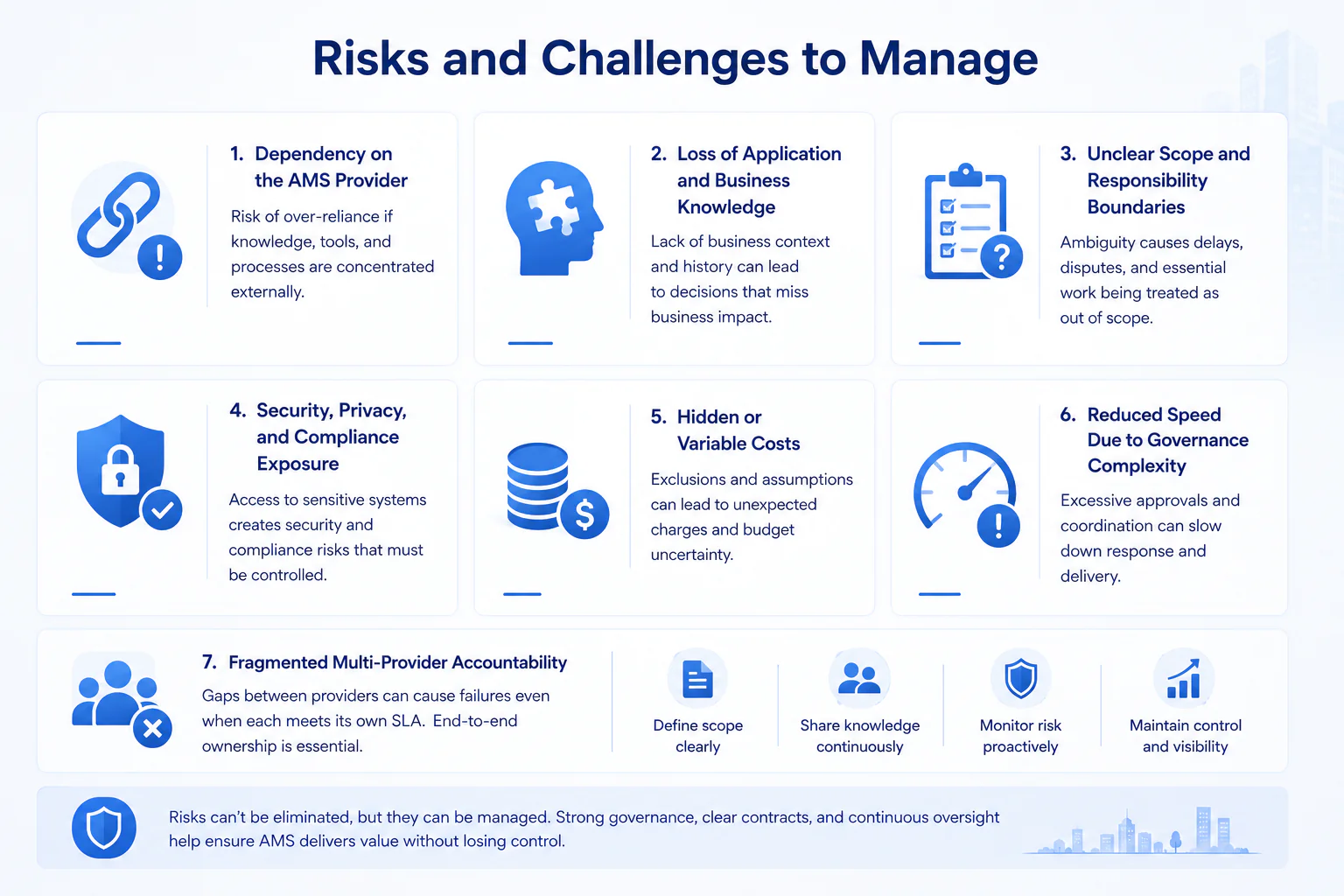
Risks and Challenges to Manage
AMS changes how responsibilities, knowledge, and control are distributed. These changes create risks that must be actively managed.
Dependency on the AMS provider
Organizations can become dependent on a provider when knowledge, tools, and processes concentrate externally. This risk grows when documentation is incomplete or internal understanding declines over time. Clear documentation ownership, knowledge sharing, and well-defined exit provisions keep this manageable. The goal is not to avoid reliance entirely, but to ensure the organization can change providers if needed.
Loss of application and business knowledge
External teams can lack understanding of business context, user priorities, and historical decisions. Without continuous knowledge transfer, this can lead to decisions that fix technical issues while overlooking business impact. Organizations should ensure providers understand key workflows and stakeholders, and that knowledge sharing continues throughout the engagement.
Unclear scope and responsibility boundaries
Ambiguous scope is a common cause of service issues. When responsibilities are not clearly defined, work gets delayed or disputed, and necessary tasks get treated as out of scope. Definitions should cover applications, environments, support levels, and ownership of integrations and changes at the process level, not just by technology component.
Security, privacy, and compliance exposure
AMS providers often need access to sensitive systems and data. This access creates security and compliance risks that must be controlled through proper access management, monitoring, and governance. Organizations must also assess the provider’s security practices, since accountability for compliance remains with the organization regardless of who performs the technical work.
Hidden or variable costs
Contracts may exclude certain activities, and excluded work generates additional charges. Enhancements, after-hours support, and transition-related work are common sources of this. Organizations should define scope, assumptions, and pricing structures clearly to know what is included versus chargeable.
Reduced speed due to governance complexity
Poorly designed governance slows down operations. If every change requires extensive approval or coordination, responsiveness drops. Organizations should distinguish routine actions, pre-approved changes, and higher-risk activities so standard work can proceed efficiently.
Fragmented multi-provider accountability
Applications often depend on multiple providers. Even when each provider meets its own SLA, the overall service can still fail at the gaps between responsibilities. End-to-end service ownership must be clearly assigned, or issues get passed between providers without resolution.
Transitioning to AMS Without Disrupting Critical Applications
Transitioning to AMS is a high-risk phase that requires careful planning. The provider must gain knowledge, access, and operational readiness without disrupting live services.
The transition should run as a structured program with defined phases: discovery, knowledge transfer, access setup, and controlled handover. Each phase builds readiness and reduces risk.
During transition, organizations should avoid major simultaneous changes and maintain overlap between teams. Documentation and access must be preserved throughout. Stabilization after handover matters equally, since it gives teams room to address early issues and refine operations.
Service Governance, KPIs, SLAs, and Review Cadence
Effective AMS requires ongoing governance. Contracts and reports alone do not ensure service quality; this governance layer is what ties together the value, delivery, accountability, and measurement described for each benefit above.
Distinguishing SLAs, KPIs, and business outcomes
SLAs define contractual commitments such as response times. KPIs measure broader service performance, while business outcomes reflect actual impact on operations. These three measures should be used together, since meeting SLAs does not necessarily mean the service is delivering value.
Service-level agreements. SLAs should align with application criticality rather than use one uniform target across the portfolio. A single 99.9% availability commitment applied to both a mission-critical payment system and a low-traffic internal tool either under-protects the former or over-engineers the latter.
Availability targets should be tiered by criticality. Tier 1 (revenue-critical, customer-facing) applications typically warrant 99.9%-99.99% uptime commitments; Tier 2 (business-important) applications 99.5%-99.9%; and Tier 3 (lower-impact) applications a looser target, since chasing five-nines on non-critical systems wastes budget better spent elsewhere.
Response and resolution targets should be defined per priority level, not as a single blanket figure. A common structure sets tighter response and resolution windows for P1 (critical, full outage) incidents and progressively looser windows down to P4 (minor, single-user) issues.
Priority classification should combine business impact and urgency into a documented priority matrix rather than leave classification to individual judgment during an incident. Without a shared matrix, priority is often set by how loudly a stakeholder escalates rather than by actual business consequence, which is exactly the confusion SLAs are meant to prevent.
Operational and service KPIs. KPIs should cover five dimensions, mirroring the benefit areas outlined above, each with its own concrete indicators rather than a single generic “performance score”:
- Reliability – availability against target, MTTD, MTTR, and incident recurrence rate.
- Support performance – time-to-staff for specialist requests, escalation resolution time by tier, and first-contact resolution rate.
- Maintenance – patch compliance rate within SLA windows, change success rate, and the share of changes requiring rollback.
- Security – mean time to remediate critical vulnerabilities, access-review completion rate, and audit finding closure time.
- Improvement – reduction in recurring incident categories, backlog velocity on the improvement register, and measurable business impact of delivered enhancements.
Organizations should interpret these five dimensions collectively rather than focusing on individual metrics in isolation. A provider can hit every response-time SLA while recurring-incident rates climb quarter over quarter – the reliability and improvement dimensions together reveal that pattern, while either one alone would miss it.
Governance roles. A clear governance structure is essential, and the clearest way to build one is a RACI assignment – naming exactly one Accountable owner per benefit area, with Responsible, Consulted, and Informed parties named alongside it.
- Application owner – accountable for the business outcome of the application; approves scope and priority changes.
- Service owner – accountable for end-to-end service quality across all providers touching the application, closing the fragmented-accountability gap described earlier.
- AMS manager – responsible for day-to-day delivery against SLAs and KPIs, and the primary point of contact for escalations.
- Technical lead – responsible for the technical execution of incident response, changes, and improvement work.
- Business representative – consulted on priority classification and improvement priorities, informed on service performance.
Each benefit area described earlier in this document should map to exactly one accountable owner. Where two roles both believe they own a benefit – or worse, where neither does – that ambiguity is a leading predictor of the fragmented accountability and slow escalation described in the risks section above.
Review cadence. Governance should follow a structured cadence that mirrors the cadences described per benefit, with each level carrying a distinct audience and agenda rather than repeating the same content at different frequencies.
- Weekly operational reviews – AMS manager and technical lead; open incidents, SLA status, and near-term capacity risks.
- Monthly service reviews – service owner and AMS manager; KPI trends across all five dimensions, cost against budget, and improvement backlog progress.
- Quarterly strategic reviews – application owner and business representative; root-cause trends, resourcing and skills-gap review, and improvement priorities for the next quarter.
- Annual reviews – all governance roles; scope, pricing, and contract alignment, including whether SLA targets and priority definitions still match current business risk.
Skipping a level of this cadence – for example, running only monthly reviews without a quarterly strategic check-in – is a common way governance quietly narrows to incident-handling alone, losing sight of the longer-term trends each benefit area depends on.
Continuous service improvement
AMS should include a formal process for identifying and implementing improvements, most practically run through a shared continual improvement register rather than an informal list of ideas raised in passing during service reviews.
The register should capture, for every improvement opportunity, its source (an incident trend, a KPI pattern, a cost driver), its expected benefit, its owner, and its status. This is what separates continuous improvement from ad hoc effort: an opportunity identified in a monthly service review has a documented path to prioritization and execution, rather than depending on someone remembering to raise it again.
This ensures the service evolves over time instead of staying focused only on incident handling. A provider that resolves every incident quickly but never reduces the volume of incidents is optimizing the wrong half of the equation, and a populated, actively reviewed register is the mechanism that catches that gap.
Evaluating AMS Success
AMS success should be assessed through reliability, performance, user experience, risk management, and cost transparency together. Organizations should ask whether applications are becoming more stable, whether issues are resolved more effectively, and whether the provider contributes meaningful improvements.
The value of AMS lies in sustained improvement of application performance, resilience, and business impact, not in the number of tickets resolved. Every claimed benefit should be checked against the same four questions: what value is created, how it is delivered, who is accountable, and how it is measured and governed.
How to Evaluate and Select an AMS Provider
Choosing an Application Management Services provider requires more than comparing price, certifications, or service lists. The provider must fit the application landscape, operating model, risk profile, and long-term business priorities.
The evaluation should follow five steps: define internal needs, compare provider capabilities, validate evidence, assess transition readiness, and confirm contract clarity.
Start With Internal Needs and Application Criticality
Before approaching providers, define which applications are in scope and why they matter. Providers cannot propose comparable services when each uses different assumptions.
The initial brief should cover application criticality, users, environments, integrations, support hours, incident history, security obligations, and expected outcomes.
Applications should also be classified by business impact. Revenue-generating, customer-facing, or regulated systems usually require stronger monitoring, faster response, and tighter governance.
Clear requirements allow providers to propose the right service model. They also prevent low-cost proposals from hiding missing responsibilities.
Use a Weighted AMS Provider Scorecard
A structured scorecard makes proposals easier to compare. Each provider should be assessed against the same criteria and required to support claims with evidence.
| Evaluation criterion | Weight | Evidence to request | Red flags |
|---|---|---|---|
| Application and business fit | 15% | Scope assumptions, dependency map, service design | Generic proposal with little application detail |
| Technical and AMS capability | 20% | Skills matrix, operating model, sample support plan | Strong development claims but limited production-support evidence |
| Security, compliance, and data protection | 20% | Certifications, access controls, incident procedures, data-flow details | Certifications used instead of service-specific controls |
| SLA, governance, and escalation | 15% | SLA model, RACI, escalation path, sample reports | No end-to-end service owner |
| Transition and knowledge transfer | 15% | Transition plan, readiness criteria, shadow-support approach | Immediate handover without discovery |
| Commercial and contract clarity | 10% | Pricing assumptions, exclusions, rate card, exit terms | Low base fee with extensive out-of-scope charges |
| Relevant delivery evidence | 5% | Comparable case studies, references, service outcomes | Client logos without verifiable scope or results |
Providers can be scored from one to five for each criterion. The weighted total should guide the decision, but critical security or transition gaps should remain disqualifying.
Assess Capability Fit and Delivery Evidence
An AMS provider needs more than software-development expertise. Managing live applications requires monitoring, incident management, root-cause analysis, maintenance, reliability engineering, and controlled change.
The proposed team should match the actual technology stack. Ask which skills are assigned directly, which depend on escalation, and how the provider manages staff turnover and coverage.
Relevant industry experience is useful when it reflects comparable applications, regulations, and operating conditions. Request case studies that state the provider’s role, service scope, challenges, and measurable outcomes.
Modernization capability may also be valuable. However, recommendations for cloud transformation, refactoring, or platform replacement should include a clear business case.
Evaluate Security, Compliance, and Data Handling
Security controls should be assessed within the proposed service model. General policies and certifications such as ISO 27001 or SOC 2 are useful evidence, but they do not prove how the service will operate day to day.
The assessment should confirm:
- Who can access production systems and sensitive data
- How access is approved, monitored, reviewed, and revoked
- Where data is stored and whether cross-border transfers occur
- Who owns patching, vulnerability management, and incident response
- How the provider supports audits and regulatory reporting
Relevant certifications should cover the teams, locations, and services included in the engagement. Responsibility for regulatory compliance remains with the organization, even when tasks are outsourced.
Review SLAs, Escalation, Reporting, and Governance
A service-level agreement should reflect application criticality and business impact. Uniform targets across all applications may increase costs or leave critical systems underprotected.
The SLA should define service hours, priority levels, response targets, resolution or restoration targets, availability expectations, exclusions, and dependency handling.
Escalation procedures should identify who makes decisions during critical incidents. They should also explain how the provider coordinates with cloud vendors, infrastructure teams, and other suppliers.
Reporting should go beyond ticket counts. Useful reports explain service trends, recurring risks, SLA performance, security status, maintenance progress, and improvement opportunities.
Governance should include named application owners, service managers, technical leads, and escalation contacts, assigned through a documented RACI structure rather than left informal. Review cadence may include weekly operational meetings, monthly service reviews, and quarterly strategic reviews.
Validate Onboarding and Transition Readiness
Transition is one of the highest-risk stages of an AMS engagement. The provider must gain knowledge and access without disrupting live applications.
A credible transition plan should include discovery, documentation review, knowledge transfer, access setup, shadow support, controlled handover, and stabilization.
Before taking full responsibility, the provider should demonstrate that:
- Required access and tools are available
- Application and dependency documentation has been validated
- Support teams have completed knowledge transfer
- Escalation procedures have been tested
- Initial monitoring and reporting are operational
- Readiness criteria have been approved by both parties
A stabilization period should follow handover. This allows teams to correct knowledge gaps and refine operating procedures before normal service begins.
Confirm Contract, Commercial, and Exit Clarity
The contract should clearly define scope, responsibilities, pricing, security obligations, service levels, reporting, and governance.
Organizations should distinguish included services from chargeable activities. Common sources of additional cost include after-hours support, major upgrades, enhancements, transition work, and increased application volume.
Exit provisions are equally important. The organization should retain access to documentation, operational data, configurations, service records, and knowledge created during the engagement.
The provider should also support transition to another supplier or back to an internal team. A contract that creates unnecessary dependency is a long-term operational risk, commonly referred to as vendor lock-in.
Making the Final Provider Decision
The best AMS provider is not automatically the lowest-cost or largest vendor. It is the provider that offers the strongest fit across capability, security, governance, transition readiness, and commercial transparency.
Final selection should combine scorecard results, scenario workshops, reference checks, and contract review. Any major assumptions should be validated before signing.
Organizations evaluating providers may review relevant AMS services, application management case studies, security and compliance capabilities, and delivery models before initiating a scoped assessment. SmartDev can be considered as one option within that wider evaluation process.
The Future of Application Management Services
The future of Application Management Services is not defined by one tool or a universal move toward autonomous operations. It is a gradual shift toward more proactive, observable, secure, and business-aware application management.
Current IBM and Accenture positioning reflects this direction. IBM emphasizes AI-driven management across hybrid and multi-cloud environments, while Accenture describes modern AMS as adding proactive innovation to application lifecycle management. However, the appropriate level of modernization still depends on application criticality, organizational maturity, risk, and expected business value.
Modern AMS is an operating model that combines application support with automation, observability, resilience, security, continuous improvement, and cost governance. Its purpose is to improve application outcomes while retaining clear human and organizational accountability.
A Trend-to-Decision Framework for Future AMS
| AMS trend | What is changing | Decision for AMS buyers | Constraint to test |
|---|---|---|---|
| AI-enabled operations | AI supports alert correlation, anomaly detection, diagnosis, and routine remediation. | Which activities should be automated, recommended, or kept under human approval? | Data quality, false alerts, auditability, and automation risk |
| Cloud-native and distributed operations | AMS must manage applications across containers, clouds, SaaS platforms, APIs, and on-premises systems. | Can the provider deliver end-to-end visibility across the complete business service? | Tool fragmentation, skills gaps, and unnecessary architecture complexity |
| Integrated security and resilience | Security, recovery, and reliability become part of daily application operations. | Which controls and recovery targets should apply to each application tier? | Shared accountability, testing quality, and application criticality |
| Continuous modernization | Operational evidence increasingly informs optimization, refactoring, replatforming, and retirement decisions. | Can the provider distinguish necessary modernization from optional technical change? | Cost, disruption, vendor incentives, and business justification |
| FinOps and value-based governance | Technical performance is measured alongside cost, user experience, risk, and business outcomes. | Which measures demonstrate value beyond SLA compliance? | Data allocation, KPI ownership, and trade-offs between cost and reliability |
AI-Enabled Operations Will Expand Selectively
AIOps applies analytics, machine learning, and automation to operational data. Current platforms use these capabilities to correlate events, reduce alert noise, identify anomalies, accelerate diagnosis, and support remediation across complex environments. IBM currently positions AIOps around centralized observability, event intelligence, and faster incident triage.
The practical shift is from manual signal review toward assisted operational decisions. Low-risk tasks such as ticket classification, diagnostic collection, or standard recovery procedures may become increasingly automated.
This does not mean AMS teams will become autonomous by default. Predictive results depend on monitoring coverage, historical data, system context, and well-designed controls. High-impact actions should retain approval rules, audit records, fallback procedures, and named accountability.
Buyer decision: Ask providers to identify which processes are automated today, which remain advisory, and which require human approval. Claims of “AI-powered AMS” without defined use cases, controls, and evidence should carry little weight.
Cloud-Native Operations Will Require End-to-End Visibility
Applications increasingly span cloud services, containers, databases, identity platforms, SaaS products, and external APIs. The 2026 CNCF Annual Survey reported that 82% of container users were running Kubernetes in production. It also emphasized that people, processes, and organizational alignment now matter alongside infrastructure maturity.
Future AMS must therefore manage complete service journeys rather than isolated components. Unified observability should connect logs, metrics, traces, dependencies, and user experience across environments. Platform engineering, DevOps, SRE, infrastructure as code, and automated deployment may increasingly form part of the operating model.
However, hybrid and multi-cloud architectures are not inherently better. They can increase tooling, governance, integration, and skills complexity when adopted without a specific business requirement.
Buyer decision: Evaluate whether the provider can monitor an end-to-end transaction across systems, coordinate multiple technology owners, and maintain consistent controls without forcing every application onto the same platform.
Security and Resilience Will Become Daily Operating Responsibilities
Security, privacy, reliability, and operational excellence are increasingly treated as connected application-management concerns. Google’s current Well-Architected guidance links effective cloud operations with security, reliability, performance, cost control, observability, incident management, and continuous improvement.
For AMS, this means integrating patching, vulnerability management, access control, recovery testing, secure releases, and incident escalation into regular operations. Resilience should also be assessed through realistic recovery objectives and tested dependencies, not uptime claims alone.
Controls should remain proportionate. A customer payment platform requires stronger recovery, monitoring, and security measures than a low-impact internal tool. Applying the same requirements to every application may increase costs without reducing material risk.
Buyer decision: Ask how the provider classifies application criticality, assigns shared security responsibilities, tests recovery, and produces evidence that controls are operating effectively.
Operational Data Will Guide Modernization Decisions
Future AMS will increasingly connect daily operations with application modernization. Incident patterns, maintenance effort, technical debt, resource consumption, and recurring performance issues can reveal when an application should be optimized, refactored, replatformed, replaced, or retired.
IBM currently links application management with hybrid-cloud performance, automation, modernization, and portfolio-level business objectives. Its application-management definition also covers operation, maintenance, support, optimization, updates, security, and lifecycle improvement.
Modernization should not become an automatic recommendation. Stable applications may remain fit for purpose, and replacement can create more cost and disruption than continued maintenance.
Buyer decision: Require modernization proposals to show the operational evidence, business problem, expected benefit, implementation risk, and total cost. Providers should not be assessed by the volume of changes they recommend.
FinOps Will Connect Application Cost With Business Value
AMS measurement is moving beyond uptime, ticket volume, and infrastructure utilization. Future governance is likely to connect reliability, user experience, operational risk, change performance, and application cost.
The FinOps Framework was updated in 2025 to reflect a broader “Cloud+” scope covering technology expenditure beyond public cloud. Current FinOps guidance also emphasizes understanding usage, optimizing value, and connecting technology spending with business outcomes rather than pursuing cost reduction alone.
Within AMS, this may include cost per transaction, service, customer journey, or application. Such measures can support capacity decisions, modernization priorities, and commercial governance.
Cost optimization must still be balanced against resilience, security, and performance. Reducing infrastructure spending is not an improvement if it creates slower services or greater operational risk.
Buyer decision: Assess whether the provider can explain application costs, identify waste, forecast demand, and connect optimization recommendations to business impact.
What These Trends Mean for AMS Buyers
Organizations should not select an AMS provider simply because it offers AIOps, cloud tooling, automation, or modernization services. The relevant question is whether those capabilities solve the organization’s specific operational problems.
Future-ready provider evaluation should focus on five questions:
- Can the provider connect technical operations with business-critical services?
- Can it apply automation without weakening accountability?
- Can it manage visibility, security, and resilience across application dependencies?
- Can it use operational evidence to support proportionate modernization?
- Can it measure value through outcomes, cost, risk, and user experience?
The strongest AMS model may combine advanced capabilities for critical applications with simpler support for stable, low-risk systems. The future of AMS is therefore not maximum automation or universal modernization. It is the more deliberate use of technology, expertise, and governance to improve application value over time.
Conclusion
Application Management Services give organizations a structured way to manage and improve business-critical applications — combining monitoring, support, maintenance, and governance into a single operating model that follows the application through its full lifecycle.
The right model depends on scope, application criticality, and governance discipline, and its value ultimately depends on provider fit as much as the model itself. Reviewing SmartDev’s Application Management Services is one way to see how these principles apply in practice.
Next Steps: Explore SmartDev’s Application Management Services
Key Takeaways
| Topic | Key takeaway |
|---|---|
| Where AMS delivers value | AMS matters most where applications are revenue-critical, regulated, or operationally complex – retail, healthcare, financial services, and legacy or integration-heavy environments. |
| Benefits and trade-offs | Each benefit – expertise access, reliability, cost predictability, and others – only holds up if its value, delivery mechanism, accountability, and metrics are explicitly defined, not assumed. |
| Selecting a provider | Choosing an AMS provider is a five-step evaluation – internal needs, capability fit, security, transition readiness, and contract clarity – not a price comparison. |
| Governance and SLAs | AMS performance depends on active governance: SLAs, KPIs, clearly assigned ownership, and a structured review cadence, not the contract alone. |
| The future of AMS | AI, cloud-native operations, integrated security, and FinOps are reshaping AMS, but the right level of adoption still depends on application criticality and business value. |
SmartDev’s approach to Application Management Services reflects this same model: continuous monitoring, structured incident response, and performance management coordinated across the application and its supporting environment, as illustrated in the SmartDev case example earlier in this guide.
If you’re assessing how an AMS model would fit your own application environment, the SmartDev Application Management Services page outlines service scope and delivery approach in more detail. It’s a useful starting point for judging fit before any conversation about your specific applications and operational challenges.